Search


Zitierungen und Referenzen (10)
Gibco™
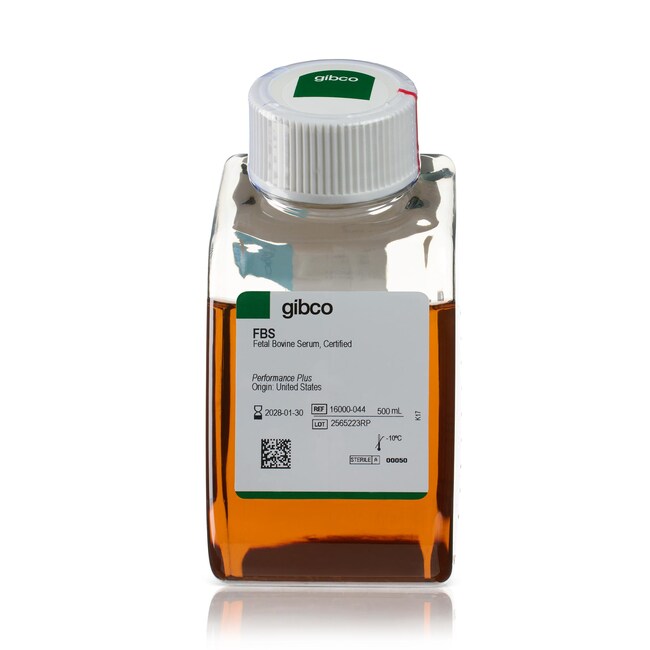
Fötales Kälberserum, zertifiziert, USA
Gibco fötale Kälberseren bieten einen ausgezeichneten Wert für die allgemeine Zellkultur, die Spezialforschung und spezifische Assays. Sie erhalten das VertrauenWeitere Informationen
Have Questions?
Ansicht ändern

| Katalognummer | Menge | Format |
|---|---|---|
| 16000044 | 500 mL | Flasche |
| A3160401 | 50 mL | One Shot |
| A3160402 | 10 x 50 mL | One Shot |
Our improved Premium Plus Fetal Bovine Serum (FBS) features enhanced specifications with unchanged stability, manufacturing, storage, and transport processes.
Katalognummer 16000044
Gibco fötale Kälberseren bieten einen ausgezeichneten Wert für die allgemeine Zellkultur, die Spezialforschung und spezifische Assays. Sie erhalten das Vertrauen von Forschern mit gleichbleibender Qualität und prämierter Unterstützung, die Ihren Forschungsanforderungen und Ihrem Budget gerecht wird
Gibco Serum: Bewährte Qualität für konsistente Leistung
Serum-Kategorie: Premium (Performance Plus)
• Zur Verwendung für eine Vielzahl von Zellarten, insbesondere für empfindliche Zelllinien
• Unser am besten charakterisiertes Serum mit dem niedrigsten Endotoxin-Gehalt und Hämoglobin-Spiegel
• Endotoxin-Gehalt: ≤ 5 EU/ml
• Hämoglobin-Spiegel: ≤ 15 mg/dl
• Herkunft: Vereinigte Staaten
Gibco Serum hält, was es verspricht
• ISO 13485-zertifiziert, wird in Einrichtungen mit FDA-Zulassung verarbeitet
• Für die In-vitro-Diagnostik gekennzeichnet (konform mit höchsten USP-Sterilitätsstandards)
• Dreifach gefiltert auf 0,1 µm
• Gibco Flaschen sind unter Abzugshauben leichter zu verwenden, reduzieren das Kontaminationsrisiko und unterstützen Sie bei der konsistenteren Züchtung von Zellkulturen.
• Der Abziehaufkleber auf dem Etikett ermöglicht eine praktische Referenz auf die in der Labordokumentation Chargennummer und Verfallsdatum im Laborheft.
Gibco Serum: Bewährte Qualität für konsistente Leistung
Serum-Kategorie: Premium (Performance Plus)
• Zur Verwendung für eine Vielzahl von Zellarten, insbesondere für empfindliche Zelllinien
• Unser am besten charakterisiertes Serum mit dem niedrigsten Endotoxin-Gehalt und Hämoglobin-Spiegel
• Endotoxin-Gehalt: ≤ 5 EU/ml
• Hämoglobin-Spiegel: ≤ 15 mg/dl
• Herkunft: Vereinigte Staaten
Gibco Serum hält, was es verspricht
• ISO 13485-zertifiziert, wird in Einrichtungen mit FDA-Zulassung verarbeitet
• Für die In-vitro-Diagnostik gekennzeichnet (konform mit höchsten USP-Sterilitätsstandards)
• Dreifach gefiltert auf 0,1 µm
• Gibco Flaschen sind unter Abzugshauben leichter zu verwenden, reduzieren das Kontaminationsrisiko und unterstützen Sie bei der konsistenteren Züchtung von Zellkulturen.
• Der Abziehaufkleber auf dem Etikett ermöglicht eine praktische Referenz auf die in der Labordokumentation Chargennummer und Verfallsdatum im Laborheft.
Für die Verwendung in der Forschung oder die Weiterverarbeitung. Nicht zur Diagnosestellung oder direkten Anwendung bei Menschen oder Tieren geeignet.
Specifications
Endotoxin-Konzentration≤5 EU/mL
Hämoglobin-Konzentration≤15 mg/dl
Reinheits- oder QualitätsgradZertifiziert
Versandbedingunggefroren
SpeziesRind/Bovine
AgeFötal
HerkunftslandVereinigte Staaten
FormFlüssig
FormatFlasche
ProdukttypFötales Kälberserum
Menge500 mL
Serum TreatmentStandard (sterilfiltriert)
SterilitätSteril
Sterilization MethodDreifach gefiltert, 0.1 μm
Unit SizeEach
Inhalt und Lagerung
Lagerbedingungen: ≤ -10 ° C
Versandbedingungen: Gefroren
Versandbedingungen: Gefroren
Häufig gestellte Fragen (FAQ)
What are the benefits and disadvantages of using heat-inactivated FBS in cell culture?
How much of the total protein measured in Fetal Bovine Serum (heat inactivated or otherwise) is attributed to albumin?
How much Fetal Bovine Serum (FBS) do I need to add to my medium?
How long can I store Gibco Fetal Bovine Serum at 4 degrees C?
How should I thaw Gibco Fetal Bovine Serum?
Zitierungen und Referenzen (10)
Zitierungen und Referenzen
Abstract
Fibroblast growth factor receptor-1 signaling induces osteopontin expression and vascular smooth muscle cell-dependent adventitial fibroblast migration in vitro.
Journal:Circulation
PubMed ID:12176960
'BACKGROUND: Increased expression of osteopontin (OPN), fibroblast growth factors (FGFs), and their type-1 receptor (FGFR-1) is associated with neointima formation and atherosclerosis. This study tested the hypothesis that ligand activation of FGFR-1 stimulates OPN expression in rat aortic smooth muscle cells (RASMCs), explored the signaling pathway involved, and assessed the
Ultraviolet-induced junD activation and apoptosis in myeloblastic leukemia ML-1 cells.
Journal:J Biol Chem
PubMed ID:12082101
'The exposure of mammalian cells to UV irradiation induces the expression of immediate early genes such as c-jun and c-fos and activates the transcription factors AP-1 and NF-kappaB. JunD is one of the three members of the Jun family and shares some functional characteristics with c-Jun. In the present study,
Dystrophin deficiency markedly increases enterovirus-induced cardiomyopathy: a genetic predisposition to viral heart disease.
Journal:Nat Med
PubMed ID:12118246
Both enteroviral infection of the heart and mutations in the dystrophin gene can cause cardiomyopathy. Little is known, however, about the interaction between genetic and acquired forms of cardiomyopathy. We previously demonstrated that the enteroviral protease 2A cleaves dystrophin; therefore, we hypothesized that dystrophin deficiency would predispose to enterovirus-induced cardiomyopathy.
Ascorbic-acid transporter Slc23a1 is essential for vitamin C transport into the brain and for perinatal survival.
Journal:Nat Med
PubMed ID:11984580
The only proven requirement for ascorbic acid (vitamin C) is in preventing scurvy, presumably because it is a cofactor for hydroxylases required for post-translational modifications that stabilize collagen. We have created mice deficient in the mouse ortholog (solute carrier family 23 member 1 or Slc23a1) of a rat ascorbic-acid transporter,
Cell docking and on-chip monitoring of cellular reactions with a controlled concentration gradient on a microfluidic device.
Journal:Anal Chem
PubMed ID:12199565
We have developed a microfluidic device for on-chip monitoring of cellular reactions. The device consists of two primary analytical functions: control of cell transport and immobilization, and dilution of an analyte solution to generate a concentration gradient. In this device, a dam structure in parallel to the fluid flow was