Search

Gibco™
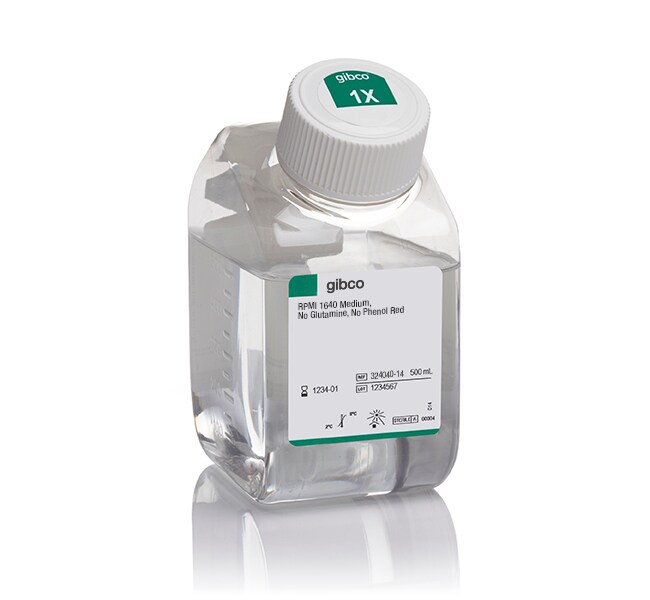
RPMI 1640 Medium, ohne Glutamin, ohne Phenolrot
Roswell Park Memorial Institute (RPMI) 1640 Medium wurde ursprünglich zur Züchtung leukämischer Humanzellen in Suspensionen und als Monolayer entwickelt. RPMIWeitere Informationen
| Katalognummer | Menge |
|---|---|
| 32404014 | 500 mL |
Katalognummer 32404014
Preis (EUR)
29,75
Each
Menge:
500 mL
Preis (EUR)
29,75
Each
Roswell Park Memorial Institute (RPMI) 1640 Medium wurde ursprünglich zur Züchtung leukämischer Humanzellen in Suspensionen und als Monolayer entwickelt. RPMI 1640 wurde seitdem für eine Reihe von Säugetierzellen wie HeLa, Jurkat, MCF-7, PC12, PBMC, Astrozyten und Karzinome als geeignet eingestuft. Wir bieten viele Gibco™ RPMI 1640-Modifikationen für eine Vielzahl von Zellkulturanwendungen. Finden Sie die richtige Zusammensetzung mithilfe des Medien-Auswahlwerkzeuges.
Die vollständige Zusammensetzung ist verfügbar.
Gibco™ RPMI 1640 unterscheidet sich deutlich von anderen Medien, da es das Reduktionsmittel Glutathion sowie hohe Konzentrationen an Vitaminen enthält. RPMI 1640 enthält Biotin, Vitamin B12 und PABA, die nicht in Eagle's Minimal Essential Medium bzw. Dulbecco's Modified Eagle Medium enthalten sind. Darüber hinaus sind die Vitamine Inositol und Cholin in sehr hohen Konzentrationen vorhanden.
Produktgemäßer Gebrauch
Nur für Forschungszwecke. Nicht für diagnostische oder therapeutische Zwecke bei Tieren und Menschen vorgesehen.
cGMP-konformes Fertigungs- und Qualitätssystem
Gibco™ RPMI 1640 wird in einer cGMP-konformen Einrichtung in Paisley, Schottland, Großbritannien, hergestellt. Die Einrichtung ist bei der FDA als Hersteller von Medizinprodukten registriert und nach ISO 13485 zertifiziert.
RPMI 1640 enthält keine Proteine, Lipide oder Wachstumsfaktoren. Aus diesem Grund kann bei RPMI 1640 eine Supplementierung, meist mit 10 % fötalem Rinderserum (FBS), erforderlich sein. RPMI 1640 nutzt einen Natriumbikarbonatpuffer (2,0 g/l) und erfordert daher zur Aufrechterhaltung des physiologischen pH-Werts eine 5 bis 10 %ige CO2-Umgebung.
Die RPMI 1640-Modifikationen sind wie folgt:
| Ohne |
| • L-Glutamin |
| • HEPES |
| • Phenolrot |
Die vollständige Zusammensetzung ist verfügbar.
Gibco™ RPMI 1640 unterscheidet sich deutlich von anderen Medien, da es das Reduktionsmittel Glutathion sowie hohe Konzentrationen an Vitaminen enthält. RPMI 1640 enthält Biotin, Vitamin B12 und PABA, die nicht in Eagle's Minimal Essential Medium bzw. Dulbecco's Modified Eagle Medium enthalten sind. Darüber hinaus sind die Vitamine Inositol und Cholin in sehr hohen Konzentrationen vorhanden.
Produktgemäßer Gebrauch
Nur für Forschungszwecke. Nicht für diagnostische oder therapeutische Zwecke bei Tieren und Menschen vorgesehen.
cGMP-konformes Fertigungs- und Qualitätssystem
Gibco™ RPMI 1640 wird in einer cGMP-konformen Einrichtung in Paisley, Schottland, Großbritannien, hergestellt. Die Einrichtung ist bei der FDA als Hersteller von Medizinprodukten registriert und nach ISO 13485 zertifiziert.
RPMI 1640 enthält keine Proteine, Lipide oder Wachstumsfaktoren. Aus diesem Grund kann bei RPMI 1640 eine Supplementierung, meist mit 10 % fötalem Rinderserum (FBS), erforderlich sein. RPMI 1640 nutzt einen Natriumbikarbonatpuffer (2,0 g/l) und erfordert daher zur Aufrechterhaltung des physiologischen pH-Werts eine 5 bis 10 %ige CO2-Umgebung.
Für die Verwendung in der Forschung oder die Weiterverarbeitung. Nicht zur Diagnosestellung oder direkten Anwendung bei Menschen oder Tieren geeignet.
Specifications
ZelllinieHeLa, Jurkat, MCF-7, PC-12, PBMC, Astrozyten und Karzinome
ZelltypLeukämische Zellen
Konzentration1X
KulturmilieuCO2
Fertigungsqualität, HerstellungsqualitätcGMP-compliant under the ISO 13485 standard
Osmolalität260 bis 300 mOsm/kg
ProduktlinieGibco
ProdukttypRPMI 1640 Medium (Roswell Park Memorial Institute 1640 Medium)
Menge500 mL
Haltbarkeit12 Monate ab Herstellungsdatum
VersandbedingungRaumtemperatur
KlassifikationOhne Stoffe tierischen Ursprungs
FormFlüssig
Serum LevelStandard-Serumzugabe
SterilitätSteril gefiltert
Mit AdditivenNatriumhydrogencarbonat
Ohne AdditiveKein Glutamin, Keine HEPES, Kein Phenolrot, Ohne Natriumpyruvat
Unit SizeEach
Inhalt und Lagerung
Lagerbedingungen: 2 bis 8 °C. Vor Licht schützen.
Versandbedingungen: Umgebungstemperatur.
Haltbarkeit: 12 Monate ab Herstellungsdatum.
Versandbedingungen: Umgebungstemperatur.
Haltbarkeit: 12 Monate ab Herstellungsdatum.