Search


Zitierungen und Referenzen (7)
Thermo Scientific™
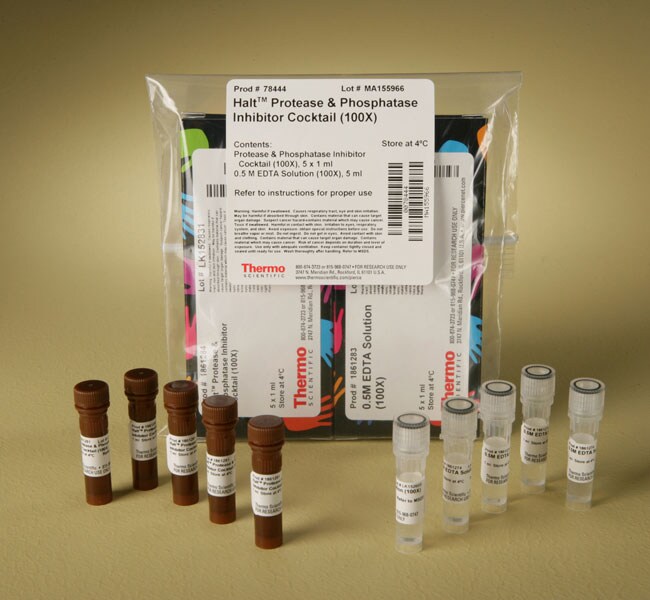
Halt™ Protease and Phosphatase Inhibitor Cocktail (100X)
Der Thermo Scientific Halt Protease- und Phosphatase-Inhibitor-Cocktail (100X) bietet den Komfort einer einzigen Lösung mit vollem Schutz der Proteinprobe fürWeitere Informationen
Have Questions?
Ansicht ändern

| Katalognummer | Menge |
|---|---|
| 78444 | 5 x 1 ml |
| 78442 | 24 x 100 μl |
| 78446 | 10 ml |
| 78440 | 1 ml |
Katalognummer 78444
Preis (EUR)
729,65
Online Exclusive
802,00Ersparnis 72,35 (9%)
Each
Menge:
5 x 1 ml
Preis (EUR)
729,65
Online Exclusive
802,00Ersparnis 72,35 (9%)
Each
Der Thermo Scientific Halt Protease- und Phosphatase-Inhibitor-Cocktail (100X) bietet den Komfort einer einzigen Lösung mit vollem Schutz der Proteinprobe für Zell- und Gewebelysate.
Merkmale des Halt Protease- und Phosphatase-Inhibitor-Cocktails (100X):
• Vollständiger Schutz: Komplett-Cocktail enthält Protease- und Phosphatase-Inhibitoren
• Mehrere Packungsgrößen: Zur Auswahl stehen vier praktische Packungsgrößen für nahezu jede Größenordnung
• Praktisch : 100X-Flüssigformulierung ist viel einfacher und effektiver zu verwenden als einzelne Inhibitoren und andere Formate
• Problemlose Lagerung: Wasserbasiertes Format ermöglicht eine bequeme Lagerung im Kühlraum ohne Einfrieren, im Gegensatz zu DMSO-basierten Cocktails
• Kompatibel: Kann in der Massenspektrometrie (MS) verwendet werden, da es kein AEBSF enthält, das zu einer Verschiebung der Peaks führen kann
• Validiert: Voll kompatibel mit Thermo Scientific Pierce Cell Lysis Puffern
Halt Protease and Phosphatase Inhibitor Cocktail ist speziell optimiert, um Proteine vor der Zersetzung während der Extraktion und Aufreinigung zu schützen. Er enthält Inhibitoren gegen die wichtigsten Protease- und Phosphatase-Klassen und wirkt gezielt gegen Aminopeptidasen, Cystein- und Serin-Proteasen sowie gegen Serin/Threonin- und Protein-Tyrosin-Phosphatasen. Um die Hemmung der Metalloproteasen zu fördern, wird 0,5 M EDTA in einem separaten Röhrchen geliefert.
Ähnliche Produkte
Halt™ Protease- und Phosphatase-Inhibitor-Cocktail, EDTA-frei (100X)
Merkmale des Halt Protease- und Phosphatase-Inhibitor-Cocktails (100X):
• Vollständiger Schutz: Komplett-Cocktail enthält Protease- und Phosphatase-Inhibitoren
• Mehrere Packungsgrößen: Zur Auswahl stehen vier praktische Packungsgrößen für nahezu jede Größenordnung
• Praktisch : 100X-Flüssigformulierung ist viel einfacher und effektiver zu verwenden als einzelne Inhibitoren und andere Formate
• Problemlose Lagerung: Wasserbasiertes Format ermöglicht eine bequeme Lagerung im Kühlraum ohne Einfrieren, im Gegensatz zu DMSO-basierten Cocktails
• Kompatibel: Kann in der Massenspektrometrie (MS) verwendet werden, da es kein AEBSF enthält, das zu einer Verschiebung der Peaks führen kann
• Validiert: Voll kompatibel mit Thermo Scientific Pierce Cell Lysis Puffern
Halt Protease and Phosphatase Inhibitor Cocktail ist speziell optimiert, um Proteine vor der Zersetzung während der Extraktion und Aufreinigung zu schützen. Er enthält Inhibitoren gegen die wichtigsten Protease- und Phosphatase-Klassen und wirkt gezielt gegen Aminopeptidasen, Cystein- und Serin-Proteasen sowie gegen Serin/Threonin- und Protein-Tyrosin-Phosphatasen. Um die Hemmung der Metalloproteasen zu fördern, wird 0,5 M EDTA in einem separaten Röhrchen geliefert.
Ähnliche Produkte
Halt™ Protease- und Phosphatase-Inhibitor-Cocktail, EDTA-frei (100X)
Nur für Forschungszwecke. Nicht zur Verwendung bei diagnostischen Verfahren.
Specifications
PufferLysepuffer
HemmstoffeProtease-Inhibitor, Phosphatase-Inhibitor
Menge5 x 1 ml
ReagenztypProtease-Inhibitor, Phosphatase-Inhibitor
FormFlüssig
ProduktlinieHalt
ProdukttypInhibitorcocktail
Unit SizeEach
Inhalt und Lagerung
Nach Erhalt bei 4 °C lagern
Häufig gestellte Fragen (FAQ)
Can I store the 1X solution of the Halt Protease and Phosphatase Inhbitor Cocktail and if so, for how long?
What are the concentrations of the various components of the combined Halt Protease and Phosphatase Inhibitor Cocktail?
Do you offer the components of the Halt Protease and Phosphatase Cocktail individually?
When do I need to add EDTA when using the Halt Protease and Phosphatase Cocktail?
How much of the Halt Protease and Phosphatase Cocktail do I use for my sample?
Zitierungen und Referenzen (7)
Zitierungen und Referenzen
Abstract
Host E3 ubiquitin ligase ITCH mediates Toxoplasma gondii effector GRA35-triggered NLRP1 inflammasome activation and cell-autonomous immunity.
Journal:mBio
PubMed ID:38376248
Toxoplasma gondii is an intracellular parasite that can activate the NLRP1 inflammasome leading to macrophage pyroptosis in Lewis rats, but the underlying mechanism is not well understood. In this study, we performed a genome-wide CRISPR screen and identified the dense granule proteins GRA35, GRA42, and GRA43 as the Toxoplasma effectors
LARP1 binds ribosomes and TOP mRNAs in repressed complexes.
Journal:The EMBO journal
PubMed ID:39533057
Terminal oligopyrimidine motif-containing mRNAs (TOPs) encode all ribosomal proteins in mammals and are regulated to tune ribosome synthesis to cell state. Previous studies have implicated LARP1 in 40S- or 80S-ribosome complexes that are thought to repress and stabilize TOPs. However, a molecular understanding of how LARP1 and TOPs interact with
A KIF1C-CNBP motor-adaptor complex for trafficking mRNAs to cell protrusions.
Journal:Cell reports
PubMed ID:39982819
mRNA localization to subcellular compartments is a widely used mechanism that functionally contributes to numerous processes. mRNA targeting can be achieved upon recognition of RNA cargo by molecular motors. However, our molecular understanding of how this is accomplished is limited, especially in higher organisms. We focus on a pathway that
hCLCA1 and mCLCA3 are secreted non-integral membrane proteins and therefore are not ion channels.
Journal:J Biol Chem
PubMed ID:15919655
'Proteins of the CLCA gene family have been proposed to mediate calcium-activated chloride currents. In this study, we used detailed bioinformatics analysis and found that no transmembrane domains are predicted in hCLCA1 or mCLCA3 (Gob-5). Further analysis suggested that they are globular proteins containing domains that are likely to be
Quantitative PCR analysis of DNA, RNAs, and proteins in the same single cell.
Journal:Clin Chem
PubMed ID:23014600
The single cell represents the basic unit of all organisms. Most investigations have been performed on large cell populations, but understanding cell dynamics and heterogeneity requires single-cell analysis. Current methods for single-cell analysis generally can detect only one class of analytes.