Search
 Elementsuche
 Struktursuche

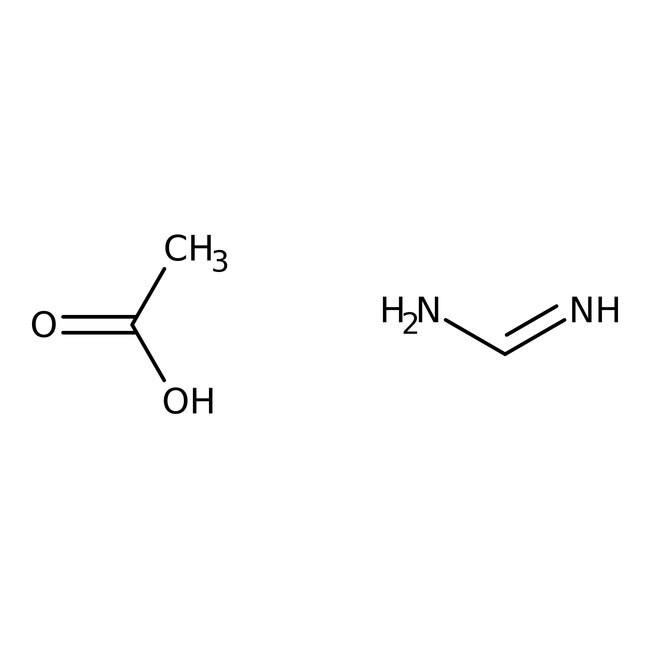

Thermo Scientific Chemicals
Formamidinacetat, 99 %, Thermo Scientific Chemicals
CAS: 3473-63-0 | C3H8N2O2 | 104.109 g/mol
Have Questions?
Ansicht ändern


Katalognummer A11158.36
auch als A11158-36 bezeichnet
Preis (EUR)
175,00
Each
Menge:
500 g
Preis (EUR)
175,00
Each
Chemikalien-Kennzeichnungen
CAS3473-63-0
IUPAC Nameacetic acid; methanimidamide
Molecular FormulaC3H8N2O2
InChI KeyXPOLVIIHTDKJRY-UHFFFAOYSA-N
SMILESNC=N.CC(O)=O
Mehr anzeigen
Specifications Datenblatt
FormCrystals or powder or crystalline powder
Identification (FTIR)Conforms
Appearance (Color)White to pale cream
Assay (Non-aqueous acid-base Titration)≥98.5 to ≤101.5%
Water Content (Karl Fischer Titration)≤0.75%
Formamidine acetate is used as an intermediate in the synthesis of active pharmaceutical ingredients. It is also used as a condensing agent for the preparation of pyrimidine and imidazole heterocycles.
This Thermo Scientific Chemicals brand product was originally part of the Alfa Aesar product portfolio. Some documentation and label information may refer to the legacy brand. The original Alfa Aesar product / item code or SKU reference has not changed as a part of the brand transition to Thermo Scientific Chemicals.
Anwendungen
Formamidinacetat wird als Zwischenprodukt bei der Synthese von pharmazeutischen Wirkstoffen eingesetzt. Es wird auch als Kondensationsmittel für die Herstellung von Pyrimidin- und Imidazolheterocyclen verwendet.
Löslichkeit
Löslich in Wasser und heißem Alkohol.
Hinweise
Hygroskopisch. Feuchtigkeitsempfindlich. Nicht kompatibel mit Oxidationsmitteln.
RUO – Research Use Only
Allgemeine Referenzen:
- Formamidin ist eine bequemere Quelle als das entsprechende Chlorid, da es nicht hygroskopisch ist und als Salz einer schwächeren Säure oft in der Synthese verwendet werden kann, ohne dass die freie Base freigesetzt werden muss.
- Weit verbreitet in heterocyclischen Synthesen, z. B. von Pyrimidin- und Imidazolderivaten.
- Maiden, T. M. M.; Swanson, S.; Procopiou, P. A.; Harrity, J. P. A Mild and Regioselective Route to Functionalized Quinazolines. Chem. Eur. J. 2015, 21 (41), 14342-14346.
- Cebrián, C.; Natali, M.; Villa, D.; Panigati, M.; Mauro, M.; D'Alfonso, G.; De Cola, L. Luminescent supramolecular soft nanostructures from amphiphilic dinuclear Re(I) complexes. Nanoscale 2015, 7, 12000-12009.