Search
 Elementsuche
 Struktursuche


Thermo Scientific Chemicals
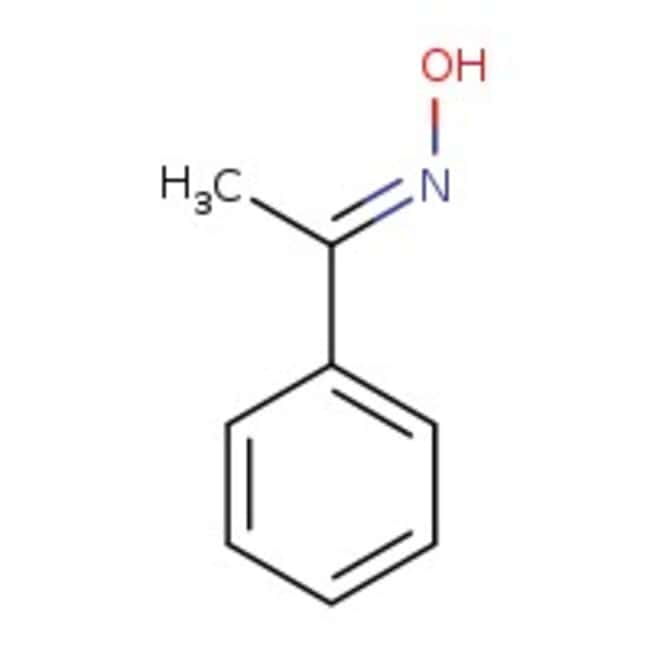
Acetophenonoxim, 98 %, Thermo Scientific Chemicals
CAS: 613-91-2 | C8H9NO | 135.17 g/mol
Have Questions?
Ansicht ändern


Katalognummer A11804.18
auch als A11804-18 bezeichnet
Preis (EUR)
117,00
Each
Menge:
50 g
Preis (EUR)
117,00
Each
Chemikalien-Kennzeichnungen
CAS613-91-2
IUPAC Name(E)-N-(1-phenylethylidene)hydroxylamine
Molecular FormulaC8H9NO
InChI KeyJHNRZXQVBKRYKN-VQHVLOKHSA-N
SMILESC\C(=N/O)C1=CC=CC=C1
Mehr anzeigen
Specifications Datenblatt
DatenblattAppearance (Color)White to cream
Formcrystalline powder
Assay (GC)> 97.5%
Clarity2.5% w/v solution in ethanol will be transparent to almost transparent by JIS K8001 5.2
Used as a ligand in transition-metal complex catalyst chemistry. Oxime acts as an antioxidant, radical scavenger which find applications in textile, plastic, paint, detergent, and rubber industry.
This Thermo Scientific Chemicals brand product was originally part of the Alfa Aesar product portfolio. Some documentation and label information may refer to the legacy brand. The original Alfa Aesar product / item code or SKU reference has not changed as a part of the brand transition to Thermo Scientific Chemicals.
Anwendungen
Wird als Ligand in der Übergangsmetall-Komplex-Katalysatorchemie verwendet. Oxim wirkt als Antioxidans, Radikalfänger, der in der Textil-, Kunststoff-, Lack-, Waschmittel- und Gummiindustrie eingesetzt wird.
Löslichkeit
Schwer in Wasser löslich. Löslich in Ethylalkohol, nahezu transparent.
Hinweise
Luft- und feuchtigkeitsempfindlich. Nicht in der Nähe von Luft und Wasser/Feuchtigkeit lagern. Kühl lagern. Behälter an einem trockenen und gut belüfteten Ort dicht verschlossen halten. Von Oxidationsmitteln entfernt aufbewahren.
Wird als Ligand in der Übergangsmetall-Komplex-Katalysatorchemie verwendet. Oxim wirkt als Antioxidans, Radikalfänger, der in der Textil-, Kunststoff-, Lack-, Waschmittel- und Gummiindustrie eingesetzt wird.
Löslichkeit
Schwer in Wasser löslich. Löslich in Ethylalkohol, nahezu transparent.
Hinweise
Luft- und feuchtigkeitsempfindlich. Nicht in der Nähe von Luft und Wasser/Feuchtigkeit lagern. Kühl lagern. Behälter an einem trockenen und gut belüfteten Ort dicht verschlossen halten. Von Oxidationsmitteln entfernt aufbewahren.
RUO – Research Use Only
Allgemeine Referenzen:
- B. J. Gregory; R. B. Moodie; and K. Schofield. Kinetics and mechanism of the Beckmann rearrangement of acetophenone oximes in sulphuric acid. J. Chem. Soc. B.,1970, 338-346.
- J Hes; LA Sternson. The metabolism of acetophenone oxime in rat liver homogenates. Drug Metabolism and Dispositon, 1974, 2 (4), 345-350.
- Das Dianion (n-BuLi) reagiert zu Heterozyklen mit Elektrophilen, z. B. Methylbenzoat (oder Benzonitril), CO2 oder Benzophenon: J. Org. Chem., 35, 1806 (1970); J. Chem. Soc. (C), 974 (1971); J. Heterocycl. Chem., 13, 449 (1976), bzw.: