Search
 Elementsuche
 Struktursuche

Thermo Scientific Chemicals
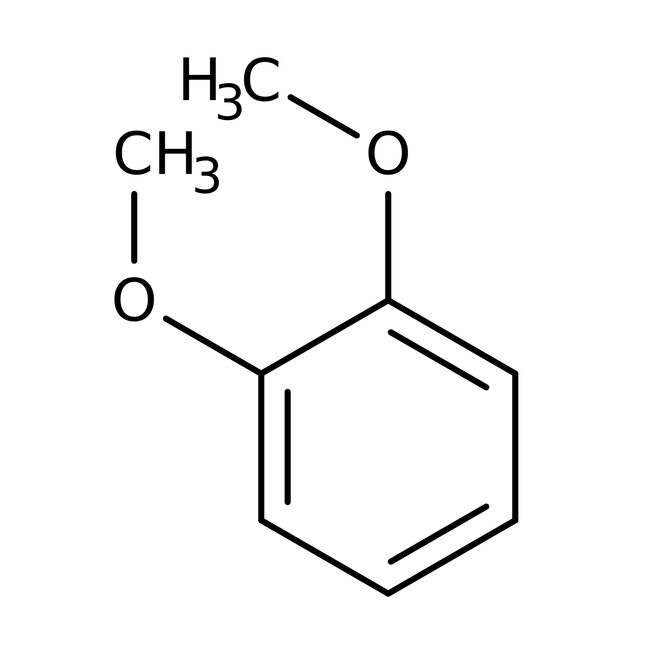
Veratrol, 99 %, Thermo Scientific Chemicals
CAS: 91-16-7 | C8H10O2 | 138.166 g/mol
Have Questions?
Ansicht ändern


Katalognummer A11985.0B
auch als A11985-0B bezeichnet
Preis (EUR)
96,30
Each
Menge:
1000 g
Preis (EUR)
96,30
Each
Chemikalien-Kennzeichnungen
CAS91-16-7
IUPAC Name1,2-dimethoxybenzene
Molecular FormulaC8H10O2
InChI KeyABDKAPXRBAPSQN-UHFFFAOYSA-N
SMILESCOC1=CC=CC=C1OC
Mehr anzeigen
Specifications Datenblatt
DatenblattFormLiquid as melt
Assay (GC)≥98.5%
Identification (FTIR)Conforms
Refractive Index1.5320-1.5350 @ 20?C
Appearance (Color)Clear colorless to pale yellow
It is useful for organic synthesis of aromatic compounds. Veratrole is relatively electron-rich and thus readily undergoes electrophilic substitution.
This Thermo Scientific Chemicals brand product was originally part of the Alfa Aesar product portfolio. Some documentation and label information may refer to the legacy brand. The original Alfa Aesar product / item code or SKU reference has not changed as a part of the brand transition to Thermo Scientific Chemicals.
Anwendungen
Es ist nützlich bei der organischen Synthese von aromatischen Verbindungen. Veratrol ist relativ elektronenreich und lässt sich somit einfach der elektrophilen Substitution unterziehen.
Löslichkeit
Löslich in Alkohol, Diethylether, Aceton und Methanol. Schwer in Wasser löslich.
Hinweise
Bei Raumtemperatur lagern. Von Hitze und Oxidationsmitteln fernhalten.
Es ist nützlich bei der organischen Synthese von aromatischen Verbindungen. Veratrol ist relativ elektronenreich und lässt sich somit einfach der elektrophilen Substitution unterziehen.
Löslichkeit
Löslich in Alkohol, Diethylether, Aceton und Methanol. Schwer in Wasser löslich.
Hinweise
Bei Raumtemperatur lagern. Von Hitze und Oxidationsmitteln fernhalten.
RUO – Research Use Only
Allgemeine Referenzen:
- Biju M. Devassy; S. B. Halligudi. Zirconia-supported heteropoly acids: Characterization and catalytic behavior in liquid-phase veratrole benzoylation.J. Catal. 2005, 236 (2),313-323.
- Irene M. Matheson (née Davidson).;O. C. Musgrave; C. J. Webster. Oxidation of veratrole by quinones. Chem. Commun. (London). 1965, (13), 278-279.
- Im Gegensatz zu 1,3-Dimethoxybenzol, A13380, ist eine direkte Dilithierung mit n-BuLi + TMEDA möglich, wobei nach der Reaktion mit TMS-Chlorid das 3,6-Dipilylderivat als Hauptprodukt mit einer Ausbeute von 50 - 60 % entsteht: J. Org. Chem., 49, 4657 (1984).