Search
 Elementsuche
 Struktursuche


Thermo Scientific Chemicals
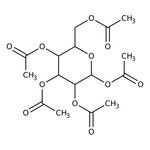
beta-d-Glucosepentaacetat, 98 %, Thermo Scientific Chemicals
CAS: 604-69-3 | C16H22O11 | 390.341 g/mol
Have Questions?
Ansicht ändern


Katalognummer A12526.18
auch als A12526-18 bezeichnet
Preis (EUR)
40,00
Each
Menge:
50 g
Preis (EUR)
40,00
Each
Chemikalien-Kennzeichnungen
CAS604-69-3
IUPAC Name[3,4,5,6-tetrakis(acetyloxy)oxan-2-yl]methyl acetate
Molecular FormulaC16H22O11
InChI KeyLPTITAGPBXDDGR-UHFFFAOYNA-N
SMILESCC(=O)OCC1OC(OC(C)=O)C(OC(C)=O)C(OC(C)=O)C1OC(C)=O
Mehr anzeigen
Specifications Datenblatt
DatenblattAppearance (Color)White to pale cream
FormPowder or crystalline powder
Assay (GC)≥97.5%
Identification (FTIR)Conforms
Water Content (Karl Fischer Titration)≤0.5%
Mehr anzeigen
β-D-Glucose Pentaacetate is used in biochemical reaction and also used as an active pharmaceutical intermediate. Further, it is used to stimulate insulin release in rat pancreatic islets.
This Thermo Scientific Chemicals brand product was originally part of the Alfa Aesar product portfolio. Some documentation and label information may refer to the legacy brand. The original Alfa Aesar product / item code or SKU reference has not changed as a part of the brand transition to Thermo Scientific Chemicals.
Anwendungen
β-D-Glucose Pentaacetat wird in biochemischen Reaktionen und auch als aktives pharmazeutisches Zwischenprodukt verwendet. Darüber hinaus wird es zur Anregung der Insulinausschüttung in pankreatischen Inseln von Ratten verwendet.
Löslichkeit
Löslich in Chloroform und Methanol. Nicht in Wasser löslich.
Hinweise
Kühl lagern. Nicht kompatibel mit starken Oxidationsmitteln.
β-D-Glucose Pentaacetat wird in biochemischen Reaktionen und auch als aktives pharmazeutisches Zwischenprodukt verwendet. Darüber hinaus wird es zur Anregung der Insulinausschüttung in pankreatischen Inseln von Ratten verwendet.
Löslichkeit
Löslich in Chloroform und Methanol. Nicht in Wasser löslich.
Hinweise
Kühl lagern. Nicht kompatibel mit starken Oxidationsmitteln.
RUO – Research Use Only
Allgemeine Referenzen:
- Ali, T. H.; Tajuddin, H. A. B.; Hussen, R. S. D.; Heidelberg, T. Increased Emulsion Stability for Reverse Y-Shaped Sugar-Based Surfactants. J. Surfactants Deterg. 2015, 18 (5), 881-886.
- Lülsdorf, N.; Pitzler, C.; Biggel, M.; Martinez, R.; Vojcic, L.; Schwaneberg, U. A flow cytometer-based whole cell screening toolbox for directed hydrolase evolution through fluorescent hydrogels. Chem. Commun. 2015, 51 (41), 8679-8682.