Search
 Elementsuche
 Struktursuche

.png-150.jpg)

Thermo Scientific Chemicals
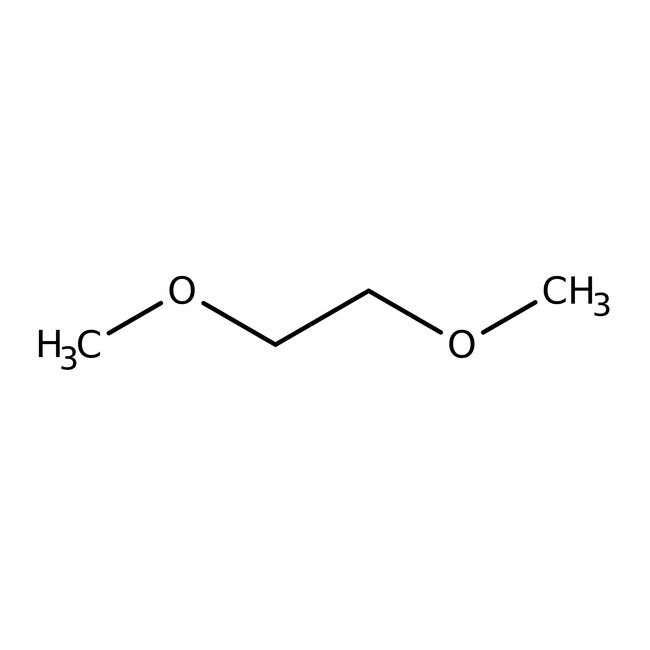
1,2-Dimethoxyethan, 99+ %, stab. mit BHT, Thermo Scientific Chemicals
CAS: 110-71-4 | C4H10O2 | 90.122 g/mol
Have Questions?
Ansicht ändern


Chemikalien-Kennzeichnungen
CAS110-71-4
IUPAC Name1,2-dimethoxyethane
Molecular FormulaC4H10O2
InChI KeyXTHFKEDIFFGKHM-UHFFFAOYSA-N
SMILESCOCCOC
Mehr anzeigen
Specifications Datenblatt
DatenblattAppearance (Color)Clear colorless
Assay (GC)≥99.0%
Identification (FTIR)Conforms
Refractive Index1.3785-1.3815 @ 20?C
FormLiquid
Mehr anzeigen
1,2-Dimethoxyethane is widely used as a solvent for electrolyte of lithium batteries, polysilicones, oligo- and polysaccharides. It plays an important role in Grignard reactions, Suzuki reactions and Stille couplings in organometallic chemistry and in pharmaceutical synthesis. It is a higher boiling point solvent and is used as an alternative to diethyl ether and tetrahydrofuran. It is used for the etching of synthetic polymers like polytetrafluoroethylene and other fluoropolymers with alkali metal dispersions.
This Thermo Scientific Chemicals brand product was originally part of the Alfa Aesar product portfolio. Some documentation and label information may refer to the legacy brand. The original Alfa Aesar product / item code or SKU reference has not changed as a part of the brand transition to Thermo Scientific Chemicals.
Anwendungen
1,2-Dimethoxyethan wird häufig als Lösungsmittel für Elektrolyte von Lithiumbatterien, Polysiliconen, Oligo- und Polysacchariden verwendet. Spielt eine wichtige Rolle bei Grignard-Reaktionen, Suzuki-Reaktionen und Stille-Kopplungen in der Organometallchemie und in der pharmazeutischen Synthese. Ist ein Lösungsmittel mit einem höheren Siedepunkt und wird als Alternative zu Diethylether und Tetrahydrofuran verwendet. Wird zum Ätzen synthetischer Polymere wie Polytetrafluorethylen und anderer Fluorpolymere mit Alkalimetalldispersionen verwendet.
Löslichkeit
Mischbar mit Wasser, Methanol, Ethanol, Diethylether, Aceton, Tetrahydrofuran, Benzol und Toluol.
Hinweise
Von Zündquellen fernhalten. Behälter an einem trockenen und gut belüfteten Ort dicht verschlossen halten. Nicht kompatibel mit starken Oxidationsmitteln. Kann an Luft oxidiert werden, um Peroxide zu bilden.
1,2-Dimethoxyethan wird häufig als Lösungsmittel für Elektrolyte von Lithiumbatterien, Polysiliconen, Oligo- und Polysacchariden verwendet. Spielt eine wichtige Rolle bei Grignard-Reaktionen, Suzuki-Reaktionen und Stille-Kopplungen in der Organometallchemie und in der pharmazeutischen Synthese. Ist ein Lösungsmittel mit einem höheren Siedepunkt und wird als Alternative zu Diethylether und Tetrahydrofuran verwendet. Wird zum Ätzen synthetischer Polymere wie Polytetrafluorethylen und anderer Fluorpolymere mit Alkalimetalldispersionen verwendet.
Löslichkeit
Mischbar mit Wasser, Methanol, Ethanol, Diethylether, Aceton, Tetrahydrofuran, Benzol und Toluol.
Hinweise
Von Zündquellen fernhalten. Behälter an einem trockenen und gut belüfteten Ort dicht verschlossen halten. Nicht kompatibel mit starken Oxidationsmitteln. Kann an Luft oxidiert werden, um Peroxide zu bilden.
RUO – Research Use Only
Allgemeine Referenzen:
- Lösungsmittel für die Reduktion von Lithiierungen und Metallhydrid.
- Empfohlenes Lösungsmittel für die Schmidt-Reaktion von Ketonen mit Hydrazoesäure, um mögliche Gefahren zu vermeiden, über die bei den üblicheren chlorierten Lösungsmitteln, insbesondere Chloroform, berichtet wird. Die Hydrazoesäure wird in situ aus NaN3 und Methansulfonsäure erzeugt: Tetrahedron, 52, 1609 (1996).
- Che, P.; Lu, F.; Si, X.; Xu, J. Catalytic etherification of hydroxyl compounds to methyl ethers with 1,2-dimethoxyethane. RSC Adv. 2015, 5 (31), 24139-24143.
- Monreal, M. J.; Thomson, R. K.; Scott, B. L.; Kiplinger, J. L. Enhancing the synthetic efficacy of thorium tetrachloride bis(1,2-dimethoxyethane) with added 1,2-dimethoxyethane: Herstellung von Metallocene-Thorium-Dichloriden. Inorg. Chem. Commun. 2014, 46, 51-53.