Search
 Elementsuche
 Struktursuche

Thermo Scientific Chemicals
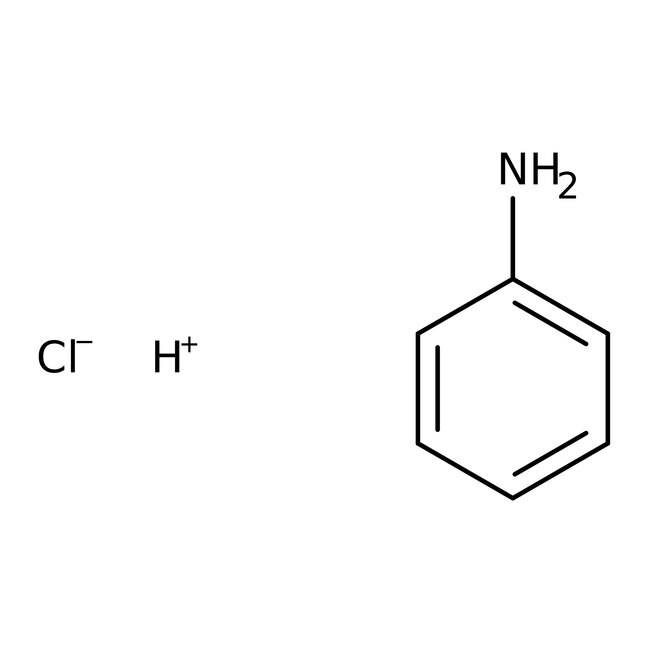
Anilinhydrochlorid, 99 %, Thermo Scientific Chemicals
CAS: 142-04-1 | C6H8ClN | 129.59 g/mol
Have Questions?
Ansicht ändern


Katalognummer A13024.22
auch als A13024-22 bezeichnet
Preis (EUR)
24,20
Each
Menge:
100 g
Preis (EUR)
24,20
Each
Chemikalien-Kennzeichnungen
CAS142-04-1
IUPAC Namehydrogen aniline chloride
Molecular FormulaC6H8ClN
InChI KeyMMCPOSDMTGQNKG-UHFFFAOYSA-N
SMILES[H+].[Cl-].NC1=CC=CC=C1
Mehr anzeigen
Specifications Datenblatt
DatenblattAppearance (Color)White to grey or pale yellow or pale green
FormCrystals or crystalline powder or powder or flakes
Assay (Titration ex Chloride)≥98.5 to ≤101.5%
Melting Point (clear melt)195-201?C
Identification (FTIR)Conforms
Mehr anzeigen
Aniline hydrochloride was used in the preparation of polyaniline coated poly(styrene-co-styrene sulfonate) nanoparticles. It was used to study the induction of Nei-like DNA glycosylases (NEIL1/2)-mediated base excision repair(BER) in rat spleen and 8-oxoguanine glycosylase 1-mediated BER due to aniline exposure. It is used in printing inks, clothing marking inks, paints and paint removers. It is also used as a stove polisher and shoe polisher, as well as in the synthesis of dyes, crayons and antioxidants.
This Thermo Scientific Chemicals brand product was originally part of the Alfa Aesar product portfolio. Some documentation and label information may refer to the legacy brand. The original Alfa Aesar product / item code or SKU reference has not changed as a part of the brand transition to Thermo Scientific Chemicals.
Anwendungen
Anilinhydrochlorid wurde bei der Herstellung von polyanilinbeschichteten Poly(styrol-co-Styrol-Sulfonat)-Nanopartikeln verwendet. Wurde zur Untersuchung der Induktion von Nei-ähnlichen DNA-Glykosylasen (NEIL1/2)-vermittelten Baseexzisionsreparatur (BER) in Ratte-Milz und 8-Oxoguanin-Glycosylase 1-vermitteltem BER aufgrund der Anilin-Exposition verwendet. Wird in Druckfarben, Bekleidungstinten, Farben und Farbentfernern verwendet. Wird auch als Ofen- und Schuhpolierer sowie in der Synthese von Farbstoffen, Buntstiften und Antioxidantien verwendet.
Löslichkeit
Löslich in Wasser (1070g/l).
Hinweise
Ist lichtempfindlich und hygroskopisch. Nicht kompatibel mit Oxidationsmitteln.
Anilinhydrochlorid wurde bei der Herstellung von polyanilinbeschichteten Poly(styrol-co-Styrol-Sulfonat)-Nanopartikeln verwendet. Wurde zur Untersuchung der Induktion von Nei-ähnlichen DNA-Glykosylasen (NEIL1/2)-vermittelten Baseexzisionsreparatur (BER) in Ratte-Milz und 8-Oxoguanin-Glycosylase 1-vermitteltem BER aufgrund der Anilin-Exposition verwendet. Wird in Druckfarben, Bekleidungstinten, Farben und Farbentfernern verwendet. Wird auch als Ofen- und Schuhpolierer sowie in der Synthese von Farbstoffen, Buntstiften und Antioxidantien verwendet.
Löslichkeit
Löslich in Wasser (1070g/l).
Hinweise
Ist lichtempfindlich und hygroskopisch. Nicht kompatibel mit Oxidationsmitteln.
RUO – Research Use Only
Allgemeine Referenzen:
- M.Khan Firoze; Bhupendra S.Kaphalia; Paul J.Boor; G.A.S.Ansari. Subchronic toxicity of aniline hydrochloride in rats. Archives of Environmental Contamination and Toxicology. 1993, 24, (3),368-374
- A. Barnes; A.Despotakis; P.V.Wright; T.C.P.Wong; B.Chambers; A.P.Anderson. Control of conductivity at microwave frequencies in a poly(aniline hydrochloride)-silver-polymer electrolyte composite material. Electronics Letters. 1996, 32, (4),358-359
- Wurde eine praktische Methode zur Erzeugung von Arylisocyanaten aus Anilinhydrochloriden und Oxalylchlorid über die Thermolyse des intermediären Oxaminchlorids beschrieben: Tetrahedron Lett., 45, 4769 (2004).