Search
 Elementsuche
 Struktursuche



Thermo Scientific Chemicals
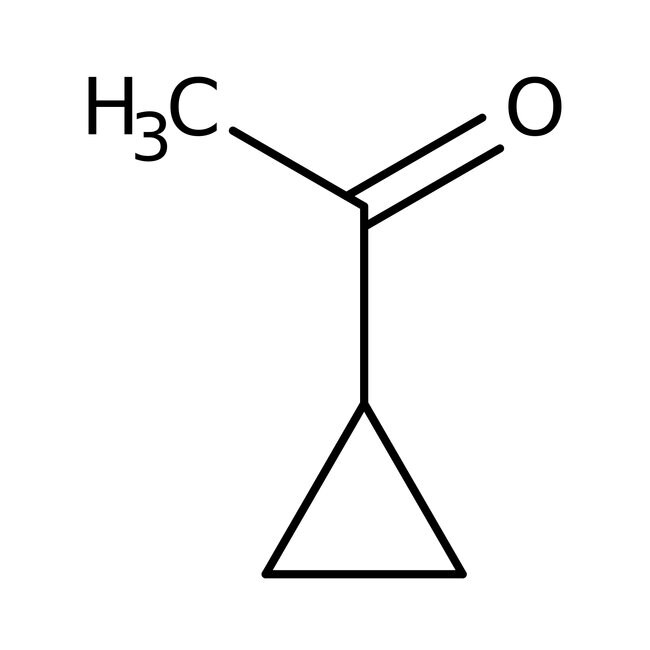
Cyclopropylmethylketon, 99 %, Thermo Scientific Chemicals
CAS: 765-43-5 | C5H8O | 84.118 g/mol
Have Questions?
Ansicht ändern


Katalognummer A13540.22
auch als A13540-22 bezeichnet
Preis (EUR)
93,20
Each
Menge:
100 g
Preis (EUR)
93,20
Each
Chemikalien-Kennzeichnungen
CAS765-43-5
IUPAC Name1-cyclopropylethan-1-one
Molecular FormulaC5H8O
InChI KeyHVCFCNAITDHQFX-UHFFFAOYSA-N
SMILESCC(=O)C1CC1
Mehr anzeigen
Specifications Datenblatt
Identification (FTIR)Conforms
Appearance (Color)Clear colorless
FormLiquid
Assay (GC)≥98.5%
Refractive Index1.4230-1.4260 @ 20?C
Cyclopropyl methyl ketone was used in the preparation of homoallylic alcohols. Acetylcyclopropane is used as an intermediate for the manufacturing pharmaceuticals, agrochemicals and other organic compounds.
This Thermo Scientific Chemicals brand product was originally part of the Alfa Aesar product portfolio. Some documentation and label information may refer to the legacy brand. The original Alfa Aesar product / item code or SKU reference has not changed as a part of the brand transition to Thermo Scientific Chemicals.
Anwendungen
Cyclopropylmethylketon wurde bei der Herstellung von homoallylischen Alkoholen verwendet. Acetylcyclopropan wird als Zwischenprodukt für die Herstellung von Pharmazeutika, Agrochemikalien und anderen organischen Verbindungen verwendet.
Löslichkeit
Vollständig mit Wasser mischbar.
Hinweise
Von starken Oxidationsmitteln fernhalten. Behälter dicht verschlossen lassen. Kühl und trocken in einem gut versiegelten Behälter lagern.
RUO – Research Use Only
Allgemeine Referenzen:
- L. S. Bartell.; J. P. Guillory.; Andrea T. Parks. Electron Diffraction Study of the Structure and Conformational Behavior of Cyclopropyl Methyl Ketone and Cyclopropanecarboxylic Acid Chloride1a. J. Phys. Chem. 1965, 69, (9), 3043-3048.
- William G. Dauben.; Richard E. Wolf. Übergangszustandskonformationen bei der reduktiven Öffnung von Cyclopropylmethylketonen. J. Org. Chem. 1970, 35, (7), 2361-2367.
- Verschiedene Cyclopropylketone wurden bei der Synthese von δ-ketonischen Phosphoniumsalzen verwendet, die als Thioacetale geschützt bei der Wittig-Reaktion Verwendung gefunden haben: Synthesis, 648 (1987):