Search
 Elementsuche
 Struktursuche


Thermo Scientific Chemicals
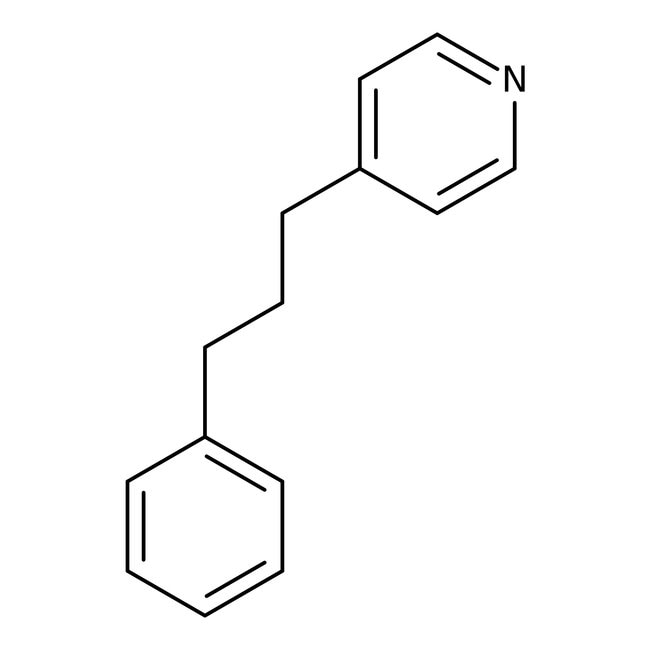
4-(3-Phenylpropyl)-pyridin, 98 %, Thermo Scientific Chemicals
CAS: 2057-49-0 | C14H15N | 197.281 g/mol
Have Questions?
Ansicht ändern


Katalognummer A13590.18
auch als A13590-18 bezeichnet
Preis (EUR)
36,80
Each
Menge:
50 g
Preis (EUR)
36,80
Each
Specifications
Beilstein142242
CAS2057-49-0
Chemischer Name oder Material4-(3-Phenylpropyl)pyridine
Dichte1.029
EINECS-Nummer218-159-1
Mehr anzeigen
4-(3-Phenylpropyl)pyridine is used in electrochemical processes for a novel system of microdroplets of PPP immobilized at graphite and in mesoporous ceramic electrodes, PPP has been used to investigate electrochemically driven mono-, di-, and tri-carboxylate anion transfer at the 4-(3-phenylpropyl)pyridine/aqueous electrolyte interface for a triple phase boundary system at graphite electrodes.
This Thermo Scientific Chemicals brand product was originally part of the Alfa Aesar product portfolio. Some documentation and label information may refer to the legacy brand. The original Alfa Aesar product / item code or SKU reference has not changed as a part of the brand transition to Thermo Scientific Chemicals.
Anwendungen
4-(3-Phenylpropyl)pyridin wird in elektrochemischen Prozessen für ein neuartiges System von Mikrotröpfchen von PPP verwendet, die bei Graphit immobilisiert sind. In mesoporösen Keramikelektroden wurde PPP zur Untersuchung elektrochemisch gesteuerter Mono-, Di- und Tricarboxylat-Anionenübertragungen an der 4-(3-phenylpropyl)pyridin/wässrigen Elektrolyt-Schnittstelle für ein Dreiphasen-Grenzsystem an Graphitelektroden verwendet.
Löslichkeit
Schwierig zu mischen.
Hinweise
Von starken Oxidationsmitteln fernhalten. Behälter dicht verschlossen lassen. Kühl und trocken in einem gut versiegelten Behälter lagern.
4-(3-Phenylpropyl)pyridin wird in elektrochemischen Prozessen für ein neuartiges System von Mikrotröpfchen von PPP verwendet, die bei Graphit immobilisiert sind. In mesoporösen Keramikelektroden wurde PPP zur Untersuchung elektrochemisch gesteuerter Mono-, Di- und Tricarboxylat-Anionenübertragungen an der 4-(3-phenylpropyl)pyridin/wässrigen Elektrolyt-Schnittstelle für ein Dreiphasen-Grenzsystem an Graphitelektroden verwendet.
Löslichkeit
Schwierig zu mischen.
Hinweise
Von starken Oxidationsmitteln fernhalten. Behälter dicht verschlossen lassen. Kühl und trocken in einem gut versiegelten Behälter lagern.
RUO – Research Use Only
Allgemeine Referenzen:
- Chris H. Senanayake.; George B. Smith.; Kenneth M. Ryan.; Laura E. Fredenburgh.; Ji Liu.; F.Edward Roberts.; David L. Hughes.; Robert D. Larsen.; Thomas R. Verhoeven.; Paul J. Reider. The role of 4-(3-phenylpropyl)pyridine N-Oxide (P3NO) in the manganese-salen-catalyzed asymmetric epoxidation of indene. Tetrahedron Letters. 1996, 37, (19), 3271-3274.
- Michael J. Bonne.; Christopher Reynolds.; Stuart Yates.; Galyna Shul.; Joanne Niedziolka.; Marcin Opallo.; Frank Marken. The electrochemical ion-transfer reactivity of porphyrinato metal complexes in 4-(3-phenylpropyl)pyridine ∣ water systems. New J. Chem. 2006, 30, 327-334.