Search
 Elementsuche
 Struktursuche


Thermo Scientific Chemicals
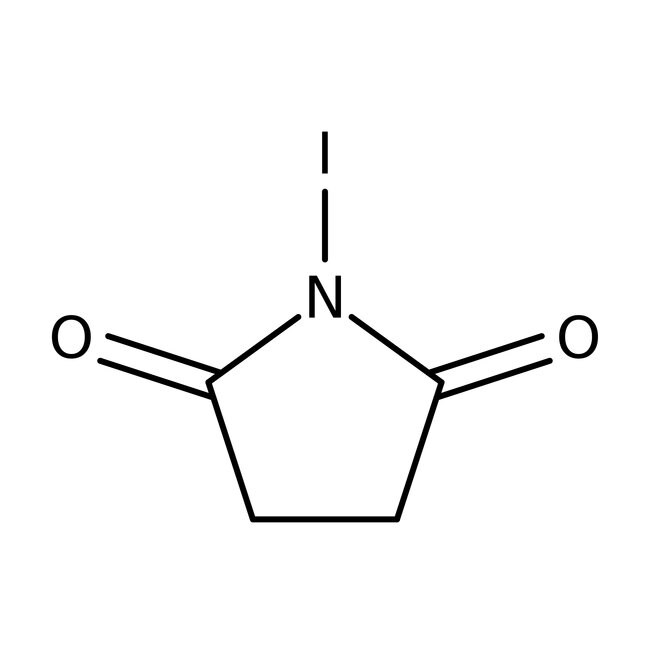
N-Iodsuccinimid, 97 %, Thermo Scientific Chemicals
CAS: 516-12-1 | C4H4INO2 | 224.99 g/mol
Have Questions?
Ansicht ändern


Preis (EUR)
386,00
Each
Chemikalien-Kennzeichnungen
CAS516-12-1
IUPAC Name1-iodopyrrolidine-2,5-dione
Molecular FormulaC4H4INO2
InChI KeyLQZMLBORDGWNPD-UHFFFAOYSA-N
SMILESIN1C(=O)CCC1=O
Mehr anzeigen
Specifications Datenblatt
DatenblattFormCrystals or powder or crystalline powder.
CommentContains a small quantity of dark particulate matter from the manufacturing process.
Identification (FTIR)Conforms
Appearance (Color)White to yellow to brown
Assay (Iodometric Titration)≥96.0 to ≤104.0%%
N-Iodosuccinimide is used in the preparation of vinyl sulfones from olefins and benzenesulfinic acid. It acts as a source for I+ and involved in Hunsdiecker reactions for the conversion of cinnamic acids, and propiolic acids to the corresponding alfa-halostyrenes and 1-halo-1-alkynes respectively. It is also used to hydrolyze thioglycosides to 1-hydroxyglycosides with triluoroacetic acid. It is involved in the preparation of iodobenzene from 1,6-diynes. Further, it acts as an iodinating agent in chemical synthesis.
This Thermo Scientific Chemicals brand product was originally part of the Alfa Aesar product portfolio. Some documentation and label information may refer to the legacy brand. The original Alfa Aesar product / item code or SKU reference has not changed as a part of the brand transition to Thermo Scientific Chemicals.
Anwendungen
N-Iodsuccinimid wird bei der Herstellung von Vinylsulfonen aus Olefinen und Benzensulfinsäure verwendet. Es dient als Quelle für I+ und ist an Hunsdiecker-Reaktionen zur Umwandlung von Cinnamin- und Propiolsäuren in die entsprechenden alfa-Halostyrene und 1-Halo-1-alkyne beteiligt. Es wird auch zur Hydrolyse von Thioglykosiden zu 1-Hydroxyglykosiden mit Triluoroessigsäure verwendet. Es ist an der Zubereitung von Iodobenzol aus 1,6-Diynen beteiligt. Darüber hinaus wirkt es bei der chemischen Synthese als iodinierendes Mittel.
Löslichkeit
Löslich in Dioxan, Tetrahydrfuran und Acetonitril. Unlöslich in Äther, Hexan und Tetrachlorkohlenstoff.
Hinweise
Feuchtigkeits- und lichtempfindlich. Kühl lagern. Behälter an einem trockenen und gut belüfteten Ort dicht verschlossen halten. Nicht kompatibel mit starken Oxidationsmitteln und starken Basen.
N-Iodsuccinimid wird bei der Herstellung von Vinylsulfonen aus Olefinen und Benzensulfinsäure verwendet. Es dient als Quelle für I+ und ist an Hunsdiecker-Reaktionen zur Umwandlung von Cinnamin- und Propiolsäuren in die entsprechenden alfa-Halostyrene und 1-Halo-1-alkyne beteiligt. Es wird auch zur Hydrolyse von Thioglykosiden zu 1-Hydroxyglykosiden mit Triluoroessigsäure verwendet. Es ist an der Zubereitung von Iodobenzol aus 1,6-Diynen beteiligt. Darüber hinaus wirkt es bei der chemischen Synthese als iodinierendes Mittel.
Löslichkeit
Löslich in Dioxan, Tetrahydrfuran und Acetonitril. Unlöslich in Äther, Hexan und Tetrachlorkohlenstoff.
Hinweise
Feuchtigkeits- und lichtempfindlich. Kühl lagern. Behälter an einem trockenen und gut belüfteten Ort dicht verschlossen halten. Nicht kompatibel mit starken Oxidationsmitteln und starken Basen.
RUO – Research Use Only
Allgemeine Referenzen:
- Source of positive iodine. Iodinatmethoxybenzol und Naphthalin in Acetonitril, z. B. Anisol, ergibt 95 % Ausbeute an 4-Iodanisol: Tetrahedron Lett., 37, 4081 (1996).
- In Kombination mit TFA und TFA-Anhydrid, iodiniert 2,4-Diethoxypyrimidin oder N-Alkyluracil speziell ihre 5-Iod-Derivate: Synth. Commun., 18, 855 (1988). Mit Trifluormethansulfonsäure wird das superelektrophile Jod(I)Triflat gebildet. Diese Spezies iodiniert selbst deaktivierte Aromaten, z. B. Nitrobenzol, in das m-Iod-Derivat: J. Org. Chem., 58, 3194 (1993).
- Allein oder mit einer katalytischen Menge an Trifluormethansulfonsäure ist es ein leistungsfähiges Kopplungsmittel in der Oligosaccharid-Synthese, insbesondere für Thioglycosylspender; siehe auch: Tetrahedron Lett., 34, 8523 (1993). Weitere Informationen finden Sie unter: Chem. Rev., 93, 1503 (1993); Contemp. Org. Synth., 3, 173 (1996).
- In Gegenwart von Triphenylphosphin oder Triphenylphosphit wandelt es Alkohole in stereospezifisch in Iodide mit Inversion um: Tetrahedron Lett., 3937 (1973). Siehe auch: Carbohydr. Res., 24, 45 (1972).
- In Kombination mit dem Phasentransferkatalysator Tetra-n-butyl Ammoniumjodid, A15484 oxidiert es Alkohole zu Carbonylverbindungen bei hoher Ausbeute unter neutralen Bedingungen: Synthesis, 394 (1981). Glykole werden zu Carbonylverbindungen gespalten; die Reaktionsgeschwindigkeit wird durch UV-Bestrahlung erhöht: J. Org. Chem., 46, 1927 (1981). Ebenso werden ɑ-Hydroxysäuren oxidativ zu Ketonen decarboxyliert: J. Org. Chem., 47, 3006 (1982).
- Mit K2CO3 in MeOH können Aldehyde direkt zu Methylestern oxidiert werden: J. Org. Chem., 54, 1213 (1989).
- Die oxidative Kopplung von Dianionen azyklischer tertiärer Amide ermöglicht eine stereoselektive Vorbereitung von ß-Lactamen: J. Org. Chem., 57, 1864 (1992):