Search
 Elementsuche
 Struktursuche


Thermo Scientific Chemicals
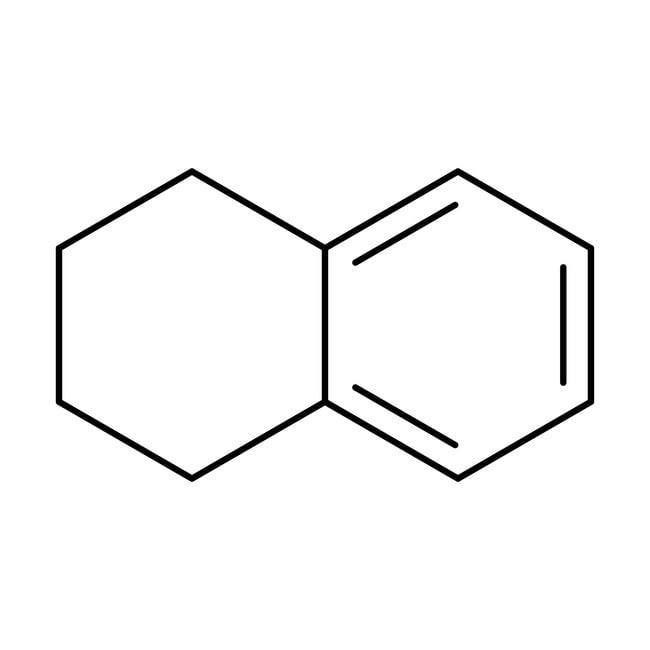
1,2,3,4-Tetrahydronaphthalin, 97 %, Thermo Scientific Chemicals
CAS: 119-64-2 | C10H12 | 132.21 g/mol
Have Questions?
Ansicht ändern


Katalognummer A14962.30
auch als A14962-30 bezeichnet
Preis (EUR)
26,80
Each
Menge:
250 g
Preis (EUR)
26,80
Each
Chemikalien-Kennzeichnungen
CAS119-64-2
IUPAC Name1,2,3,4-tetrahydronaphthalene
Molecular FormulaC10H12
InChI KeyCXWXQJXEFPUFDZ-UHFFFAOYSA-N
SMILESC1CCC2=CC=CC=C2C1
Mehr anzeigen
Specifications Datenblatt
DatenblattCommentSpecification differs for U.S. and non-U.S. material where indicated
Identification (FTIR)Conforms (non-U.S. specification)
Impurity contentDecahydonaphthalene (≤1.5%) (U.S. specification)
Impurity contentNaphthalene (≤0.7%) (U.S. specification)
Refractive Index1.5385-1.5435 @ 20°C (non-U.S. specification)
Mehr anzeigen
1,2,3,4-Tetrahydronaphthalene, is used as an intermediate for organic synthesis, solvent. It is used as a solvent.It is also used for the laboratory synthesis of dry HBr gas.
This Thermo Scientific Chemicals brand product was originally part of the Alfa Aesar product portfolio. Some documentation and label information may refer to the legacy brand. The original Alfa Aesar product / item code or SKU reference has not changed as a part of the brand transition to Thermo Scientific Chemicals.
Anwendungen
1,2,3,4-Tetrahydronaphthalin wird als Zwischenprodukt bei der organischen Synthese verwendet, Lösungsmittel. Es wird als Lösungsmittel verwendet. Außerdem wird es bei der Laborsynthese von trockenem HBr-Gas verwendet.
Löslichkeit
Es ist unlöslich in Wasser.
Hinweise
Kühl lagern. Behälter an einem trockenen und gut belüfteten Ort dicht verschlossen halten. Unter inertem Gas lagern. Luft- und lichtempfindlich. Wärmeempfindlich. Kann bei Lagerung dunkler werden. Stabil unter empfohlenen Lagerbedingungen.
1,2,3,4-Tetrahydronaphthalin wird als Zwischenprodukt bei der organischen Synthese verwendet, Lösungsmittel. Es wird als Lösungsmittel verwendet. Außerdem wird es bei der Laborsynthese von trockenem HBr-Gas verwendet.
Löslichkeit
Es ist unlöslich in Wasser.
Hinweise
Kühl lagern. Behälter an einem trockenen und gut belüfteten Ort dicht verschlossen halten. Unter inertem Gas lagern. Luft- und lichtempfindlich. Wärmeempfindlich. Kann bei Lagerung dunkler werden. Stabil unter empfohlenen Lagerbedingungen.
RUO – Research Use Only
Allgemeine Referenzen:
- Gonçalves, F. A.; Hamano, K.; Sengers, J. V. Density and viscosity of tetralin and trans-decalin. International Journal of Thermophysics. 1989, 10, (4), 845-847.
- Krichko, A. A.; Skvortsov, D. V.; Titova, T. A.; Filippov, B. S.; Dogadkina, N. E. Production of tetralin by the hydrogenation of naphthalene-containing fractions. Chemistry and Technology of Fuels and Oils. 1969, 5, (18), 1007-1009.