Search
 Elementsuche
 Struktursuche


Thermo Scientific Chemicals
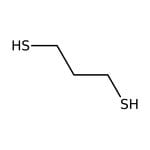
1,3-Propandithiol, 97 %, Thermo Scientific Chemicals
CAS: 109-80-8 | C3H8S2 | 108.217 g/mol
Have Questions?
Ansicht ändern


Katalognummer A15261.06
auch als A15261-06 bezeichnet
Preis (EUR)
27,40
Each
Menge:
5 g
Preis (EUR)
27,40
Each
Chemikalien-Kennzeichnungen
CAS109-80-8
IUPAC Namepropane-1,3-dithiol
Molecular FormulaC3H8S2
InChI KeyZJLMKPKYJBQJNH-UHFFFAOYSA-N
SMILESSCCCS
Mehr anzeigen
Specifications Datenblatt
DatenblattFormLiquid
Appearance (Color)Clear, colorless to pale yellow
Assay (GC)>96.0%
Refractive Index1.5375-1.5425 @ 20?C
1,3-Propanedithiol is used as a reagent in the preparation of thioketals and thioacetals. It acts as a flavoring agent. It is used as a precursor in the synthesis of cyclic dithioacetal (1,3-dithiane) derivatives of carbonyl compounds. It is involved in the preparation of diiron propanedithiolate hexacarbonyl by reacting reaction with triiron dodecacarbonyl. Further, it is used for the protection of aldehydes and ketones through their reversible formation of dithianes. In addition to this, it reacts with metal ions to form chelate rings.
This Thermo Scientific Chemicals brand product was originally part of the Alfa Aesar product portfolio. Some documentation and label information may refer to the legacy brand. The original Alfa Aesar product / item code or SKU reference has not changed as a part of the brand transition to Thermo Scientific Chemicals.
Anwendungen
1,3-Propandithiol wird als Reagenz bei der Herstellung von Thioketalen und Thioacetalen verwendet. Fungiert als Aromastoff. Wird als Vorläufer bei der Synthese zyklischer Dithioacetal (1,3-Dithian)-Derivate von Carbonylverbindungen verwendet. Ist an der Vorbereitung von Diiron-Propandithiolat-Hexacarbonyl beteiligt, indem es mit Triiron-Dodecacarbonyl reagiert. Wird darüber hinaus zum Schutz von Aldehyden und Ketonen durch ihre reversible Bildung von Dithianen verwendet. Reagiert darüber hinaus mit Metallionen zu Chelatringen.
Löslichkeit
Schwer in Wasser löslich. Mischbar mit Alkohol, Äther, Chloroform, Äther. Mischbar mit Alkohol, Äther, Chloroform und Äther. Leicht mit Wasser mischbar.
Hinweise
Kühl lagern. Nicht kompatibel mit Basen, Oxidationsmitteln, Reduktionsmitteln und Alkalimetallen.
1,3-Propandithiol wird als Reagenz bei der Herstellung von Thioketalen und Thioacetalen verwendet. Fungiert als Aromastoff. Wird als Vorläufer bei der Synthese zyklischer Dithioacetal (1,3-Dithian)-Derivate von Carbonylverbindungen verwendet. Ist an der Vorbereitung von Diiron-Propandithiolat-Hexacarbonyl beteiligt, indem es mit Triiron-Dodecacarbonyl reagiert. Wird darüber hinaus zum Schutz von Aldehyden und Ketonen durch ihre reversible Bildung von Dithianen verwendet. Reagiert darüber hinaus mit Metallionen zu Chelatringen.
Löslichkeit
Schwer in Wasser löslich. Mischbar mit Alkohol, Äther, Chloroform, Äther. Mischbar mit Alkohol, Äther, Chloroform und Äther. Leicht mit Wasser mischbar.
Hinweise
Kühl lagern. Nicht kompatibel mit Basen, Oxidationsmitteln, Reduktionsmitteln und Alkalimetallen.
RUO – Research Use Only
Allgemeine Referenzen:
- Vorläufer zyklischer Dithioacetal (1,3-Dithian)-Derivate von Carbonylverbindungen. Der Schutzschritt wird durch Lewis-Säuren katalysiert, z. B. BF3-Ätherat: Tetrahedron Lett., 871 (1971), TiCl4: Tetrahedron Lett., 24, 1289 (1983), Aluminum-Trifluoromethanesulfonat, B20785, oder Indium(III) Trifluoromethanesulfonat, 40131. Die Diothioacetalisierung kann unter neutralen, lösungsmittelfreien Bedingungen mit Lithium-Trifluormethansulfonat, 39322, als Katalysator durchgeführt werden: Tetrahedron Lett., 40, 4055 (1999). Zur Vorbereitung monozyklischer Dithioacetale von ß-Dyketone bei niedriger Temperatur in Gegenwart von BF3-Ätherat siehe: Tetrahedron, 44, 2283 (1988).
- Alternativ können 1,3-Dithiane durch Alkylierung mit reaktiven Gem-Dihalogeniden unter Phasenübertragungsbedingungen vorbereitet werden: Liebigs Ann. Chem., 1589 (1982).
- Für Deschutzmethoden und 1,3-Dithiane als Acylanion-Äquivalente siehe: 1,3-Dithiane, A10505.
- Wang, L.; Li, R.; Feng, L.; Liu, J.; Gao, X.; Wang, W. Study on the interface electronic states of chemically modified ZnO nanowires. RSC Adv. 2015, 5 (119), 98130-98135.
- Kuciński, K.; Pawluć, P.; Marciniec, B.; Hreczycho, G. Highly Selective Hydrothiolation of Unsaturated Organosilicon Compounds Catalyzed by Scandium(III) Triflate. Chem. Eur. J. 2015, 21 (13), 4940-4943.