Search
 Elementsuche
 Struktursuche


Thermo Scientific Chemicals
O-Benzoesulfimid-Natriumsalzinhydrat, 99 %, Thermo Scientific Chemicals
CAS: 82385-42-0 | C7H4NNaO3S | 205.16 g/mol
Have Questions?
Ansicht ändern


Katalognummer A15530.0B
auch als A15530-0B bezeichnet
Preis (EUR)
131,00
Each
Menge:
1000 g
Preis (EUR)
131,00
Each
Chemikalien-Kennzeichnungen
CAS82385-42-0
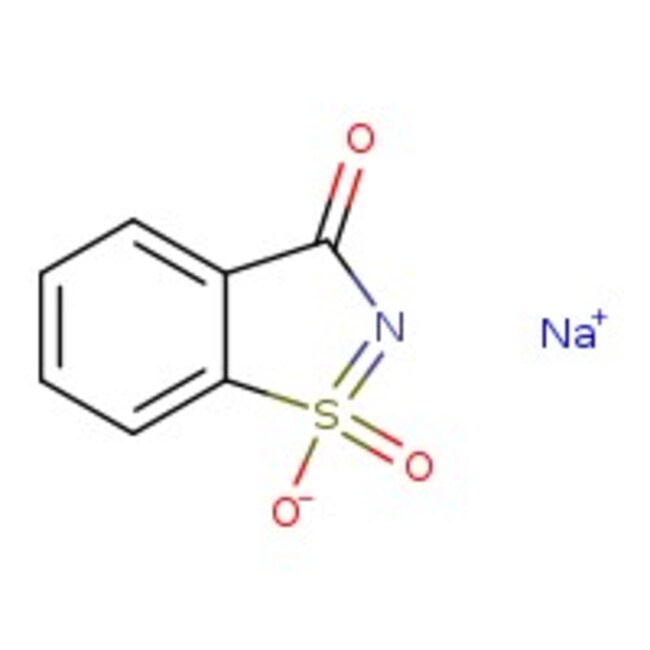
IUPAC Namesodium 1,3-dioxo-3H-1λ⁶,2-benzothiazol-1-olate
Molecular FormulaC7H4NNaO3S
InChI KeyOAZGZMKGRPRHJX-UHFFFAOYSA-M
SMILES[Na+].[O-]S1(=O)=NC(=O)C2=CC=CC=C12
Mehr anzeigen
Specifications Datenblatt
DatenblattAssay (Non-aqueous acid-base Titration)≥98.5 to ≤101.5%
FormCrystals or powder or crystalline powder
Water Content (Karl Fischer Titration)≤18%
Appearance (Color)White
O-benzoic sulfimide sodium salt is used as an artificial sweetener in drinks, candies, cookies, medicines and toothpaste. It is used in the food industry and for sweetening diabetes diet. It is also used as a synthetic sweet ignorance agent. It finds application in a variety of beverages, foods, cosmetics and pharmaceuticals to provide sweetness without adding calories. It is involved as a nickel electroplating brightener, chemical intermediate, animal feed sweetener and anaerobic adhesive accelerator.
This Thermo Scientific Chemicals brand product was originally part of the Alfa Aesar product portfolio. Some documentation and label information may refer to the legacy brand. The original Alfa Aesar product / item code or SKU reference has not changed as a part of the brand transition to Thermo Scientific Chemicals.
Anwendungen
O-benzoisches Sulfimid-Natriumsalz wird als künstlicher Süßstoff in Getränken, Süßigkeiten, Keksen, Medikamenten und Zahncremes verwendet. Wird in der Lebensmittelindustrie und zur Süßung von Diabetesnahrungsmitteln verwendet. Wird auch als synthetischer Sweet-Ignorance-Stoff verwendet. Findet Anwendung in einer Vielzahl von Getränken, Lebensmitteln, Kosmetika und Pharmazeutika, um Süße ohne zusätzliche Kalorien hinzuzufügen. Wir auch als Nickel-Galvanik-Aufheller, chemisches Zwischenprodukt, Süßstoff für Futtermittel und anaerober Haftbeschleuniger eingesetzt.
Löslichkeit
Wasserlöslich.
Hinweise
Nicht kompatibel mit starken Oxidationsmitteln.
O-benzoisches Sulfimid-Natriumsalz wird als künstlicher Süßstoff in Getränken, Süßigkeiten, Keksen, Medikamenten und Zahncremes verwendet. Wird in der Lebensmittelindustrie und zur Süßung von Diabetesnahrungsmitteln verwendet. Wird auch als synthetischer Sweet-Ignorance-Stoff verwendet. Findet Anwendung in einer Vielzahl von Getränken, Lebensmitteln, Kosmetika und Pharmazeutika, um Süße ohne zusätzliche Kalorien hinzuzufügen. Wir auch als Nickel-Galvanik-Aufheller, chemisches Zwischenprodukt, Süßstoff für Futtermittel und anaerober Haftbeschleuniger eingesetzt.
Löslichkeit
Wasserlöslich.
Hinweise
Nicht kompatibel mit starken Oxidationsmitteln.
RUO – Research Use Only
Allgemeine Referenzen:
- Effective catalyst for the silylation of a wide range of functional groups by Hexamethyl disilazane, A15139: J. Org. Chem., 47, 3966 (1982).
- Park, D. Y. Study of Stress Changes in Nanocrystalline Ni Thin Films Eletrodeposited from Chloride Baths. J. Korean electrochem. soc. 2011, 14 (3), 163-170.
- Zhao, S.; Yang, X.; Zhao, H.; Dong, A.; Wang, J.; Zhang, M.; Huang, W. Water-compatible surface imprinting of ‘Saccharin sodium’on silica surface for selective recognition and detection in aqueous solution. Talanta 2015, 144, 717-725.