Search
 Elementsuche
 Struktursuche


Thermo Scientific Chemicals
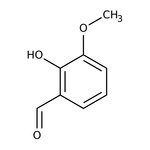
2-Hydroxy-3-Methoxybenzaldehyd, 99 %, Thermo Scientific Chemicals
CAS: 148-53-8 | C8H8O3 | 152.15 g/mol
Have Questions?
Ansicht ändern


Katalognummer A15672.22
auch als A15672-22 bezeichnet
Preis (EUR)
53,40
Each
Menge:
100 g
Preis (EUR)
53,40
Each
Chemikalien-Kennzeichnungen
CAS148-53-8
Specifications Datenblatt
DatenblattAppearance (Color)Yellow to brown
FormCrystals or powder or crystalline powder or flakes
Assay (GC)≥98.5%
Identification (FTIR)Conforms
Melting Point (clear melt)40-45°C
o-Vanillin has been used to study the solvent-free reaction between o-vanillin and p-toluidine using NMR, DSC and XRD analysis. It was used in the synthesis of new ligand for Fe(III) and Al(lII). It is also used in the study of mutagenesis and as a synthetic precursor for pharmaceuticals.
This Thermo Scientific Chemicals brand product was originally part of the Alfa Aesar product portfolio. Some documentation and label information may refer to the legacy brand. The original Alfa Aesar product / item code or SKU reference has not changed as a part of the brand transition to Thermo Scientific Chemicals.
Anwendungen
O-Vanillin wurde zur Untersuchung der lösungsmittelfreien Reaktion zwischen O-Vanillin und p-Toluidin mit NMR-, DSC- und XRD-Analyse verwendet. Wurde bei der Synthese von neuem Ligand für Fe(III) und Al(III) verwendet. Wird auch in der Mutagenese und als synthetischer Vorläufer für Pharmazeutika verwendet.
Löslichkeit
Die Löslichkeit in Methanol ist nahezu transparent. Löslich in Alkohol, Methanol und Dioxan (1 g in 10 ml). Unlöslich in Wasser.
Hinweise
Luftempfindlich. Nicht in der Nähe von Luft und Oxidationsmitteln lagern. Halten Sie den Behälter dicht verschlossen und stellen Sie ihn an einen kühlen, trockenen und gut belüfteten Ort.
O-Vanillin wurde zur Untersuchung der lösungsmittelfreien Reaktion zwischen O-Vanillin und p-Toluidin mit NMR-, DSC- und XRD-Analyse verwendet. Wurde bei der Synthese von neuem Ligand für Fe(III) und Al(III) verwendet. Wird auch in der Mutagenese und als synthetischer Vorläufer für Pharmazeutika verwendet.
Löslichkeit
Die Löslichkeit in Methanol ist nahezu transparent. Löslich in Alkohol, Methanol und Dioxan (1 g in 10 ml). Unlöslich in Wasser.
Hinweise
Luftempfindlich. Nicht in der Nähe von Luft und Oxidationsmitteln lagern. Halten Sie den Behälter dicht verschlossen und stellen Sie ihn an einen kühlen, trockenen und gut belüfteten Ort.
RUO – Research Use Only
Allgemeine Referenzen:
- Dolotko O, et al. Mechanically induced reactions in organic solids: liquid eutectics or solid-state processes?.New J. Chem.,2010,34(1), 25-28.
- Valeria M Nurchi, et al. Kojic acid derivatives as powerful chelators for iron(III) and aluminum(III).Dalton Trans.,2011,40(22), 5984-5998.