Search
 Elementsuche
 Struktursuche


Thermo Scientific Chemicals
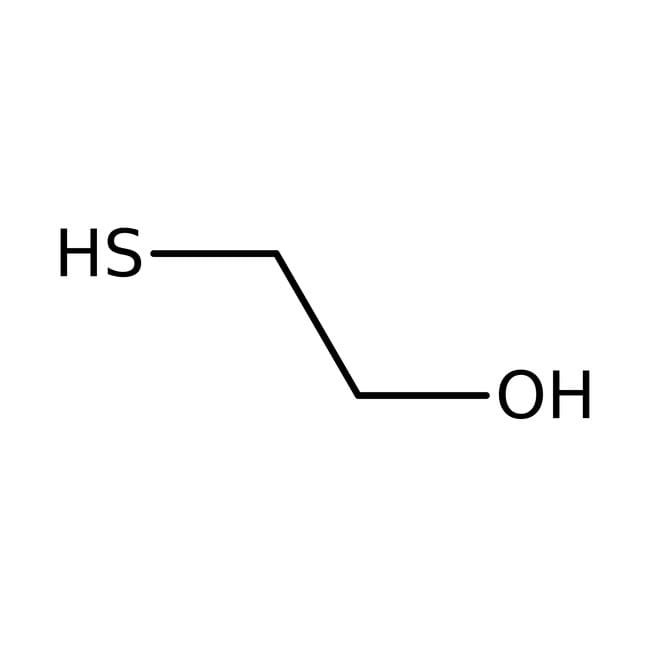
2-Mercaptoethanol, +98 %, Thermo Scientific Chemicals
2-Mercaptoethanol, CAS-Nr. 60-24-2, wird häufig als Reduktionsmittel in Labors verwendet und hat eine Vielzahl von Anwendungen wie die Solubilisierung von Proteinen.
Have Questions?
Ansicht ändern


Katalognummer A15890.0I
auch als A15890-0I bezeichnet
Preis (EUR)
-
Menge:
5000 g
Chemikalien-Kennzeichnungen
CAS60-24-2
IUPAC Name2-sulfanylethan-1-ol
Molecular FormulaC2H6OS
InChI KeyDGVVWUTYPXICAM-UHFFFAOYSA-N
SMILESOCCS
Mehr anzeigen
Specifications Datenblatt
DatenblattAppearance (Color)Clear colorless to pale yellow
FormLiquid
Assay (GC)≥98.0%
Identification (FTIR)Conforms
Refractive Index1.4990-1.5030 @ 20°C
Solubilizes proteins by reducing disulfide linkages2-Mercaptoethanol is used in the preparation of nano-graphene for cellular imaging and drug delivery as well as multifunctional polymeric micelle. It acts as a reducing agent used in electrophoresis, amino acid detection, and distinguishing ssDNA/dsDNA. It is also employed as a standard buffer. It is also used in the preparation of PVC heat stabilizers and as a chain transfer agent in the manufacture of PVC. Further, it is used in some RNA isolation procedures to eliminate ribonuclease. It is utilized as a corrosion inhibitor and ore floatation agent. In biochemistry, it is useful to study the activity of the immune system.
This Thermo Scientific Chemicals brand product was originally part of the Alfa Aesar product portfolio. Some documentation and label information may refer to the legacy brand. The original Alfa Aesar product / item code or SKU reference has not changed as a part of the brand transition to Thermo Scientific Chemicals.
Anwendungen
Löst Proteine durch Reduktion von Disulfid-Verbindungen2-Mercaptoethanol wird bei der Herstellung von Nano-Graphen für die zelluläre Bildgebung und Arzneimittelverabreichung sowie für multifunktionale polymere Mizellen verwendet. Dient als Reduktionsmittel für Elektrophorese, Aminosäurendetektion und zur Unterscheidung von ssDNA/dsDNA. Wird auch als Standardpuffer eingesetzt. Wird auch bei der Herstellung von PVC-Wärmestabilisatoren und als Kettenübertragungsmittel bei der Herstellung von PVC verwendet. Wird darüber hinaus in einigen RNA-Isolierungsverfahren zur Eliminierung von Ribonuklease verwendet. Wird als Korrosionshemmer und Erzflotationsmittel verwendet. In der Biochemie ist es sinnvoll, die Aktivität des Immunsystems zu studieren.
Löslichkeit
Mischbar mit Wasser, Alkohol, Äther, Benzol und anderen organischen Lösungsmitteln.
Hinweise
Hygroskopisch. Luft- und wärmeempfindlich. Nicht kompatibel mit Metallen, starken Säuren, Schwermetallsalzen und Oxidationsmitteln. Kühl lagern.
Löst Proteine durch Reduktion von Disulfid-Verbindungen2-Mercaptoethanol wird bei der Herstellung von Nano-Graphen für die zelluläre Bildgebung und Arzneimittelverabreichung sowie für multifunktionale polymere Mizellen verwendet. Dient als Reduktionsmittel für Elektrophorese, Aminosäurendetektion und zur Unterscheidung von ssDNA/dsDNA. Wird auch als Standardpuffer eingesetzt. Wird auch bei der Herstellung von PVC-Wärmestabilisatoren und als Kettenübertragungsmittel bei der Herstellung von PVC verwendet. Wird darüber hinaus in einigen RNA-Isolierungsverfahren zur Eliminierung von Ribonuklease verwendet. Wird als Korrosionshemmer und Erzflotationsmittel verwendet. In der Biochemie ist es sinnvoll, die Aktivität des Immunsystems zu studieren.
Löslichkeit
Mischbar mit Wasser, Alkohol, Äther, Benzol und anderen organischen Lösungsmitteln.
Hinweise
Hygroskopisch. Luft- und wärmeempfindlich. Nicht kompatibel mit Metallen, starken Säuren, Schwermetallsalzen und Oxidationsmitteln. Kühl lagern.
RUO – Research Use Only
Allgemeine Referenzen:
- Schutzmittel zur Verhinderung der Oxidation von Thiolgruppen in Proteinen: Enzym-Assays, R. Eisenthal und M. J. Danson, Eds., OUP, Oxford (1992), p 265.
- Reagiert bei Vorhandensein von BF3-Ätherat mit Carbonylverbindungen, wodurch Monothioacetale (1,3-Oxathiolane) entstehen: J. Org. Chem., 33, 2133 (1968). Amberlyst-15 ist auch wirksam: Synthese, 1826 (2001), wie In(OTf)3: Synlett, 1535 (2002). 1,3-Oxathiolane können aus säureempfindlichen Aldehyden mit LiBH4 als Katalysator in Acetonitril hergestellt werden: Synlett, 238 (2001). Die Spaltung kann z. B. mit Chloramin-T erfolgen: Tetrahedron Lett., 3445 (1971), isoamyl nitrite: Tetrahedron. Lett., 3561 (1978), or periodic acid: Tetrahedron Lett., 37, 4331 (1996). Selective cleavage of oxathiolanes in the presence of dithiolanes has been achieved with triphenylcarbenium tetrafluoroborate: J. Chem. Soc., Perkin 1, 542 (1972), or 4-nitrobenzaldehyde catalyzed by TMS-OTf: J. Chem. Soc. Chem. Commun., 1937 (1994). Vergleichen Sie 1,2-Ethandithiol, L12865.
- 2-Mercaptoethanol ist ein Reagenz für die spezifische Spaltung der N-Dithiasuccinimid-Schutzgruppe vor Aminen. Siehe Chlorocarbonyl Sulfenyl Chlorid, L06432.
- Sugimoto, Y.; Kitazumi, Y.; Shirai, O.; Yamamoto, M.; Kano, K. Role of 2-mercaptoethanol in direct electron transfer-type bioelectrocatalysis of fructose dehydrogenase at Au electrodes. Electrochim. Acta 2015, 170, 242-247.
- Mohebbi, S.; Eslami, S. Electrocatalytic oxidation of 2-mercaptoethanol using modified glassy carbon electrode by MWCNT in combination with unsymmetrical manganese(II) Schiff base complexes. Mater. Res. Bull. 2015, 66, 219-225.