Search


Zitierungen und Referenzen (2)
Invitrogen™
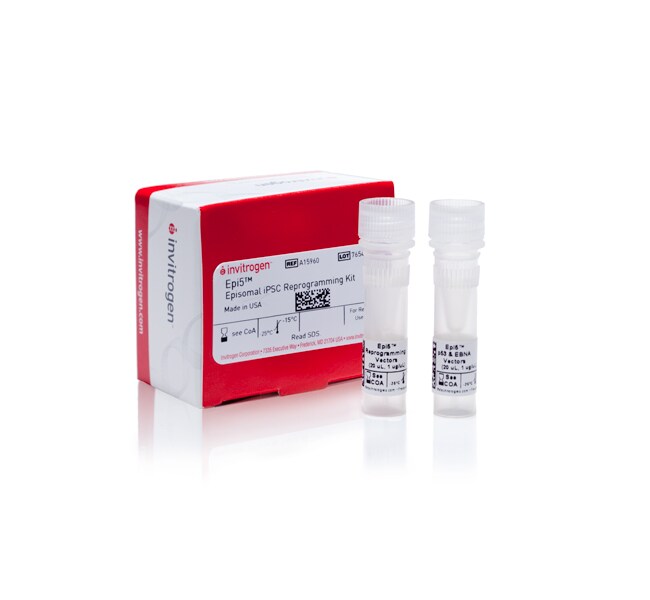
Epi5™ Episomal iPSC Reprogramming Kit
Das Epi5™ Episomal iPSC Umprogrammierungskit bietet eine anwenderfreundliche, hocheffiziente Reihe von 5 episomalen Vektoren, die von Dr. Okita im LaborWeitere Informationen
| Katalognummer | Menge |
|---|---|
| A15960 | 1 Kit |
Katalognummer A15960
Preis (EUR)
1.446,00
Each
Menge:
1 Kit
Preis (EUR)
1.446,00
Each
Das Epi5™ Episomal iPSC Umprogrammierungskit bietet eine anwenderfreundliche, hocheffiziente Reihe von 5 episomalen Vektoren, die von Dr. Okita im Labor von Professor Yamanaka am Zentrum für iPS-Zellforschung und -anwendung (CiRA) der Universität Kyoto entwickelt wurden. Dieses System produziert transgen- und virenfreie, humaninduzierte pluripotente Stammzellen (iPSCs) mit Wirkungsgraden im Bereich von 0,04 bis 0,3 %, je nachdem, welcher Zelltyp neu programmiert wird.
Das Epi™ Episomal iPSC Umprogrammierungskit bietet folgende Funktionen:
•Leicht anwendbar und hocheffizient: keine kleinen Moleküle erforderlich, und die zusätzliche p53-Suppression ermöglicht eine verbesserte iPSC-Generierung (1)
• Verwendbar für alle Stadien Ihrer Forschung an iPSC: Transgen- und Virus-freie Reprogrammierung ermöglicht die Nutzung in der Grundlagen- bis hin zur präklinischen Forschung
• Flexibilität bei Mediensystemen: verwendbar in Mediensystemen mit und ohne Feeder
Erzeugung von Transgen- und Virus-freien iPSCs
Episomale Vektoren sind ein vielfach beschriebenes System für die Erzeugung von Transgen- und Virus-freien iPSCs und damit einer Quelle von iPSCs für alle Stadien Ihrer Forschung an pluripotenten Stammzellen. Andere Reprogrammierungsmethoden wie das Lentivirus enthalten Transgene, die sich in das Wirtsgenom integrieren können und dadurch möglicherweise Störungen des Genoms oder unvorhersehbare Ergebnisse verursachen könnten.
Als oriP/EBNA1-Vektoren enthalten diese episomalen Vektoren 5 Umprogrammierungsfaktoren (Oct4, Sox2, Lin28, Klf4 und L-Myc) und replizieren extrachromosomal nur einmal pro Zellzyklus. Bei dieser Replikationsrate gehen die Episome mit einer Rate von etwa 5 % pro Zellgeneration verloren. Dieses System zeigt eine verbesserte iPSC-Generierung durch p53-Suppression, und die Aufnahme von L-Myc hat sich bei der Erzeugung menschlicher iPSC als potenter und spezifischer als c-Myc erwiesen (1).
Anwenderfreundlich es System
Dieses Kit mit 2 Fläschchen bietet das optimale System zur Umprogrammierung des episomalen Vektors und macht die Verwendung kleiner Moleküle im Umprogrammierungsmedium überflüssig. Die episomalen Vektoren werden durch Elektroporation in die Zelle eingeführt. Zur Elektroporation empfehlen wir die Verwendung des Neon™ Transfektionssystems, wodurch das Volumen und damit die Anzahl der Zellen, die für die Neuprogrammierung benötigt werden, flexibler gewählt werden kann.
Flexibilität bei der Auswahl von Mediensystemen
Das Epi5™ Episomal iPSC Umprogrammierungskit kann mit einer Vielzahl von Zelltypen und Mediensystemen verwendet werden. Protokolle für Fibroblasten und CD34+ Blutkörperchen sind als Umprogrammierung mit oder ohne Nährboden erhältlich.
1. Okita K, Matsumara Y, Sato Y, et al. Eine effizientere Methode zur Generierung integrationsfreier menschlicher iPS-Zellen. Nature Methods 8, 409-412, 2011.
Das Epi™ Episomal iPSC Umprogrammierungskit bietet folgende Funktionen:
•Leicht anwendbar und hocheffizient: keine kleinen Moleküle erforderlich, und die zusätzliche p53-Suppression ermöglicht eine verbesserte iPSC-Generierung (1)
• Verwendbar für alle Stadien Ihrer Forschung an iPSC: Transgen- und Virus-freie Reprogrammierung ermöglicht die Nutzung in der Grundlagen- bis hin zur präklinischen Forschung
• Flexibilität bei Mediensystemen: verwendbar in Mediensystemen mit und ohne Feeder
Erzeugung von Transgen- und Virus-freien iPSCs
Episomale Vektoren sind ein vielfach beschriebenes System für die Erzeugung von Transgen- und Virus-freien iPSCs und damit einer Quelle von iPSCs für alle Stadien Ihrer Forschung an pluripotenten Stammzellen. Andere Reprogrammierungsmethoden wie das Lentivirus enthalten Transgene, die sich in das Wirtsgenom integrieren können und dadurch möglicherweise Störungen des Genoms oder unvorhersehbare Ergebnisse verursachen könnten.
Als oriP/EBNA1-Vektoren enthalten diese episomalen Vektoren 5 Umprogrammierungsfaktoren (Oct4, Sox2, Lin28, Klf4 und L-Myc) und replizieren extrachromosomal nur einmal pro Zellzyklus. Bei dieser Replikationsrate gehen die Episome mit einer Rate von etwa 5 % pro Zellgeneration verloren. Dieses System zeigt eine verbesserte iPSC-Generierung durch p53-Suppression, und die Aufnahme von L-Myc hat sich bei der Erzeugung menschlicher iPSC als potenter und spezifischer als c-Myc erwiesen (1).
Anwenderfreundlich es System
Dieses Kit mit 2 Fläschchen bietet das optimale System zur Umprogrammierung des episomalen Vektors und macht die Verwendung kleiner Moleküle im Umprogrammierungsmedium überflüssig. Die episomalen Vektoren werden durch Elektroporation in die Zelle eingeführt. Zur Elektroporation empfehlen wir die Verwendung des Neon™ Transfektionssystems, wodurch das Volumen und damit die Anzahl der Zellen, die für die Neuprogrammierung benötigt werden, flexibler gewählt werden kann.
Flexibilität bei der Auswahl von Mediensystemen
Das Epi5™ Episomal iPSC Umprogrammierungskit kann mit einer Vielzahl von Zelltypen und Mediensystemen verwendet werden. Protokolle für Fibroblasten und CD34+ Blutkörperchen sind als Umprogrammierung mit oder ohne Nährboden erhältlich.
1. Okita K, Matsumara Y, Sato Y, et al. Eine effizientere Methode zur Generierung integrationsfreier menschlicher iPS-Zellen. Nature Methods 8, 409-412, 2011.
Nur für Forschungszwecke. Darf nicht für diagnostische Verfahren eingesetzt werden.
Specifications
KlonierungsmethodeKeine
LiefertypTransfektion
Zur Verwendung mit (Anwendung)Stammzellen-Engineering und -Reprogrammierung
Zur Verwendung mit (Geräte)Elektroporator, Neon Transfektionssystem
Hauptbedienfelderel
ProduktlinieEpi5
ProdukttypEpisomales iPSC Umprogrammierungskit
PromoterCAG
ProteinmarkierungKeine
Menge1 Kit
ReplikationsursprungpUC-Ursprung
Reporter-GenKeine
Selektionsmittel (eukaryotisch)Keine
VektorEBNA-OriP
Unit SizeEach
Inhalt und Lagerung
2 Röhrchen. Bei -5 bis -20 °C lagern.
Häufig gestellte Fragen (FAQ)
Can I use pen/strep or other antibiotics for episomal reprogramming of cells?
Can I reprogram mouse cells with the Epi5 Episomal iPSC Reprograming Kit (Cat. No. A15960)?
When generating iPSCs using the Epi5 Episomal iPSC Reprogramming Kit (Cat. No. A15960), how confluent should my cells be on the day of transfection?
How many reprogramming experiments can I perform with the Epi5 Episomal iPSC Reprogramming Kit (Cat. No. A15960)?
Which kits do you offer for stem cell reprogramming?
Zitierungen und Referenzen (2)
Zitierungen und Referenzen
Abstract
An optogenetic approach for assessing formation of neuronal connections in a co-culture system.
Journal:
PubMed ID:25742527
'Here we describe a protocol to generate a co-culture consisting of 2 different neuronal populations. Induced pluripotent stem cells (iPSCs) are reprogrammed from human fibroblasts using episomal vectors. Colonies of iPSCs can be observed 30 days after initiation of fibroblast reprogramming. Pluripotent colonies are manually picked and grown in neural
Generation of human iPSCs from cells of fibroblastic and epithelial origin by means of the oriP/EBNA-1 episomal reprogramming system.
Journal:
PubMed ID:26088261
The prospect of therapeutic applications of the induced pluripotent stem cells (iPSCs) is based on their ability to generate virtually any cell type present in human body. Generation of iPSCs from somatic cells has opened up new possibilities to investigate stem cell biology, to better understand pathophysiology of human diseases,