Search
 Elementsuche
 Struktursuche


Thermo Scientific Chemicals
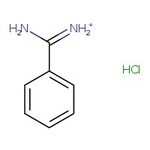
Benzamidinhydrochloridhydrat, 98 %, Wasser ca. 10–14 %, Thermo Scientific Chemicals
CAS: 206752-36-5 | C7H9ClN2 | 156.61 g/mol
Have Questions?
Ansicht ändern


Katalognummer A16002.22
auch als A16002-22 bezeichnet
Preis (EUR)
220,00
Each
Menge:
100 g
Preis (EUR)
220,00
Each
Chemikalien-Kennzeichnungen
CAS206752-36-5
IUPAC Namebenzenecarboximidamide hydrochloride
Molecular FormulaC7H9ClN2
InChI KeyLZCZIHQBSCVGRD-UHFFFAOYSA-N
SMILESCl.NC(=N)C1=CC=CC=C1
Mehr anzeigen
Specifications Datenblatt
DatenblattAppearance (Color)White
FormPowder
Assay (Titration ex Chloride)> 97.5 to <102.5% (Dry wt. basis)
Water Content (Karl Fischer Titration)<18.0%
Benzamidine hydrochloride hydrate is a reversible inhibitor of trypsin, trypsin-like enzymes, and serine proteases. It is a proteolytic inhibitor and apoptosis reagent.
This Thermo Scientific Chemicals brand product was originally part of the Alfa Aesar product portfolio. Some documentation and label information may refer to the legacy brand. The original Alfa Aesar product / item code or SKU reference has not changed as a part of the brand transition to Thermo Scientific Chemicals.
Anwendungen
Benzamidin-Hydrochloridhydrat ist ein reversibler Hemmstoff von Trypsin, trypsin-ähnlichen Enzymen, und Serinproteasen. Es handelt sich um einen proteolytischen Hemmstoff und ein Apoptose-Reagenz.
Löslichkeit
Wasserlöslich.
Hinweise
Halten Sie den Behälter dicht verschlossen. Kühl und trocken in einem gut versiegelten Behälter lagern. Nicht kompatibel mit Oxidationsmitteln. Es ist von Natur aus hygroskopisch.
Benzamidin-Hydrochloridhydrat ist ein reversibler Hemmstoff von Trypsin, trypsin-ähnlichen Enzymen, und Serinproteasen. Es handelt sich um einen proteolytischen Hemmstoff und ein Apoptose-Reagenz.
Löslichkeit
Wasserlöslich.
Hinweise
Halten Sie den Behälter dicht verschlossen. Kühl und trocken in einem gut versiegelten Behälter lagern. Nicht kompatibel mit Oxidationsmitteln. Es ist von Natur aus hygroskopisch.
RUO – Research Use Only
Allgemeine Referenzen:
- A Bini, J J Fenoglio Jr, R Mesa-Tejada, B Kudryk, K L Kaplan. Identification and distribution of fibrinogen, fibrin, and fibrin(ogen) degradation products in atherosclerosis. Use of monoclonal antibodies. Arteriosclerosis, Thrombosis, and Vascular Biology. 1989, 9 109-121.
- Frederick G. Bordwell, Guo Zhen Ji. Effects of structural changes on acidities and homolytic bond dissociation energies of the hydrogen-nitrogen bonds in amidines, carboxamides, and thiocarboxamides. J. Am. Chem. Soc. 1991, 113 (22), 8398-8401.