Search Thermo Fisher Scientific
 Elementsuche
 Struktursuche
Thermo Scientific Chemicals
Diphenyliodnium-Hexafluorphosphat, 98 %, Thermo Scientific Chemicals
Katalognummer: A17934.09
10 g, Each
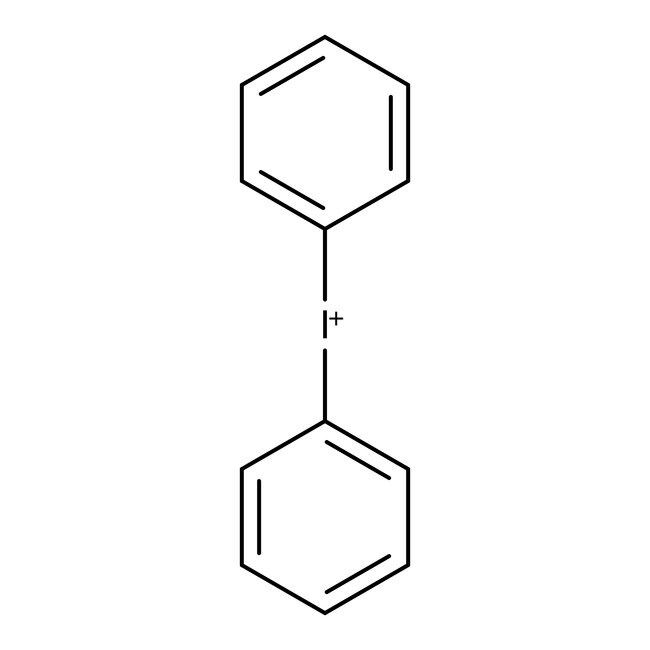


Thermo Scientific Chemicals
Diphenyliodnium-Hexafluorphosphat, 98 %, Thermo Scientific Chemicals
Katalognummer: A17934.09
10 g, Each
Menge
Chemikalien-Kennzeichnungen
CAS
58109-40-3
Spezifikationen
 Datenblatt
Appearance (Color)
White to pale cream
Melting Point (clear melt)
138-145?C
Form
Crystals or powder or crystalline powder
Elemental Analysis
Carbon: 32.98-34.67% (Theory: 33.83%)
Identification (FTIR)
Conforms
Beschreibung
Diphenyliodonium hexafluorophosphate is used as cationic photoinitiator and photoacid generator. It acts as a catalyst for the photochemical polymerization of various monomers. Further, it used as arylating reagent as well as an oxidant in organic synthesis.
This Thermo Scientific Chemicals brand product was originally part of the Alfa Aesar product portfolio. Some documentation and label information may refer to the legacy brand. The original Alfa Aesar product / item code or SKU reference has not changed as a part of the brand transition to Thermo Scientific Chemicals.
Anwendungen
Diphenyliodonium Hexafluorophosphat wird als kationischer Photoinitiator und Photosäure-Generator verwendet. Es dient als Katalysator für die photochemische Polymerisation verschiedener Monomere. Darüber hinaus wurde es als Arylierungsreagenz sowie als Oxidationsmittel in der organischen Synthese verwendet.
Löslichkeit
Löslich in Tetrahydrofuran, Ethylacetat, Methanol, Acetonitril, Dimethylformamid, Dimethylcarbonat. Schwerlöslich in Chloroform und Dichlormethan. Unlöslich in Pentanen, Hexanen, Toluol und Diethylether.
Hinweise
Lichtempfindlich und hygroskopisch. Nicht kompatibel mit starken Säuren.
Diphenyliodonium Hexafluorophosphat wird als kationischer Photoinitiator und Photosäure-Generator verwendet. Es dient als Katalysator für die photochemische Polymerisation verschiedener Monomere. Darüber hinaus wurde es als Arylierungsreagenz sowie als Oxidationsmittel in der organischen Synthese verwendet.
Löslichkeit
Löslich in Tetrahydrofuran, Ethylacetat, Methanol, Acetonitril, Dimethylformamid, Dimethylcarbonat. Schwerlöslich in Chloroform und Dichlormethan. Unlöslich in Pentanen, Hexanen, Toluol und Diethylether.
Hinweise
Lichtempfindlich und hygroskopisch. Nicht kompatibel mit starken Säuren.
RUO – Research Use Only
Abbildungen
Dokumente und Downloads
Zertifikate
Nach Chargennummer oder Teil-Chargennummer suchen
Häufig gestellte Fragen (FAQ)
Zitierungen und Referenzen
Search citations by name, author, journal title or abstract text
Sicherheit und Handhabung
Classification of the substance or mixture
CLP classification - Regulation(EC) No 1272/2008
Skin Corrosion/Irritation
Category 1
Serious Eye Damage/Eye Irritation
Category 1
Label Elements
Signal Word
Danger
Hazard Statements
H314 - Causes severe skin burns and eye damage
Precautionary Statements
P280 - Wear protective gloves/protective clothing/eye protection/face protection
P301 + P330 + P331 - IF SWALLOWED: Rinse mouth. Do NOT induce vomiting
P303 + P361 + P353 - IF ON SKIN (or hair): Take off immediately all contaminated clothing. Rinse skin with water or shower
P305 + P351 + P338 - IF IN EYES: Rinse cautiously with water for several minutes. Remove contact lenses, if present and easy to do. Continue rinsing
P310 - Immediately call a POISON CENTER or doctor/physician