Search


Zitierungen und Referenzen (8)
Thermo Scientific™
High Select™ Reagenzien für Phosphopeptid-Anreicherungs-Kits&
Die erweiterte High Select-Familie von Komplettkits unterstützt die Anreicherung phosphorylierter Peptide mit Fe-NTA- und TiO2-immobilisierten Harzen in Spin-Säulen-, Spitzen- und Magnet-Beads-Formaten, die für die Verwendung bei der MS-Analyse entwickelt wurden.
Have Questions?
Ansicht ändern

| Katalognummer | Menge | Produkttyp |
|---|---|---|
| A32992 | 30 Reaktionen | Phosphopeptid-Anreicherungskit |
| A32993 | 24 Reaktionen | Phosphopeptid-Anreicherungskit |
| 88302 | 30 Säulen | Säule |
| 88303 | 96 Spitzen | Spin-Spitze für Phosphopeptid-Anreicherung |
Katalognummer A32992
Preis (EUR)
443,65
온라인 행사
510,00Ersparnis 66,35 (13%)
Each
Menge:
30 Reaktionen
Produkttyp:
Phosphopeptid-Anreicherungskit
Preis (EUR)
443,65
온라인 행사
510,00Ersparnis 66,35 (13%)
Each
Die Massenspektrometrie (MS) ist ein Schlüsselwerkzeug für die Identifizierung von Stellen mit Proteinphosphorylation und die Quantifizierung von Veränderungen der Phosphorylation. Die MS-Analyse der Proteinphosphorylation ist jedoch aufgrund der niedrigen Stöchiometrie, der hohen Hydrophilität, der schlechten Ionisierung und der unvollständigen Fragmentierung von Phosphopeptiden eine Herausforderung. Durch die geringe relative Fülle von Phosphorylationsmodifikationen in komplexen Proteinproben ist eine Anreicherung für eine erfolgreiche MS-Analyse von Phosphopeptiden unerlässlich. Die High-Select Fe-NTA und TiO2 Phosphopeptid-Anreicherungskits ergänzen unsere Lyse-, Reduktions-, Alkylierungs- und Verdaureagenzien zusammen mit unseren C18-, Graphit-Spin- und High-pH-Umkehrphasen-Peptid-Fraktionierungssäulen, wodurch ein vollständiger Arbeitsablauf für die Phosphopeptid-Anreicherung zur Verfügung steht.
- Praktisch—vorformulierte Puffer für einfache Verwendung in Spin-Säulen (Fe-NTA und TiO2) oder magnetische Formate (Fe-NTA) für die parallele Verarbeitung mehrerer Proben
- Hohe Spezifität—ermöglicht die Rückgewinnung von Phosphopeptiden mit > 90 % Selektivität
- Hervorragende Rückgewinnung—reichert insgesamt eine größere Menge und mehr einzigartige Phosphopeptide als andere handelsübliche Harze an
- Hohe Rückgewinnung—Rückgewinnung von Peptiden mit einzelnen und mehreren Phosphorylierungsstellen
- Skalierbar—kompatibel mit Automatisierung, einschließlich der Verwendung von KingFisher Magnetpartikelprozessoren
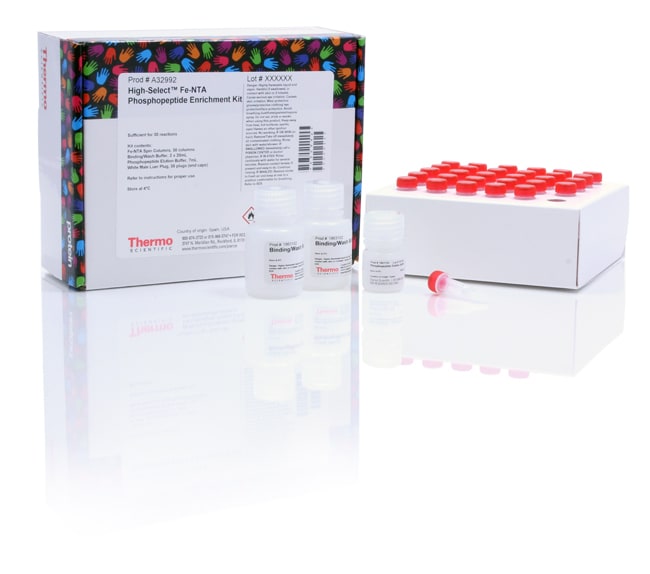
High-Select Fe-NTA Phosphopeptid-Anreicherungskitreichert Phosphopeptide aus komplexen Proben mit Eisen-Chelat-Harz in Spin-Säulen an. Jede Säule kann Phosphopeptide von 0,5 bis 5 mg Gesamtproteinverdau als Ausgangsprobe anreichern. Zusammen mit vorformulierten Puffern reichert das verbesserte und vereinfachte Verfahren in weniger als 45 Minuten bis zu 150 μg Phosphopeptide mit einer Selektivität von mehr als 90 % an.
Das High-Select TiO2 Phosphopeptid Anreicherungskit enthält 24 Titandioxid (TiO2)-Spin-Spitzen mit optimierten Puffern und erleichtert so die Vorbereitung von angereicherten Phosphopeptiden. Jede Säule kann Phosphopeptide von 0,5 bis 3 mg Gesamtproteinverdau als Ausgangsprobe anreichern. Die optimierten Puffer und das vereinfachte Verfahren machen Pyrrolidin im Elutionspuffer und die anschließende Reinigung mit Graphit-Spin-Säulen überflüssig. Die Verwendung dieses Kits führt zu einer Anreicherung von bis zu 150 μg Phosphopeptiden mit einer Selektivität von mehr als 90 %. TiO2 reichert eine einzigartige Gruppe von Phosphopeptiden an, die das High-Select Fe-NTA IMAC Phosphopeptide Anreicherungskit ergänzt.
Das High-Select Fe-NTA Magnetic Phosphopeptid Anreicherungskit reichert Phosphopeptide aus komplexen Proben mit Eisen-Chelat-Magnet-Agarose-Beads an. Jede Reaktion reicht aus, um in weniger als 45 Minuten 250–1000 μg Phosphopeptide aus 0,5–5 mg Gesamtproteinverdau als Ausgangsprobe anzureichern. Darüber hinaus kann das Kit auch zur Anreicherung von chemisch modifizierten Peptiden mit funktionellen Gruppen verwendet werden, die für immobilisierte Metallaffinitätschromatographie-Harze entwickelt wurden.
High Select Fe-NTA Magnetic Agarose wurde speziell für die Anreicherung von Phosphopeptiden und chemisch modifizierten Peptiden für die MS-Analyse entwickelt. Unsere nicht aggregierenden, mit Magnetit (Fe3O4) versehenen superparamagnetischen Beads bieten eine außergewöhnliche Gleichförmigkeit für hohe Leistung in manuellen und automatisierten Aufreinigungsanwendungen. Die Fe-NTA Magnetic Agarose ist separat erhältlich, was die experimentelle Konzeption flexibel macht.
Zur hochauflösenden Analyse der angereicherten Phosphopeptide wird als LC-Säule für die Nanospray Flex-Quelle die Acclaim PepMap 100 C18 LC-Säule empfohlen (Bestell- (Best.-Nr. 164942 oder 164939). Für die Quelle EASY-Spray wird die LC-Säule EASY-Spray C18 empfohlen (Best.- Nr. ES902 oder ES903). Die eigenständigen High Select Fe-NTA Magnetic Agarose-Beads bieten Flexibilität für Skalierung und Durchsatz und können sowohl in manuellen als auch automatisierten Plattformen, einschließlich KingFisher 96 und KingFisher Flex Magnetpartikelprozessoren, verwendet werden.
For Research Use Only. Not for use in diagnostic procedures.
Specifications
EndprodukttypPeptide
Zur Verwendung mit (Geräte)Mikrozentrifuge
Marker oder FarbstoffUnmarkiert
Menge30 Reaktionen
VersandbedingungNasseis
ArbeitsablaufschrittPeptidanreicherung
NachweisverfahrenMassenspektrometrie
FormatKit
ProduktlinieHigh Select
ProdukttypPhosphopeptid-Anreicherungskit
AusgangsmaterialProtease-verdautes Protein
Unit SizeEach
Inhalt und Lagerung
• Spin-Säulen (30)
• Weißer Luer-Stopfen (Endkappe) (30)
• Bindungs-/Waschpuffer (2 x 20 ml)
• Phosphopeptid-Elutionspuffer (7 ml)
• Weißer Luer-Stopfen (Endkappe) (30)
• Bindungs-/Waschpuffer (2 x 20 ml)
• Phosphopeptid-Elutionspuffer (7 ml)
Häufig gestellte Fragen (FAQ)
Should I desalt my peptide samples before enrichment using the High Select Phosphopeptide Enrichment Kits?
In the SMOAC protocol (https://www.thermofisher.com/blog/learning-at-the-bench/wp-content/uploads/sites/13/2024/10/High-SelectTM-SMOAC-Protocol.pdf), can I enrich with High-Select Fe-NTA kit first?
Why do you offer two phosphopeptide enrichment kits: the High-Select TiO2 kit (Cat. No. A32993) and the High-Select Fe-NTA kit (Cat. No. A32993)?
What are the differences between the old Fe-NTA kit (Cat. No. 88300) and the new High-Select Fe-NTA kit (Cat. No. A32992)?
What type of samples can I use with the High-Select Fe-NTA Phosphopeptide Enrichment Kit and High-Select Fe-NTA Magnetic Phosphopeptide Enrichment Kit?
Zitierungen und Referenzen (8)
Zitierungen und Referenzen
Abstract
Phosphorylation of pyruvate dehydrogenase inversely associates with neuronal activity.
Journal:Neuron
PubMed ID:38266644
For decades, the expression of immediate early genes (IEGs) such as FOS has been the most widely used molecular marker representing neuronal activation. However, to date, there is no equivalent surrogate available for the decrease of neuronal activity. Here, we developed an optogenetic-based biochemical screen in which population neural activities
Phosphoproteomics Reveals Selective Regulation of Signaling Pathways by Lysophosphatidic Acid Species in Macrophages.
Journal:Cells
PubMed ID:38786034
Lysophosphatidic acid (LPA) species, prevalent in the tumor microenvironment (TME), adversely impact various cancers. In ovarian cancer, the 18:0 and 20:4 LPA species are selectively associated with shorter relapse-free survival, indicating distinct effects on cellular signaling networks. Macrophages represent a cell type of high relevance in the TME, but the
Increase of Phosphoprotein Expressions in Amotosalen/UVA-Treated Platelet Concentrates.
Journal:Transfusion medicine and hemotherapy : offizielles Organ der Deutschen Gesellschaft fur Transfusionsmedizin und Immunhamatologie
PubMed ID:38584699
BACKGROUND: Pathogen inactivation treatment (PIT) has been shown to alter platelet function, phenotype, morphology and to induce a faster aging of platelet concentrates (PCs). Key pieces of information are still missing to understand the impacts of PITs at the cellular level. OBJECTIVES: This study investigated the impact of amotosalen/UVA on
TMTpro-18plex: The Expanded and Complete Set of TMTpro Reagents for Sample Multiplexing.
Journal:Journal of proteome research
PubMed ID:33900084
The development of the TMTpro-16plex series expanded the breadth of commercial isobaric tagging reagents by nearly 50% over classic TMT-11plex. In addition to the described 16plex reagents, the proline-based TMTpro molecule can accommodate two additional combinations of heavy carbon and nitrogen isotopes. Here, we introduce the final two labeling reagents,
Phosphoproteomic Profiling Reveals mTOR Signaling in Sustaining Macrophage Phagocytosis of Cancer Cells.
Journal:Cancers
PubMed ID:39766137
Background: Macrophage-mediated cancer cell phagocytosis has demonstrated considerable therapeutic potential. While the initiation of phagocytosis, facilitated by interactions between cancer cell surface signals and macrophage receptors, has been characterized, the mechanisms underlying its sustentation and attenuation post-initiation remain poorly understood. Methods: Through comprehensive phosphoproteomic profiling, we interrogated the temporal evolution