Search

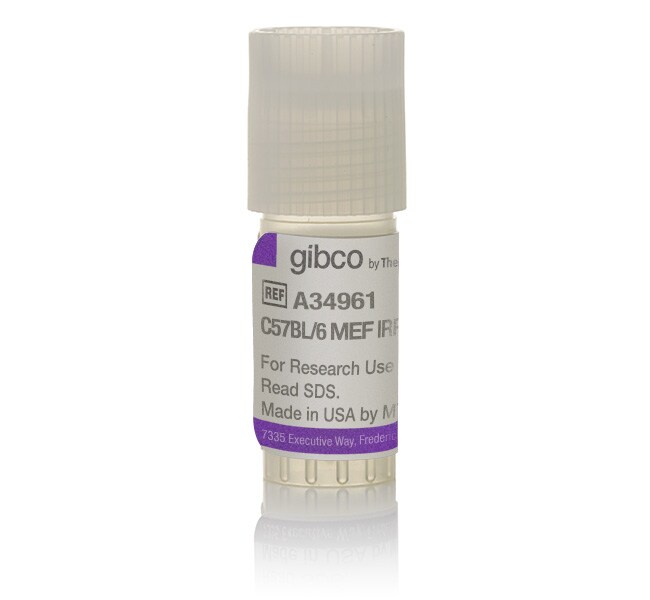
Gibco™
C57BL/6 Mouse Embryonic Fibroblasts, irradiated
Bestrahlte Gibco C57BL/6-Mausembryonen-Fibroblasten (MEFs) sind Feeder-Zellen, die die Kultivierung gesunder undifferenzierter embryonaler Stammzellen (ESCs) und induzierter pluripotenter Stammzellen (iPSC) unterstützen,Weitere Informationen
| Katalognummer | Anzahl Zellen |
|---|---|
| A34961 | 4 x 10⁶ Zellen |
Katalognummer A34961
Preis (EUR)
72,50
Each
Anzahl Zellen:
4 x 10⁶ Zellen
Preis (EUR)
72,50
Each
Bestrahlte Gibco C57BL/6-Mausembryonen-Fibroblasten (MEFs) sind Feeder-Zellen, die die Kultivierung gesunder undifferenzierter embryonaler Stammzellen (ESCs) und induzierter pluripotenter Stammzellen (iPSC) unterstützen, insbesondere Maus-ESCs/iPSCs. Hergestellt von MTI-GlobalStem und gleichwertig mit MTI-GlobalStem Kat. Nummern GSC-6002G und GSC-6202G. Diese MEF-Zellen werden von ingezüchteten C57BL/6-Mäusen isoliert, durch Bestrahlung mitotisch arretiert und getestet, um die Leistungsfähigkeit sicherzustellen und das Risiko einer Kontamination zu minimieren.
• Sparen Sie wertvolle Zeit mit bereits inaktivierten, gebrauchsfertigen MEFs
• Kultivieren Sie ESCs und iPSCs zuverlässig mit sorgfältig geprüften Feeder-Zellen
• Bieten Sie optimale Unterstützung für Maus-ESCs und -iPSCs
Sparen Sie Zeit mit gebrauchsfertigen MEFs
Mit bestrahlten C57BL MEFs sparen Sie Zeit und Mühe, sich um eine Tieranlage zu kümmern, langwierige, zeitraubende Sektionen durchzuführen und Zellen Tag für Tag, Woche für Woche zu expandieren und zu testen. Konzentrieren Sie sich mit diesen bereits inaktivierten, gebrauchsfertigen Zuführungen auf Ihre Forschung.
Kultivieren Sie mit sorgfältig geprüften Feeder-Zellen
Jede Charge bestrahlter C57BL/6 MEFs wird auf Bakterien, Pilze, Mykoplasmen und Maus-Pathogene getestet, um das Kontaminationsrisiko zu minimieren. Jede Charge wird außerdem auf ihre Funktionsfähigkeit nach dem Auftauen getestet (in der Regel mehr als 95 %) und auf ihre Fähigkeit, Maus- und humane ESCs zu unterstützen, um eine stabile und konsistente Leistung zu gewährleisten. Kultivieren Sie Ihre ESCs und iPSCs mit der Gewissheit, dass Sie sich auf diese hochwertigen Feeder-Zellen verlassen können.
Bieten Sie optimale Unterstützung für Maus-ESCs und -iPSCs
Wenngleich C57BL/6-MEFs auch humane ESCs und iPSCs unterstützen können, eignen sich diese Feeder-Zellen besonders gut für die Kultivierung von Maus-ESCs und -iPSCs und erzielen bessere Ergebnisse im Vergleich zu CF1 und ICR-Stamm MEFs.
For Research Use Only. Not for use in diagnostic procedures.
Specifications
SpenderquelleGepoolte Proben
Anzahl Zellen4 x 106 Zellen
Menge4 x 106 cells
VersandbedingungAuf Trockeneis geliefert.
Ageembryonisch
ZelltypFütterzelle, Fibroblastenzelle Mausembryo
FormKryokonserviert
SpeziesMaus
Unit SizeEach
Inhalt und Lagerung
Kryokonservierte embryonale Mausfibroblasten
Lagerung in Flüssigstickstoff.
Lagerung in Flüssigstickstoff.