Search


Zitierungen und Referenzen (2)
Gibco™
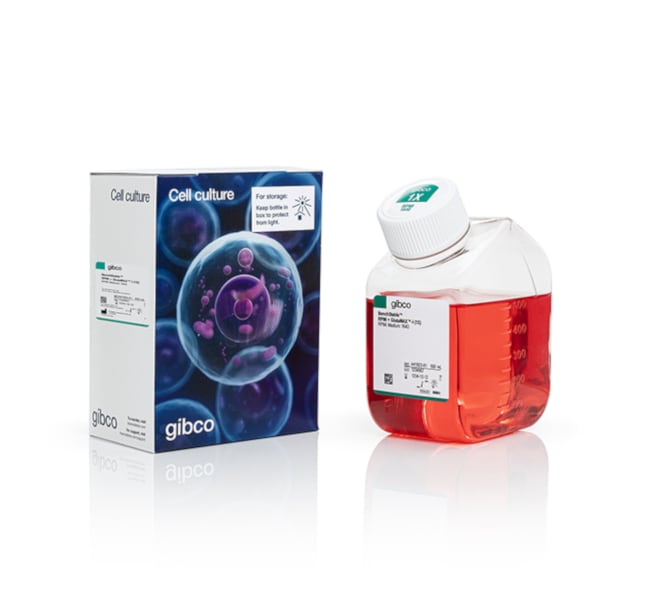
BenchStable™ RPMI 1640

Gibco RPMI 1640 Medium (Roswell Park Memorial Institute 1640 Medium) wurde ursprünglich zur Züchtung leukämischer Humanzellen in Suspensionen und alsWeitere Informationen
Have Questions?
Ansicht ändern

| Katalognummer | Menge |
|---|---|
| A4192301 | 500 mL |
| A4192302 | 10 x 500 mL |
Katalognummer A4192301
Preis (EUR)
47,42
Each
Menge:
500 mL
Preis (EUR)
47,42
Each
Gibco RPMI 1640 Medium (Roswell Park Memorial Institute 1640 Medium) wurde ursprünglich zur Züchtung leukämischer Humanzellen in Suspensionen und als Monolayer entwickelt. RPMI 1640 Medium wurde seitdem für eine Reihe von Säugetierzellen wie HeLa, Jurkat, MCF-7, PC12, PBMC, Astrozyten und Karzinome als geeignet eingestuft. Wir führen verschiedene RPMI 1640-Modifikationen für eine Vielzahl von Zellkulturanwendungen. Finden Sie die richtige Formulierung mithilfe des Medien-Auswahlwerkzeuges.
BenchStable RPMI 1640 Medium wurde für die Lagerung bei Raumtemperatur entwickelt und unterstützt gleichzeitig die Zellproliferation und maximale Zelldichten, die mit dem herkömmlichen RPMI 1640 Medium vergleichbar sind, wenn es mit ≥10%igem fötalem Kälberserum (FBS) ergänzt wird.
Dieses RPMI 1640 Medium wird wie folgt modifiziert:
• Optimiert für Stabilität bei Raumtemperatur
• Mit GlutaMAX, Phenolrot
• Ohne HEPES
Mit BenchStable RPMI 1640 Medium
RPMI 1640 Medium unterscheidet sich eindeutig von anderen Medien, da es das Reduktionsmittel Glutathion sowie hohe Konzentrationen an Vitaminen enthält. RPMI 1640 Medium enthält Biotin, Vitamin B12 und PABA, die nicht in Eagle's Minimal Essential Medium bzw. Dulbecco's Modified Eagle Medium enthalten sind. Darüber hinaus sind die Vitamine Inositol und Cholin in sehr hohen Konzentrationen enthalten. RPMI 1640 Medium nutzt einen Natriumbikarbonatpuffer (2,0 g/l) und erfordert daher zur Aufrechterhaltung des physiologischen pH-Werts eine 5 bis 10%ige CO2-Umgebungsatmosphäre. RPMI 1640 Medium mit GlutaMAX Supplement ist ein anwenderfreundliches Nährmedium, das die Ansammlung von giftigem Ammoniak minimiert und Lebensfähigkeit und Wachstum der Zellen verbessert. BenchStable RPMI 1640 Medium enthält keine Proteine, Lipide oder Wachstumsfaktoren und erfordert daher eine Ergänzung mit ≥10%igem fötalem Kälberserum (FBS).
cGMP-Herstellungs- und Qualitätssystem
Gibco BenchStable Medium wird in einer cGMP-konformen Einrichtung in Grand Island, New York, hergestellt. Die Einrichtung ist bei der US-Arzneimittelbehörde FDA als Hersteller medizinischer Geräte registriert und nach ISO 13485 zertifiziert.
Weitere Informationen zu Gibco BenchStable Medien finden Sie unter thermofisher.com/benchstable.
BenchStable RPMI 1640 Medium wurde für die Lagerung bei Raumtemperatur entwickelt und unterstützt gleichzeitig die Zellproliferation und maximale Zelldichten, die mit dem herkömmlichen RPMI 1640 Medium vergleichbar sind, wenn es mit ≥10%igem fötalem Kälberserum (FBS) ergänzt wird.
Dieses RPMI 1640 Medium wird wie folgt modifiziert:
• Optimiert für Stabilität bei Raumtemperatur
• Mit GlutaMAX, Phenolrot
• Ohne HEPES
Mit BenchStable RPMI 1640 Medium
RPMI 1640 Medium unterscheidet sich eindeutig von anderen Medien, da es das Reduktionsmittel Glutathion sowie hohe Konzentrationen an Vitaminen enthält. RPMI 1640 Medium enthält Biotin, Vitamin B12 und PABA, die nicht in Eagle's Minimal Essential Medium bzw. Dulbecco's Modified Eagle Medium enthalten sind. Darüber hinaus sind die Vitamine Inositol und Cholin in sehr hohen Konzentrationen enthalten. RPMI 1640 Medium nutzt einen Natriumbikarbonatpuffer (2,0 g/l) und erfordert daher zur Aufrechterhaltung des physiologischen pH-Werts eine 5 bis 10%ige CO2-Umgebungsatmosphäre. RPMI 1640 Medium mit GlutaMAX Supplement ist ein anwenderfreundliches Nährmedium, das die Ansammlung von giftigem Ammoniak minimiert und Lebensfähigkeit und Wachstum der Zellen verbessert. BenchStable RPMI 1640 Medium enthält keine Proteine, Lipide oder Wachstumsfaktoren und erfordert daher eine Ergänzung mit ≥10%igem fötalem Kälberserum (FBS).
cGMP-Herstellungs- und Qualitätssystem
Gibco BenchStable Medium wird in einer cGMP-konformen Einrichtung in Grand Island, New York, hergestellt. Die Einrichtung ist bei der US-Arzneimittelbehörde FDA als Hersteller medizinischer Geräte registriert und nach ISO 13485 zertifiziert.
Weitere Informationen zu Gibco BenchStable Medien finden Sie unter thermofisher.com/benchstable.
Nur für Forschungszwecke. Nicht zur Verwendung bei diagnostischen Verfahren.
Specifications
ZelllinieHeLa, Jurkat, MCF-7, PC-12, PBMC, Astrozyten und Karzinome
Konzentration1 X
Umweltfreundliche EigenschaftenEnergieeffizient, weniger Ressourcenverbrauch, nachhaltige Verpackung
Fertigungsqualität, HerstellungsqualitätcGMP-compliant under the ISO 9001: 2015 standard
ProduktlinieBenchStable
ProdukttypRPMI 1640 Medium (Roswell Park Memorial Institute 1640 Medium)
Menge500 mL
Haltbarkeit12 Monate ab Herstellungsdatum
VersandbedingungRaumtemperatur
KlassifikationOhne Stoffe tierischen Ursprungs
FormFlüssig
Serum LevelStandard-Serumzugabe
SterilitätSteril gefiltert
Mit AdditivenGeringe Glukosekonzentration, Phenolrot, Phenol Red
Ohne AdditiveKeine HEPES, Ohne Natriumpyruvat
Unit SizeEach
Inhalt und Lagerung
Bei Raumtemperatur lagern. Vor Licht schützen.
Häufig gestellte Fragen (FAQ)
Is it okay if I supplement BenchStable media with more than 10% FBS?
Is it okay if I supplement BenchStable media with 5% FBS?
Which cell lines have been tested in BenchStable media?
Do you offer BenchStable media without phenol red?
Will the shelf-life of BenchStable media improve if stored at lower temperature (2-8 degrees C)?
Zitierungen und Referenzen (2)
Zitierungen und Referenzen
Abstract
Non-viral-mediated gene transfer of OX40 ligand for tumor immunotherapy.
Journal:Frontiers in immunology
PubMed ID:39007148
BACKGROUND: Immune checkpoint blockade (ICB) is rapidly becoming a standard of care in the treatment of many cancer types. However, the subset of patients who respond to this type of therapy is limited. Another way to promote antitumoral immunity is the use of immunostimulatory molecules, such as cytokines or T
FELICX: A robust nucleic acid detection method using flap endonuclease and CRISPR-Cas12.
Journal:Biosensors & bioelectronics
PubMed ID:36527830