Search


Zitierungen und Referenzen (41)
Invitrogen™
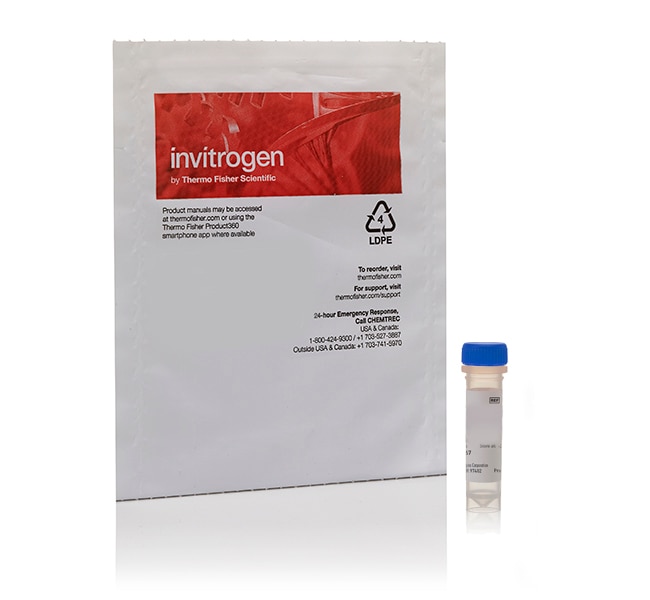
CellLight™ Early Endosomes-GFP, BacMam 2.0
CellLight™ Early Endosomes-GFP, BacMam 2.0 bietet eine einfache Methode zur Markierung früher Endosome in lebenden Zellen mit grün fluoreszierendem ProteinWeitere Informationen
| Katalognummer | Menge |
|---|---|
| C10586 | 1 Röhrchen |
Katalognummer C10586
Preis (EUR)
710,00
Each
Menge:
1 Röhrchen
Preis (EUR)
710,00
Each
CellLight™ Early Endosomes-GFP, BacMam 2.0 bietet eine einfache Methode zur Markierung früher Endosome in lebenden Zellen mit grün fluoreszierendem Protein (GFP). Geben Sie das Reagenz einfach zu Ihren Zellen, inkubieren Sie über Nacht, und am nächsten Morgen sind die Zellen bereit für die Analyse.
Sie möchten andere Zellstrukturen markieren? Erfahren Sie mehr über CellLight™ fluoreszierende Proteinmarkierungswerkzeuge
Dieses gebrauchsfertige Konstrukt wird mithilfe der BacMam 2.0-Technologie in Zellen transfiziert, wo es mit Rab5a fusioniertes GFP exprimiert. Sie können das Verhalten von GFP früher Endosomen in lebenden Zellen unabhängig vom pH-Wert der Organelle beobachten und mit mehreren Tracking- oder Tracing-Farbstoffen beschriften, um dynamische zelluläre Prozesse abzubilden.
Zellen, die CellLight™ Konstrukte exprimieren, können auch mit Formaldehyd für die Multiplex-Bildgebung mit immunzytochemischen Verfahren fixiert werden.
CellLight™ Technologie ist:
• Schnell und praktisch: Einfach CellLight™ Reagenz in Ihre Zellen geben, über Nacht inkubieren und bildgebendes Verfahren nutzen — oder gefrorene, assay-fähige Zellen für den späteren Gebrauch lagern
• Hocheffizient: Bis zu 90 % Transduktion einer Vielzahl von Säugetierzelllinien, einschließlich Primärzellen, Stammzellen und Neuronen
• Flexibel: Ko-transduzieren Sie von mehr als einem BacMam Reagenz für Multiplex-Experimente oder Co-Lokalisationsstudien; strenge Kontrolle der Expressionsniveaus durch einfaches Variieren der Dosis
• Weniger toxisch: CellLight Reagenzien™ sind nicht-replizierend in Säugetierzellen und eignen sich für die Handhabung auf Biosicherheitsstufe (BSL) 1
von BacMam Technology
CellLight™ Early Endosomes-GFP, BacMam 2.0, ist ein Fusionskonstrukt aus Rab5a und emGFP, das genaues und spezifisches Targeting für zelluläre frühe Endosome bietet. Dieses Verschmelzungskonstrukt ist im Insektenvirus Baculovirus verpackt, das in menschlichen Zellen nicht repliziert wird und in den meisten Labors als sicher für Bioschutzstufe (BSL) 1 ausgewiesen ist. Die BacMam Technologie sorgt dafür, dass die meisten Säugetierzelltypen mit hoher Effizienz und minimaler Toxizität transduziert, bzw. transfiziert werden. Diese transiente Transfektion kann nach einer über Nacht erfolgten Inkubation bis zu fünf Tage lang nachgewiesen werden – genügend Zeit für die meisten dynamischen Zellanalysen. Wie jede Transfektions-/Transduktionstechnik transfiziert/transduziert die BacMam Methode nicht alle Zellen mit der gleichen Effizienz, wodurch sie für Zellpopulationsuntersuchungen oder automatisierte Bildgebung/Zellzählung schlecht geeignet ist. CellLight™ Reagenzien sind ideal für Experimente geeignet, bei denen eine zelluläre oder subzelluläre Co-Lokalisierung erforderlich ist, oder für Zellfunktionsuntersuchungen, die eine spezielle Auflösung benötigen.
Sie möchten andere Zellstrukturen markieren? Erfahren Sie mehr über CellLight™ fluoreszierende Proteinmarkierungswerkzeuge
Dieses gebrauchsfertige Konstrukt wird mithilfe der BacMam 2.0-Technologie in Zellen transfiziert, wo es mit Rab5a fusioniertes GFP exprimiert. Sie können das Verhalten von GFP früher Endosomen in lebenden Zellen unabhängig vom pH-Wert der Organelle beobachten und mit mehreren Tracking- oder Tracing-Farbstoffen beschriften, um dynamische zelluläre Prozesse abzubilden.
Zellen, die CellLight™ Konstrukte exprimieren, können auch mit Formaldehyd für die Multiplex-Bildgebung mit immunzytochemischen Verfahren fixiert werden.
CellLight™ Technologie ist:
• Schnell und praktisch: Einfach CellLight™ Reagenz in Ihre Zellen geben, über Nacht inkubieren und bildgebendes Verfahren nutzen — oder gefrorene, assay-fähige Zellen für den späteren Gebrauch lagern
• Hocheffizient: Bis zu 90 % Transduktion einer Vielzahl von Säugetierzelllinien, einschließlich Primärzellen, Stammzellen und Neuronen
• Flexibel: Ko-transduzieren Sie von mehr als einem BacMam Reagenz für Multiplex-Experimente oder Co-Lokalisationsstudien; strenge Kontrolle der Expressionsniveaus durch einfaches Variieren der Dosis
• Weniger toxisch: CellLight Reagenzien™ sind nicht-replizierend in Säugetierzellen und eignen sich für die Handhabung auf Biosicherheitsstufe (BSL) 1
von BacMam Technology
CellLight™ Early Endosomes-GFP, BacMam 2.0, ist ein Fusionskonstrukt aus Rab5a und emGFP, das genaues und spezifisches Targeting für zelluläre frühe Endosome bietet. Dieses Verschmelzungskonstrukt ist im Insektenvirus Baculovirus verpackt, das in menschlichen Zellen nicht repliziert wird und in den meisten Labors als sicher für Bioschutzstufe (BSL) 1 ausgewiesen ist. Die BacMam Technologie sorgt dafür, dass die meisten Säugetierzelltypen mit hoher Effizienz und minimaler Toxizität transduziert, bzw. transfiziert werden. Diese transiente Transfektion kann nach einer über Nacht erfolgten Inkubation bis zu fünf Tage lang nachgewiesen werden – genügend Zeit für die meisten dynamischen Zellanalysen. Wie jede Transfektions-/Transduktionstechnik transfiziert/transduziert die BacMam Methode nicht alle Zellen mit der gleichen Effizienz, wodurch sie für Zellpopulationsuntersuchungen oder automatisierte Bildgebung/Zellzählung schlecht geeignet ist. CellLight™ Reagenzien sind ideal für Experimente geeignet, bei denen eine zelluläre oder subzelluläre Co-Lokalisierung erforderlich ist, oder für Zellfunktionsuntersuchungen, die eine spezielle Auflösung benötigen.
Nur für Forschungszwecke. Nicht zur Verwendung bei diagnostischen Verfahren.
Specifications
FarbeGrün
NachweisverfahrenFluoreszent
FarbstofftypGFP (EmGFP)
EmissionSichtbar
Anregungswellenlängenbereich488⁄510
Zur Verwendung mit (Geräte)Konfokalmikroskop, Fluoreszenzmikroskop
FormFlüssig
ProduktlinieCellLight
Menge1 Röhrchen
VersandbedingungNasseis
VerfahrenFluoreszenzintensitätsmessung
MarkertypFluoreszenzprotein
ProdukttypEndosome
Sub Cellular LocalizationEndosome
Unit SizeEach
Inhalt und Lagerung
Bei 2-6 °C lagern, vor Licht schützen. Nicht einfrieren.
Häufig gestellte Fragen (FAQ)
How can I increase the transduction efficiency with the BacMam 2.0 reagents such as the the CellLight and Premo products?
Is there any way to preserve the CellLights labeling beyond 5 days?
Are the CellLights products toxic to cells?
For how long will the CellLights products label my cells?
What cell types can the CellLights products be used with?
Zitierungen und Referenzen (41)
Zitierungen und Referenzen
Abstract
Identification and Characterization of Receptor-Specific Peptides for siRNA Delivery.
Journal:ACS Nano
PubMed ID:22909216
Tumor-targeted delivery of siRNA remains a major barrier in fully realizing the therapeutic potential of RNA interference. While cell-penetrating peptides (CPP) are promising siRNA carrier candidates, they are universal internalizers that lack cell-type specificity. Herein, we design and screen a library of tandem tumor-targeting and cell-penetrating peptides that condense siRNA
Targeted Polymersome Delivery of siRNA Induces Cell Death of Breast Cancer Cells Dependent upon Orai3 Protein Expression.
Journal:Langmuir
PubMed ID:22827285
Polymersomes, polymeric vesicles that self-assemble in aqueous solutions from block copolymers, have been avidly investigated in recent years as potential drug delivery agents. Past work has highlighted peptide-functionalized polymersomes as a highly promising targeted delivery system. However, few reports have investigated the ability of polymersomes to operate as gene delivery
Cell-permeable gomesin peptide promotes cell death by intracellular Ca(2+) overload.
Journal:Mol Pharm
PubMed ID:22873645
In recent years, the antitumoral activity of antimicrobial peptides (AMPs) has been the goal of many research studies. Among AMPs, gomesin (Gm) displays antitumor activity by unknown mechanisms. Herein, we studied the cytotoxicity of Gm in the Chinese hamster ovary (CHO) cell line. Furthermore, we investigated the temporal ordering of
Tear-mediated delivery of nanoparticles through transcytosis of the lacrimal gland.
Journal:J Control Release
PubMed ID:25523518
Rapid clearance from the tears presents a formidable obstacle to the delivery of peptide drugs to the eye surface. This impedes therapies for ocular infections, wound healing, and dry-eye disease that affect the vision of millions worldwide. To overcome this challenge, this manuscript explores a novel strategy to reach the
A Rab11a-enriched subapical membrane compartment regulates a cytoskeleton-dependent transcytotic pathway in secretory epithelial cells of the lacrimal gland.
Journal:J Cell Sci
PubMed ID:21984810
'Despite observations that the lacrimal gland has been identified as the principal source of dimeric immunoglobulin A (dIgA) in tears, the mechanism used by lacrimal gland acinar cells (LGACs) to transcytose dIgA produced by interstitial plasma cells is not well-characterized. This study identifies a transcytotic pathway in LGACs regulated by