Search


Zitierungen und Referenzen (6)
Invitrogen™
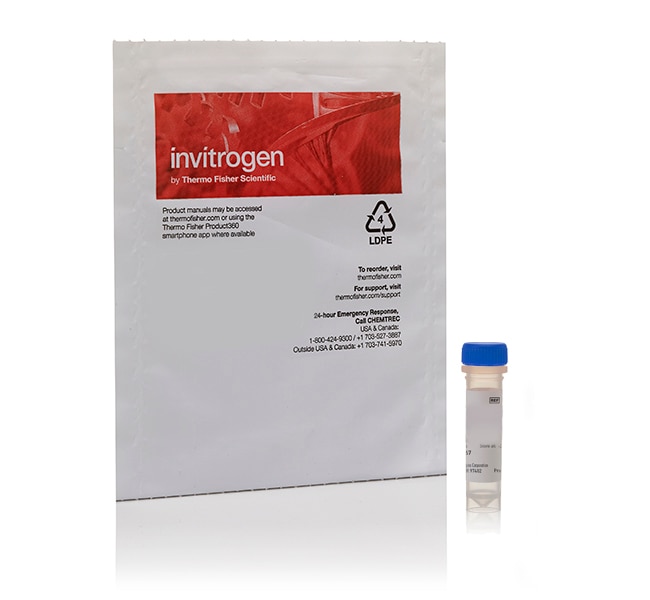
CellLight™ Plasma Membrane-CFP, BacMam 2.0
CellLight™ Plasmamembran-CFP, BacMam 2.0 bietet eine einfache Methode zur Markierung der Plasmamembran in lebenden Zellen mit cyanfarben fluoreszierendem Protein (CFP).Weitere Informationen
| Katalognummer | Menge |
|---|---|
| C10606 | 1 Röhrchen, 1 Röhrchen |
Katalognummer C10606
Preis (EUR)
692,00
Each
Menge:
1 Röhrchen, 1 Röhrchen
Preis (EUR)
692,00
Each
CellLight™ Plasmamembran-CFP, BacMam 2.0 bietet eine einfache Methode zur Markierung der Plasmamembran in lebenden Zellen mit cyanfarben fluoreszierendem Protein (CFP). Geben Sie das Reagenz einfach zu Ihren Zellen, inkubieren Sie über Nacht, und am nächsten Morgen sind die Zellen bereit für die Analyse.
Sie möchten andere Zellstrukturen markieren? Erfahren Sie mehr über CellLight™ fluoreszierende Proteinmarkierungswerkzeuge
Dieses gebrauchsfertige Konstrukt wird mithilfe der BacMam 2.0-Technologie in Zellen transfiziert, wo es CFP exprimiert, das mit Myristloyations-/Palmitoylationsseuqenz von Lck-Tyrosinkinase fusioniert ist. Sie können das Verhalten von Plasmamembran-CFP in lebenden Zellen ohne Färbung interner Membranen beobachten und mit mehreren Tracking- oder Tracing-Farbstoffen verwenden, um dynamische zelluläre Prozesse abzubilden.
Zellen, die CellLight™ Konstrukte exprimieren, können auch mit Formaldehyd für die Multiplex-Bildgebung mit immunzytochemischen Verfahren fixiert werden.
CellLight™ Technologie ist:
• Schnell und praktisch: Einfach CellLight™ Reagenz in Ihre Zellen geben, über Nacht inkubieren und bildgebendes Verfahren nutzen — oder gefrorene, assay-fähige Zellen für den späteren Gebrauch lagern
• Hocheffizient: Bis zu 90 % Transduktion einer Vielzahl von Säugetierzelllinien, einschließlich Primärzellen, Stammzellen und Neuronen
• Flexibel: Ko-transduzieren Sie von mehr als einem BacMam Reagenz für Multiplex-Experimente oder Co-Lokalisationsstudien; strenge Kontrolle der Expressionsniveaus durch einfaches Variieren der Dosis
• Weniger toxisch: CellLight Reagenzien™ sind nicht-replizierend in Säugetierzellen und eignen sich für die Biosicherheitsstufe (BSL) 1 BacMam
Technology
CellLight™ Plasmamembran-CFP, BacMam 2.0, ist ein Fusionskonstrukt der Myristoylations-/Palmitoylationssequenz von Lck-Tyrosinkinase und CFP, das genaues und spezifisches Targeting für zelluläre Plasmamembran-CFP bietet. Dieses Verschmelzungskonstrukt ist im Insektenvirus Baculovirus verpackt, das in menschlichen Zellen nicht repliziert wird und in den meisten Labors als sicher für Bioschutzstufe (BSL) 1 ausgewiesen ist. Die BacMam Technologie sorgt dafür, dass die meisten Säugetierzelltypen mit hoher Effizienz und minimaler Toxizität transduziert, bzw. transfiziert werden. Diese transiente Transfektion kann nach einer über Nacht erfolgten Inkubation bis zu fünf Tage lang nachgewiesen werden – genügend Zeit für die meisten dynamischen Zellanalysen. Wie jede Transfektions-/Transduktionstechnik transfiziert/transduziert die BacMam Methode nicht alle Zellen mit der gleichen Effizienz, wodurch sie für Zellpopulationsuntersuchungen oder automatisierte Bildgebung/Zellzählung schlecht geeignet ist. CellLight™ Reagenzien sind ideal für Experimente geeignet, bei denen eine zelluläre oder subzelluläre Co-Lokalisierung erforderlich ist, oder für Zellfunktionsuntersuchungen, die eine spezielle Auflösung benötigen.
Sie möchten andere Zellstrukturen markieren? Erfahren Sie mehr über CellLight™ fluoreszierende Proteinmarkierungswerkzeuge
Dieses gebrauchsfertige Konstrukt wird mithilfe der BacMam 2.0-Technologie in Zellen transfiziert, wo es CFP exprimiert, das mit Myristloyations-/Palmitoylationsseuqenz von Lck-Tyrosinkinase fusioniert ist. Sie können das Verhalten von Plasmamembran-CFP in lebenden Zellen ohne Färbung interner Membranen beobachten und mit mehreren Tracking- oder Tracing-Farbstoffen verwenden, um dynamische zelluläre Prozesse abzubilden.
Zellen, die CellLight™ Konstrukte exprimieren, können auch mit Formaldehyd für die Multiplex-Bildgebung mit immunzytochemischen Verfahren fixiert werden.
CellLight™ Technologie ist:
• Schnell und praktisch: Einfach CellLight™ Reagenz in Ihre Zellen geben, über Nacht inkubieren und bildgebendes Verfahren nutzen — oder gefrorene, assay-fähige Zellen für den späteren Gebrauch lagern
• Hocheffizient: Bis zu 90 % Transduktion einer Vielzahl von Säugetierzelllinien, einschließlich Primärzellen, Stammzellen und Neuronen
• Flexibel: Ko-transduzieren Sie von mehr als einem BacMam Reagenz für Multiplex-Experimente oder Co-Lokalisationsstudien; strenge Kontrolle der Expressionsniveaus durch einfaches Variieren der Dosis
• Weniger toxisch: CellLight Reagenzien™ sind nicht-replizierend in Säugetierzellen und eignen sich für die Biosicherheitsstufe (BSL) 1 BacMam
Technology
CellLight™ Plasmamembran-CFP, BacMam 2.0, ist ein Fusionskonstrukt der Myristoylations-/Palmitoylationssequenz von Lck-Tyrosinkinase und CFP, das genaues und spezifisches Targeting für zelluläre Plasmamembran-CFP bietet. Dieses Verschmelzungskonstrukt ist im Insektenvirus Baculovirus verpackt, das in menschlichen Zellen nicht repliziert wird und in den meisten Labors als sicher für Bioschutzstufe (BSL) 1 ausgewiesen ist. Die BacMam Technologie sorgt dafür, dass die meisten Säugetierzelltypen mit hoher Effizienz und minimaler Toxizität transduziert, bzw. transfiziert werden. Diese transiente Transfektion kann nach einer über Nacht erfolgten Inkubation bis zu fünf Tage lang nachgewiesen werden – genügend Zeit für die meisten dynamischen Zellanalysen. Wie jede Transfektions-/Transduktionstechnik transfiziert/transduziert die BacMam Methode nicht alle Zellen mit der gleichen Effizienz, wodurch sie für Zellpopulationsuntersuchungen oder automatisierte Bildgebung/Zellzählung schlecht geeignet ist. CellLight™ Reagenzien sind ideal für Experimente geeignet, bei denen eine zelluläre oder subzelluläre Co-Lokalisierung erforderlich ist, oder für Zellfunktionsuntersuchungen, die eine spezielle Auflösung benötigen.
Nur für Forschungszwecke. Nicht zur Verwendung bei diagnostischen Verfahren.
Specifications
FarbeBlau, Blau
NachweisverfahrenFluoreszent, Fluoreszent
FarbstofftypCFP (cyan-fluoreszierendes Protein)
EmissionSichtbar
Anregungswellenlängenbereich435⁄485
Zur Verwendung mit (Geräte)Konfokalmikroskop, Fluoreszenzmikroskop, Konfokalmikroskop, Fluoreszenzmikroskop
FormFlüssig
ProduktlinieCellLight
Menge1 Röhrchen, 1 Röhrchen
VersandbedingungNasses Eis, Nasseis
VerfahrenFluoreszenzintensitätsmessung
MarkertypFluoreszenzprotein
ProdukttypPlasmamembranfärbemittel
SubCellular LocalizationPlasmamembran
Unit SizeEach
Inhalt und Lagerung
Bei 2-6 °C lagern, vor Licht schützen. Nicht einfrieren.
Häufig gestellte Fragen (FAQ)
How can I increase the transduction efficiency with the BacMam 2.0 reagents such as the the CellLight and Premo products?
Is there any way to preserve the CellLights labeling beyond 5 days?
Are the CellLights products toxic to cells?
For how long will the CellLights products label my cells?
What cell types can the CellLights products be used with?
Zitierungen und Referenzen (6)
Zitierungen und Referenzen
Abstract
Relocalization of junctional adhesion molecule A during inflammatory stimulation of brain endothelial cells.
Journal:Mol Cell Biol
PubMed ID:22733993
'Junctional adhesion molecule A (JAM-A) is a unique tight junction (TJ) transmembrane protein that under basal conditions maintains endothelial cell-cell interactions but under inflammatory conditions acts as a leukocyte adhesion molecule. This study investigates the fate of JAM-A during inflammatory TJ complex remodeling and paracellular route formation in brain endothelial
Improved throughput traction microscopy reveals pivotal role for matrix stiffness in fibroblast contractility and TGF-ß responsiveness.
Journal:Am J Physiol Lung Cell Mol Physiol
PubMed ID:22659883
'Lung fibroblast functions such as matrix remodeling and activation of latent transforming growth factor-ß1 (TGF-ß1) are associated with expression of the myofibroblast phenotype and are directly linked to fibroblast capacity to generate force and deform the extracellular matrix. However, the study of fibroblast force-generating capacities through methods such as traction
Exosomes reflect the hypoxic status of glioma cells and mediate hypoxia-dependent activation of vascular cells during tumor development.
Journal:Proc Natl Acad Sci U S A
PubMed ID:23589885
'Hypoxia, or low oxygen tension, is a major regulator of tumor development and aggressiveness. However, how cancer cells adapt to hypoxia and communicate with their surrounding microenvironment during tumor development remain important questions. Here, we show that secreted vesicles with exosome characteristics mediate hypoxia-dependent intercellular signaling of the highly malignant
Baculovirus-mediated gene transfer into mammalian cells.
Journal:Proc Natl Acad Sci U S A
PubMed ID:8637876
This paper describes the use of the baculovirus Autographa californica multiple nuclear polyhedrosis virus (AcMNPV) as a vector for gene delivery into mammalian cells. A modified AcMNPV virus was prepared that carried the Escherichia coli lacZ reporter gene under control of the Rous sarcoma virus promoter and mammalian RNA processing
BacMam technology and its application to drug discovery.
Journal:Expert Opin Drug Discov
PubMed ID:23488908
The recombinant baculovirus/insect cell system was firmly established as a leading method for recombinant protein production when a new potential use for these viruses was revealed in 1995. It was reported that engineered recombinant baculoviruses could deliver functional expression cassettes to mammalian cell types; a system which has come to