Search

Invitrogen™
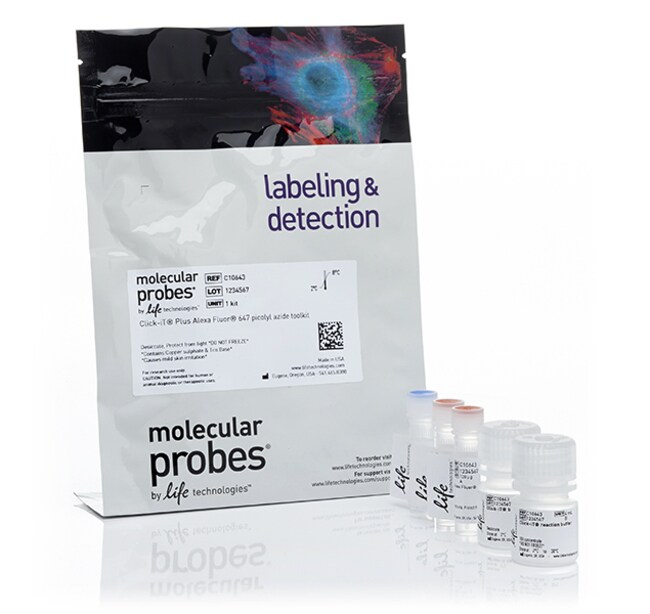
Click-iT™ Plus Alexa Fluor™ 647 Picolyl Azide Toolkit
Die Click-iT™ Plus Alexa Fluor™ Picolylazid-Toolkits enthalten alles Notwendige für kupferkatalysierte Click-Reaktionen mit kupfersensitiven Verbindungen, bei allen Vorteilen der standardmäßigenWeitere Informationen
| Katalognummer | Menge |
|---|---|
| C10643 | 1 Kit |
Katalognummer C10643
Preis (EUR)
479,65
Online exclusive
640,00Ersparnis 160,35
Each
Menge:
1 Kit
Preis (EUR)
479,65
Online exclusive
640,00Ersparnis 160,35
Each
Die Click-iT™ Plus Alexa Fluor™ Picolylazid-Toolkits enthalten alles Notwendige für kupferkatalysierte Click-Reaktionen mit kupfersensitiven Verbindungen, bei allen Vorteilen der standardmäßigen Azid-/Alkin-Click-Reaktion. Picolylazide reagieren effizient mit cheliertem Kupfer, sodass freies Kupfer in der Click-Reaktion minimiert werden kann, um unerwünschte kupferseitige Reaktionen mit Proteinen (z. B. GFP, RPE), Nukleinsäuren (z. B. RNA, Oligos) und auch kleinen Molekülen (z. B. Phalloidin) zu verhindern.
• Flexibel – optimieren Sie Ihre Click–iT™-Reaktion zum Nachweis oder zur Markierung sämtlicher alkinhaltiger Biomoleküle in vitro oder in Zellen und Gewebeproben
• Hell und empfindlich – erstklassige fluoreszierende Alexa Fluor™ Farbstoffe in Kombination mit der Effizienz von Picolylazid
•Praktisch – enthält alle Puffer und Reagenzien, die zur Erzeugung der optimalen Click-Reaktion erforderlich sind
Jedes Click-iT™ Plus Picolylazid-Toolkit enthält 100 µg Alexa Fluor™ Farbstoff-Picolylazid und alle Reagenzien, die zur Herstellung eines Reaktionscocktails mit der optimalen Kupfer- und Chelatkonzentration zur Markierung oder zum Nachweis durch Click-Chemie benötigt werden. Richtlinien für die Entwicklung und Optimierung der Picolylazid/Alkin-Click-Reaktion Ihrer Wahl finden Sie im Produkthandbuch. Darüber hinaus bieten die Click-iT™ Plus Picolylazide bei identischen Reaktionsbedingungen erhöhte Empfindlichkeit und schnellere Reaktionszeiten im Vergleich zu Standard-Aziden.
• Flexibel – optimieren Sie Ihre Click–iT™-Reaktion zum Nachweis oder zur Markierung sämtlicher alkinhaltiger Biomoleküle in vitro oder in Zellen und Gewebeproben
• Hell und empfindlich – erstklassige fluoreszierende Alexa Fluor™ Farbstoffe in Kombination mit der Effizienz von Picolylazid
•Praktisch – enthält alle Puffer und Reagenzien, die zur Erzeugung der optimalen Click-Reaktion erforderlich sind
Jedes Click-iT™ Plus Picolylazid-Toolkit enthält 100 µg Alexa Fluor™ Farbstoff-Picolylazid und alle Reagenzien, die zur Herstellung eines Reaktionscocktails mit der optimalen Kupfer- und Chelatkonzentration zur Markierung oder zum Nachweis durch Click-Chemie benötigt werden. Richtlinien für die Entwicklung und Optimierung der Picolylazid/Alkin-Click-Reaktion Ihrer Wahl finden Sie im Produkthandbuch. Darüber hinaus bieten die Click-iT™ Plus Picolylazide bei identischen Reaktionsbedingungen erhöhte Empfindlichkeit und schnellere Reaktionszeiten im Vergleich zu Standard-Aziden.
Nur für Forschungszwecke. Darf nicht für diagnostische Verfahren eingesetzt werden.
Specifications
BeschreibungClick-iT™ Plus Alexa Fluor™ 647 Picolylazid Materialkit, 5 mg, Feststoff, 650 nm Emission, 670 nm Anregung, 1 Jahr haltbar, bei 2 bis 8 °C lagern, weniger umweltgefährliche Eigenschaften, für die Markierungschemie
Anregung/Emission650/670
Zur Verwendung mit (Anwendung)Markierungschemie, Zellanalyse, Klick-Chemie, Glykoproteinanalyse mit Klick-Chemie, metabolische Markierung und naszente Proteinsynthese mit Klick-Chemie, Zellproliferation mit Klick-Chemie, naszent RNA-Nachweis und Erfassung mit Klick
FormatFest
ProduktlinieClick-iT
ProdukttypClick-iT™ Plus Alexa Fluor™ 647 Picolylazid-Toolkit
Menge1 Kit
Marker oder FarbstoffAlexa Fluor 647
Unit SizeEach
Inhalt und Lagerung
- 1 x 100 μg Alexa Fluor™ Farbstoff Picolylazid
- 1 x 4 ml Click-iT™ Reaktionspuffer
- 1 x 1,5 ml Kupfer(II)-Sulfat
- 1 x 500 μl Kupferschutzmittel
- 1 Click-iT™ Pufferadditiv