Search


Zitierungen und Referenzen (5)
Invitrogen™
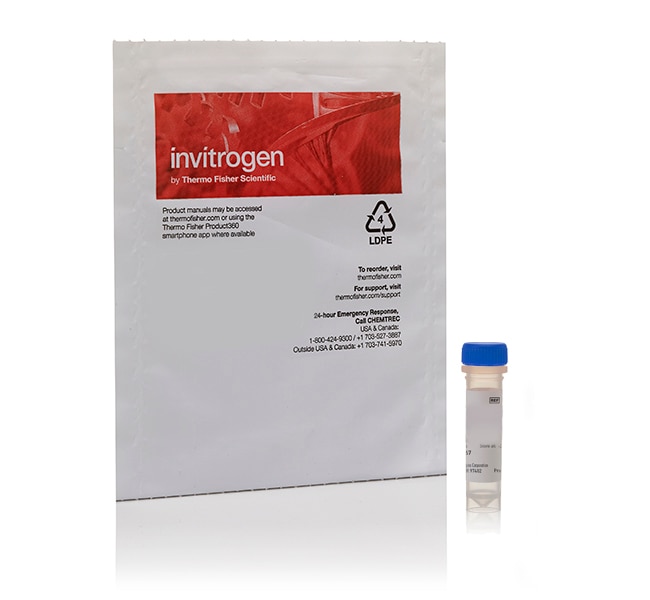
ChromaTide™ Alexa Fluor™ 568-5-dUTP
Mit dem Farbstoff ChromaTide™ Molecular Probes™ dUTP-, OBEA-dCTP- und UTP-markierte Nukleotide können zur Synthese markierter DNA-Sonden verwendet werden, ohne dassWeitere Informationen
| Katalognummer | Menge |
|---|---|
| C11399 | 25 μl |
Katalognummer C11399
Preis (EUR)
924,00
Each
Menge:
25 μl
Preis (EUR)
924,00
Each
Mit dem Farbstoff ChromaTide™ Molecular Probes™ dUTP-, OBEA-dCTP- und UTP-markierte Nukleotide können zur Synthese markierter DNA-Sonden verwendet werden, ohne dass gefährliche und teure radioisotopenmarkierte Nukleotide erforderlich sind. Diese Nukleotide können mithilfe von molekularbiologischen Standardverfahren integriert werden. Markierte Sonden können dann in In-situ-Hybridisierungs-, Microarray- oder Blotting-Protokollen eingesetzt werden. Mit dem Farbstoff ChromaTide™ markierte Nukleotide sind in verschiedenen fluoreszierenden Farben erhältlich, die die mehrfarbige Analyse erleichtern.
Spezifikation der ChromaTide™ Markierten Nukleotide:
• Ex/Em von Farbstoffen: Alexa Fluor™ 568-5-dUTP (575/600 nm)
• Länge des alkynolaminischen Linkers: 5 Atome
Verfahren zur Integration von ChromaTide™ Nukleotiden in Sonden
• Nick Translation
• Random-Priming
• Endmarkierung mit terminaler Desoxynucleotidyltransferase
• Reverse Transkription
• PCR-Amplifikation
Für spezifische Richtlinien für jedes dieser Verfahren siehe Methoden für die enzymatische Inkorporation von ChromaTide™ DUTPs
Alexa Fluor™ und BODIPY™ Fluoreszenzfarbstoffe erzeugen ausgezeichnete Sonden
Mit markierten Nukleotiden hergestellte Sonden können für mehrfarbige Techniken wie die in-situ-Hybridisierung und Hybridisierung auf Arrays verwendet werden. Unsere firmeneigenen Farbstoffkonjugate BODIPY™ und Alexa Fluor™ sind außergewöhnlich hell, photostabil und grundsätzlich pH-unempfindlich. Das schmale Emissionsprofil der BODIPY™ Farbstoffe sorgt für minimale spektrale Überlappung. Die Alexa Fluor™ Farbstoffe sind hochgradig wasserlöslich, ebenso die DNA-Sonden, die aus ihnen hergestellt werden. Sie sind daher die Marker der Wahl für die Fluoreszenz-in-situ-Hybridisierung.
Lange Linker verbessern die Leistung
Die ChromaTide™ dUTP- und UTP-Nukleotide werden an der C-5-Position von Uridin über einen eindeutigen Alkynylamin-Linker modifiziert, der einen Spacer zwischen dem Nukleotid und dem Farbstoff anlegt, um Interaktionen zwischen diesen beiden zu reduzieren. Die Nummer im Produktnamen, z. B. “12” in Fluorescein-12-dUTP gibt die Nettolänge des Spacers in Atomen an. Diese Spacer führen zu helleren Konjugaten und einer verbesserten Hapten-Zugänglichkeit für sekundäre Nachweisreagenzien.
Vollständige Liste unserer ChromaTide™ Reagenzien: Mit Molecular Probes ChromaTide™ and aha markierte Nukleotide—Tabelle 8.5.
Weitere Informationen zu diesen Markierungsreagenzien finden Sie im Molecular Probes™ Handbuch in Abschnitt 8.2—Markierung von Oligonukleotiden und Nukleinsäuren.
Nur für Forschungszwecke. Nicht für therapeutische oder diagnostische Zwecke bei Menschen und Tieren.
Spezifikation der ChromaTide™ Markierten Nukleotide:
• Ex/Em von Farbstoffen: Alexa Fluor™ 568-5-dUTP (575/600 nm)
• Länge des alkynolaminischen Linkers: 5 Atome
Verfahren zur Integration von ChromaTide™ Nukleotiden in Sonden
• Nick Translation
• Random-Priming
• Endmarkierung mit terminaler Desoxynucleotidyltransferase
• Reverse Transkription
• PCR-Amplifikation
Für spezifische Richtlinien für jedes dieser Verfahren siehe Methoden für die enzymatische Inkorporation von ChromaTide™ DUTPs
Alexa Fluor™ und BODIPY™ Fluoreszenzfarbstoffe erzeugen ausgezeichnete Sonden
Mit markierten Nukleotiden hergestellte Sonden können für mehrfarbige Techniken wie die in-situ-Hybridisierung und Hybridisierung auf Arrays verwendet werden. Unsere firmeneigenen Farbstoffkonjugate BODIPY™ und Alexa Fluor™ sind außergewöhnlich hell, photostabil und grundsätzlich pH-unempfindlich. Das schmale Emissionsprofil der BODIPY™ Farbstoffe sorgt für minimale spektrale Überlappung. Die Alexa Fluor™ Farbstoffe sind hochgradig wasserlöslich, ebenso die DNA-Sonden, die aus ihnen hergestellt werden. Sie sind daher die Marker der Wahl für die Fluoreszenz-in-situ-Hybridisierung.
Lange Linker verbessern die Leistung
Die ChromaTide™ dUTP- und UTP-Nukleotide werden an der C-5-Position von Uridin über einen eindeutigen Alkynylamin-Linker modifiziert, der einen Spacer zwischen dem Nukleotid und dem Farbstoff anlegt, um Interaktionen zwischen diesen beiden zu reduzieren. Die Nummer im Produktnamen, z. B. “12” in Fluorescein-12-dUTP gibt die Nettolänge des Spacers in Atomen an. Diese Spacer führen zu helleren Konjugaten und einer verbesserten Hapten-Zugänglichkeit für sekundäre Nachweisreagenzien.
Vollständige Liste unserer ChromaTide™ Reagenzien: Mit Molecular Probes ChromaTide™ and aha markierte Nukleotide—Tabelle 8.5.
Weitere Informationen zu diesen Markierungsreagenzien finden Sie im Molecular Probes™ Handbuch in Abschnitt 8.2—Markierung von Oligonukleotiden und Nukleinsäuren.
Nur für Forschungszwecke. Nicht für therapeutische oder diagnostische Zwecke bei Menschen und Tieren.
Nur für Forschungszwecke. Darf nicht für diagnostische Verfahren eingesetzt werden.
Specifications
MarkierungsmethodeDirekte Markierung
Marker oder FarbstoffAlexa Fluor™ 568
Menge25 μl
VersandbedingungTrockeneis
Konzentration1 mmol
ProduktlinieAlexa Fluor, ChromaTide
Unit SizeEach
Inhalt und Lagerung
Bei -5 bis -30 °C lagern und vor Licht schützen.
Häufig gestellte Fragen (FAQ)
I'm getting high background after labeling with ChromaTide nucleotides. What do you recommend I do?
The nucleic acid probe is not fluorescent after labeling with ChromaTide nucleotides. What do you recommend I try?
Can ChromaTide nucleotides be used for labeling nucleic acids in live cells?
How do I determine the incorporation efficiency of the ChromaTide Labeling Nucleotides after enzymatic incorporation?
What is the average dye to base incorporation rate when enzymatically incorporating ChromaTide nucleotides?
Zitierungen und Referenzen (5)
Zitierungen und Referenzen
Abstract
The genetic architecture of Down syndrome phenotypes revealed by high-resolution analysis of human segmental trisomies.
Journal:Proc Natl Acad Sci U S A
PubMed ID:19597142
'Down syndrome (DS), or trisomy 21, is a common disorder associated with several complex clinical phenotypes. Although several hypotheses have been put forward, it is unclear as to whether particular gene loci on chromosome 21 (HSA21) are sufficient to cause DS and its associated features. Here we present a high-resolution
HIM-10 is required for kinetochore structure and function on Caenorhabditis elegans holocentric chromosomes.
Journal:J Cell Biol
PubMed ID:11402066
'Macromolecular structures called kinetochores attach and move chromosomes within the spindle during chromosome segregation. Using electron microscopy, we identified a structure on the holocentric mitotic and meiotic chromosomes of Caenorhabditis elegans that resembles the mammalian kinetochore. This structure faces the poles on mitotic chromosomes but encircles meiotic chromosomes. Worm kinetochores
Cytogenetic evidence for asexual evolution of bdelloid rotifers.
Journal:Proc Natl Acad Sci U S A
PubMed ID:14747655
DNA sequencing has shown individual bdelloid rotifer genomes to contain two or more diverged copies of every gene examined and has revealed no closely similar copies. These and other findings are consistent with long-term asexual evolution of bdelloids. It is not entirely ruled out, however, that bdelloid genomes consist of
Telomere-associated endonuclease-deficient Penelope-like retroelements in diverse eukaryotes.
Journal:Proc Natl Acad Sci U S A
PubMed ID:17483479
The evolutionary origin of telomerases, enzymes that maintain the ends of linear chromosomes in most eukaryotes, is a subject of debate. Penelope-like elements (PLEs) are a recently described class of eukaryotic retroelements characterized by a GIY-YIG endonuclease domain and by a reverse transcriptase domain with similarity to telomerases and group
Intramitochondrial localization of universal minicircle sequence-binding protein, a trypanosomatid protein that binds kinetoplast minicircle replication origins.
Journal:J Cell Biol
PubMed ID:11352934
Kinetoplast DNA (kDNA), the mitochondrial DNA of the trypanosomatid Crithidia fasciculata, is a unique structure containing 5,000 DNA minicircles topologically linked into a massive network. In vivo, the network is condensed into a disk-shaped structure. Replication of minicircles initiates at unique origins that are bound by universal minicircle sequence (UMS)-binding