Search


Zitierungen und Referenzen (5)
Invitrogen™
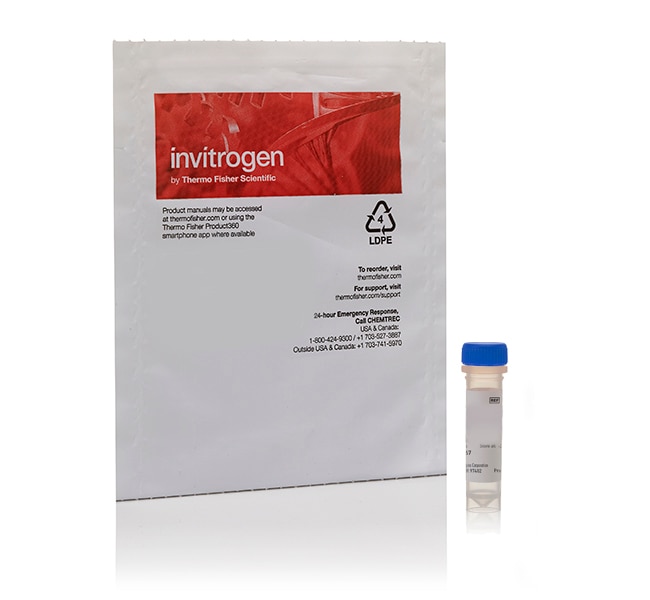
ChromaTide™ Alexa Fluor™ 546-14-dUTP
Mit dem Farbstoff ChromaTide™ Molecular Probes™ dUTP-, OBEA-dCTP- und UTP-markierte Nukleotide können zur Synthese markierter DNA-Sonden verwendet werden, ohne dassWeitere Informationen
| Katalognummer | Menge |
|---|---|
| C11401 | 25 μl |
Katalognummer C11401
Preis (EUR)
958,00
Each
Menge:
25 μl
Preis (EUR)
958,00
Each
Mit dem Farbstoff ChromaTide™ Molecular Probes™ dUTP-, OBEA-dCTP- und UTP-markierte Nukleotide können zur Synthese markierter DNA-Sonden verwendet werden, ohne dass gefährliche und teure radioisotopenmarkierte Nukleotide erforderlich sind. Diese Nukleotide können mithilfe von molekularbiologischen Standardverfahren integriert werden. Markierte Sonden können dann in In-situ-Hybridisierungs-, Microarray- oder Blotting-Protokollen eingesetzt werden. Mit dem Farbstoff ChromaTide™ markierte Nukleotide sind in verschiedenen fluoreszierenden Farben erhältlich, die die mehrfarbige Analyse erleichtern.
Spezifikation der ChromaTide™ Markierten Nukleotide:
• Ex/Em von Farbstoffen: Alexa Fluor™ 546-14-dUTP (555/570 nm)
• Länge des alkynolaminischen Linkers: 14 Atome
Verfahren zur Integration von ChromaTide™ Nukleotiden in Sonden
• Nick Translation
• Random-Priming
• Endmarkierung mit terminaler Desoxynucleotidyltransferase
• Reverse Transkription
• PCR-Amplifikation
Für spezifische Richtlinien für jedes dieser Verfahren siehe Methoden für die enzymatische Inkorporation von ChromaTide™ DUTPs
Alexa Fluor™ und BODIPY™ Fluoreszenzfarbstoffe erzeugen ausgezeichnete Sonden
Mit markierten Nukleotiden hergestellte Sonden können für mehrfarbige Techniken wie die in-situ-Hybridisierung und Hybridisierung auf Arrays verwendet werden. Unsere firmeneigenen Farbstoffkonjugate BODIPY™ und Alexa Fluor™ sind außergewöhnlich hell, photostabil und grundsätzlich pH-unempfindlich. Das schmale Emissionsprofil der BODIPY™ Farbstoffe sorgt für minimale spektrale Überlappung. Die Alexa Fluor™ Farbstoffe sind hochgradig wasserlöslich, ebenso die DNA-Sonden, die aus ihnen hergestellt werden. Sie sind daher die Marker der Wahl für die Fluoreszenz-in-situ-Hybridisierung.
Lange Linker verbessern die Leistung
Die ChromaTide™ dUTP- und UTP-Nukleotide werden an der C-5-Position von Uridin über einen eindeutigen Alkynylamin-Linker modifiziert, der einen Spacer zwischen dem Nukleotid und dem Farbstoff anlegt, um Interaktionen zwischen diesen beiden zu reduzieren. Die Nummer im Produktnamen, z. B. “12” in Fluorescein-12-dUTP gibt die Nettolänge des Spacers in Atomen an. Diese Spacer führen zu helleren Konjugaten und einer verbesserten Hapten-Zugänglichkeit für sekundäre Nachweisreagenzien.
Vollständige Liste unserer ChromaTide™ Reagenzien: Mit Molecular Probes ChromaTide™ and aha markierte Nukleotide—Tabelle 8.5.
Weitere Informationen zu diesen Markierungsreagenzien finden Sie im Molecular Probes™ Handbuch in Abschnitt 8.2—Markierung von Oligonukleotiden und Nukleinsäuren.
Nur für Forschungszwecke. Nicht für therapeutische oder diagnostische Zwecke bei Menschen und Tieren.
Spezifikation der ChromaTide™ Markierten Nukleotide:
• Ex/Em von Farbstoffen: Alexa Fluor™ 546-14-dUTP (555/570 nm)
• Länge des alkynolaminischen Linkers: 14 Atome
Verfahren zur Integration von ChromaTide™ Nukleotiden in Sonden
• Nick Translation
• Random-Priming
• Endmarkierung mit terminaler Desoxynucleotidyltransferase
• Reverse Transkription
• PCR-Amplifikation
Für spezifische Richtlinien für jedes dieser Verfahren siehe Methoden für die enzymatische Inkorporation von ChromaTide™ DUTPs
Alexa Fluor™ und BODIPY™ Fluoreszenzfarbstoffe erzeugen ausgezeichnete Sonden
Mit markierten Nukleotiden hergestellte Sonden können für mehrfarbige Techniken wie die in-situ-Hybridisierung und Hybridisierung auf Arrays verwendet werden. Unsere firmeneigenen Farbstoffkonjugate BODIPY™ und Alexa Fluor™ sind außergewöhnlich hell, photostabil und grundsätzlich pH-unempfindlich. Das schmale Emissionsprofil der BODIPY™ Farbstoffe sorgt für minimale spektrale Überlappung. Die Alexa Fluor™ Farbstoffe sind hochgradig wasserlöslich, ebenso die DNA-Sonden, die aus ihnen hergestellt werden. Sie sind daher die Marker der Wahl für die Fluoreszenz-in-situ-Hybridisierung.
Lange Linker verbessern die Leistung
Die ChromaTide™ dUTP- und UTP-Nukleotide werden an der C-5-Position von Uridin über einen eindeutigen Alkynylamin-Linker modifiziert, der einen Spacer zwischen dem Nukleotid und dem Farbstoff anlegt, um Interaktionen zwischen diesen beiden zu reduzieren. Die Nummer im Produktnamen, z. B. “12” in Fluorescein-12-dUTP gibt die Nettolänge des Spacers in Atomen an. Diese Spacer führen zu helleren Konjugaten und einer verbesserten Hapten-Zugänglichkeit für sekundäre Nachweisreagenzien.
Vollständige Liste unserer ChromaTide™ Reagenzien: Mit Molecular Probes ChromaTide™ and aha markierte Nukleotide—Tabelle 8.5.
Weitere Informationen zu diesen Markierungsreagenzien finden Sie im Molecular Probes™ Handbuch in Abschnitt 8.2—Markierung von Oligonukleotiden und Nukleinsäuren.
Nur für Forschungszwecke. Nicht für therapeutische oder diagnostische Zwecke bei Menschen und Tieren.
Nur für Forschungszwecke. Darf nicht für diagnostische Verfahren eingesetzt werden.
Specifications
MarkierungsmethodeDirekte Markierung
Marker oder FarbstoffAlexa Fluor™ 546
Menge25 μl
VersandbedingungTrockeneis
Konzentration1 mmol
ProduktlinieAlexa Fluor, ChromaTide
Unit SizeEach
Inhalt und Lagerung
Bei -5 bis -30 °C lagern und vor Licht schützen.
Häufig gestellte Fragen (FAQ)
I'm getting high background after labeling with ChromaTide nucleotides. What do you recommend I do?
The nucleic acid probe is not fluorescent after labeling with ChromaTide nucleotides. What do you recommend I try?
Can ChromaTide nucleotides be used for labeling nucleic acids in live cells?
How do I determine the incorporation efficiency of the ChromaTide Labeling Nucleotides after enzymatic incorporation?
What is the average dye to base incorporation rate when enzymatically incorporating ChromaTide nucleotides?
Zitierungen und Referenzen (5)
Zitierungen und Referenzen
Abstract
Live-cell imaging of rhabdovirus-induced morphological changes in plant nuclear membranes.
Journal:Mol Plant Microbe Interact
PubMed ID:16042016
'Potato yellow dwarf virus (PYDV) and Sonchus yellow net virus (SYNV) belong to the genus Nucleorhabdovirus. These viruses replicate in nuclei of infected cells and mature virions accumulate in the perinuclear space after budding through the inner nuclear membrane. Infection of transgenic Nicotiana benthamiana 16c plants (which constitutively express green
High-density polymerase-mediated incorporation of fluorochrome-labeled nucleotides.
Journal:Anal Biochem
PubMed ID:15649370
'DNA-polymerase-mediated incorporation of different fluorochrome-labeled nucleotides (FdNTPs) was investigated with the goals of optimizing the high-density labeling of probes and exploring DNA sequencing strategies that rely on the controlled, sequential addition of such compounds. By systematically evaluating variables--including polymerase type, buffer conditions, and fluorochrome chemistries--a rational strategy for the sequential
Determination of surface-bound-fluorophore orientation by goniometric fluorescence polarization: application to quantification of DNA-chip readouts.
Journal:Appl Opt
PubMed ID:12153110
We present a polarized goniofluorimeter designed to measure the observation-angle and polarization-dependent intensity emitted by a group of surface-bound fluorescent molecules. We studied two types of surface bonding: In one case, dyes were adsorbed into the surface by spin coating, and in the other, dyes were covalently immobilized to DNA
Maximization of signal derived from cDNA microarrays.
Journal:Biotechniques
PubMed ID:11196312
Microarray technology is a powerful tool for generating expression data on a large number of genes simultaneously. However, as for any assay, it must be reproducible to give confidence in the results. Using a classical statistical method--the factorial design of experiments--we have assessed the effects of different experimental factors in
The positioning and dynamics of origins of replication in the budding yeast nucleus.
Journal:J Cell Biol
PubMed ID:11266454
We have analyzed the subnuclear position of early- and late-firing origins of DNA replication in intact yeast cells using fluorescence in situ hybridization and green fluorescent protein (GFP)-tagged chromosomal domains. In both cases, origin position was determined with respect to the nuclear envelope, as identified by nuclear pore staining or