Search


Zitierungen und Referenzen (5)
Invitrogen™
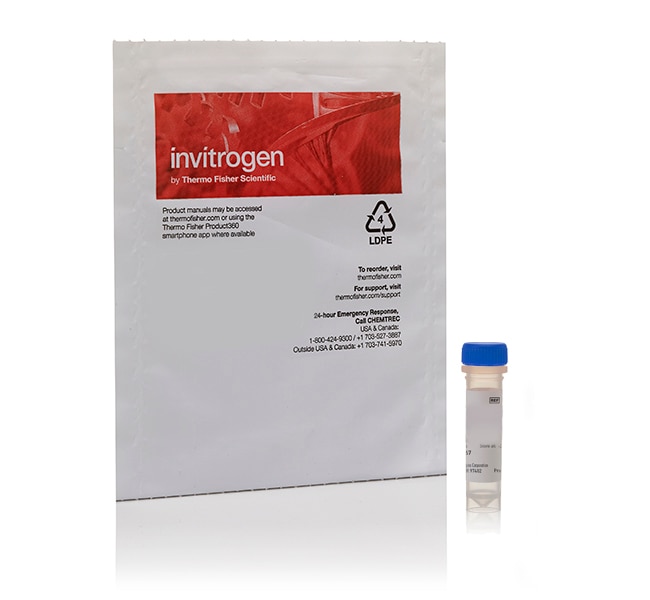
Click-IT™ GalNAz Metabolic Glycoprotein Labeling Reagent (Tetraacetylated N-Azidoacetylgalactosamine)
Das Click-iT™ GalNAz Metabolische Glycoprotein-Markierungsreagenz liefert den ersten Teil eines einfachen und robusten Zwei-Schritt-Verfahrens zur Identifizierung und Charakterisierung von ringverknüpftenWeitere Informationen
| Katalognummer | Menge |
|---|---|
| C33365 | 5,2 mg |
Katalognummer C33365
Preis (EUR)
387,00
Each
Menge:
5,2 mg
Preis (EUR)
387,00
Each
Das Click-iT™ GalNAz Metabolische Glycoprotein-Markierungsreagenz liefert den ersten Teil eines einfachen und robusten Zwei-Schritt-Verfahrens zur Identifizierung und Charakterisierung von ringverknüpften Glykoproteinen auf der Zelloberfläche. In Schritt 1 werden kultivierte Zellen mit dem azidmodifizierten Galactosamin (GalNAz) inkubiert. Der Azido-Zucker wird metabolisch durch die permissive Natur des Oligosaccharid-Biosynthesewegs in ringgebundene Glykoproteine der Zelloberfläche eingearbeitet. In Schritt 2 können die azido-markierten Glykoproteine über die chemoselektive Ligation oder Klickreaktion zwischen einem Azid und einem Alkin mit einem Click-iT™ Glycoprotein-Nachweiskit für Gele (Tamra oder Dapoxyl™ Alkine) oder Western-Blots (Biotin-Alkine) nachgewiesen werden. Diese Click-iT™ Produkte sind kompatibel mit LC-MS⁄MS und Multiplexed Proteomics™ Technologien für detaillierte Analysen des Glykoproteoms.
Nur für Forschungszwecke. Nicht zur Verwendung bei diagnostischen Verfahren.
Specifications
NachweisverfahrenBiotinbasiert, fluoreszierend
ProduktlinieClick-iT
ProdukttypKennzeichnungsreagenz
Menge5,2 mg
VersandbedingungRaumtemperatur
Labeling TargetProteine
Marker oder FarbstoffAlexa Fluor 488, Alexa Fluor 555, Alexa Fluor 594, Alexa Fluor 647, Biotin, Oregon Green 488, TMR (Tetramethylrhodamin)
Unit SizeEach
Inhalt und Lagerung
Im Tiefkühlgerät lagern (-5 bis -30 °C).
Zitierungen und Referenzen (5)
Zitierungen und Referenzen
Abstract
Binding of herpes simplex virus glycoprotein B (gB) to paired immunoglobulin-like type 2 receptor alpha depends on specific sialylated O-linked glycans on gB.
Journal:J Virol
PubMed ID:19812165
'Paired immunoglobulin-like type 2 receptor alpha (PILRalpha) is an inhibitory receptor expressed on both hematopoietic and nonhematopoietic cells. Its binding to a cellular ligand, CD99, depends on the presence of sialylated O-linked glycans on CD99. Glycoprotein B (gB) of herpes simplex virus type 1 (HSV-1) binds to PILRalpha, and this
Metabolic labeling of glycans with azido sugars for visualization and glycoproteomics.
Journal:Methods Enzymol
PubMed ID:17116478
'The staggering complexity of glycans renders their analysis extraordinarily difficult, particularly in living systems. A recently developed technology, termed metabolic oligosaccharide engineering, enables glycan labeling with probes for visualization in cells and living animals, and enrichment of specific glycoconjugate types for proteomic analysis. This technology involves metabolic labeling of glycans
The cytoplasmic tail dileucine motif LL572 determines the glycosylation pattern of membrane-type 1 matrix metalloproteinase.
Journal:J Biol Chem
PubMed ID:18955496
'Membrane-type 1 matrix metalloproteinase (MT1-MMP; MMP-14) drives fundamental physiological and pathological processes, due to its ability to process a broad spectrum of substrates. Because subtle changes in its activity can produce profound physiological effects, MT1-MMP is tightly regulated. Currently, many aspects of this regulation remain to be elucidated. It has
Dynamic monitoring of newly synthesized proteomes: up-regulation of myristoylated protein kinase A during butyric acid induced apoptosis.
Journal:Angew Chem Int Ed Engl
PubMed ID:21678537
Doubly charged: A double metabolic incorporation approach capable of proteome-wide profiling of post-translational modification dynamics on newly synthesized proteins has been developed (see scheme; blue box: methionine surrogate, orange diamond: PTM probe). This strategy reveals for the first time that up-regulation of myristoylated PKA protein is necessary for the occurrence
Sialic Acids Attached to O-Glycans Modulate Voltage-gated Potassium Channel Gating.
Journal:J Biol Chem
PubMed ID:21115483
Neuronal, cardiac, and skeletal muscle action potentials are produced and conducted through the highly regulated activity of several types of voltage-gated ion channels. Voltage-gated potassium (K(v)) channels are responsible for action potential repolarization. Glycans can be attached to glycoproteins through N- and O-linkages. Previous reports described the impact of N-glycans