Search


Zitierungen und Referenzen (28)
Invitrogen™
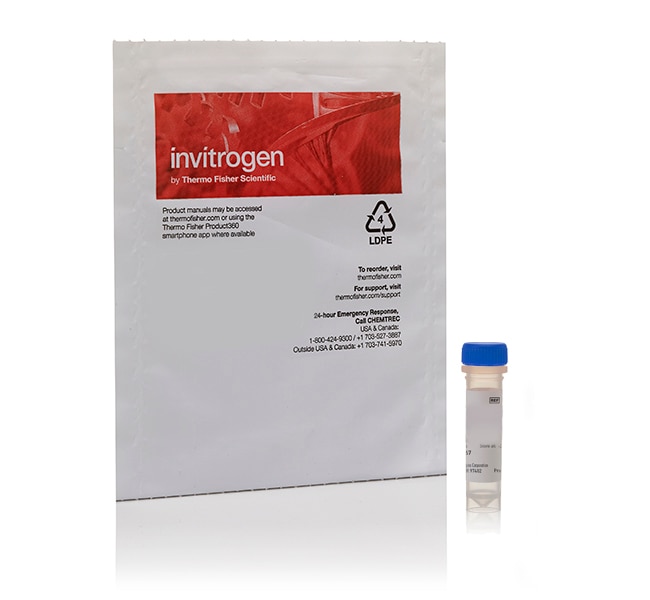
ER-Tracker™ Red (BODIPY™ TR Glibenclamid), für die Bildgebung lebender Zellen
ER-Tracker™ Red Dye ist ein zelldurchlässiges Färbemittel zur Anfärbung lebender Zellen und hochgradig selektiv für das endoplasmatische Retikulum (ER). BeiWeitere Informationen
| Katalognummer | Menge |
|---|---|
| E34250 | 100 μg |
Katalognummer E34250
Preis (EUR)
660,65
キャンペーン価格
718,00Ersparnis 57,35 (8%)
Each
Menge:
100 μg
Preis (EUR)
660,65
キャンペーン価格
718,00Ersparnis 57,35 (8%)
Each
ER-Tracker™ Red Dye ist ein zelldurchlässiges Färbemittel zur Anfärbung lebender Zellen und hochgradig selektiv für das endoplasmatische Retikulum (ER). Bei Färbung gemäß beiliegendem Protokoll bleibt das Färbemuster nach der Fixierung mit Formaldehyd teilweise erhalten. Dieses Färbemittel besteht aus dem grün fluoreszierenden BODIPY™ TR Farbstoff und Glibenclamid. Glibenclamid (Glyburid) bindet an die Sulfonylharnstoff-Rezeptoren der ATP-empfindlichen K+ Kanäle, die auf dem ER in großer Zahl vorhanden sind. Die pharmakologische Aktivität von Glibenclamid könnte die ER-Funktion beeinträchtigen. Die variable Expression der Sulfonylharnstoff-Rezeptoren in einigen spezialisierten Zelltypen kann zur Markierung außerhalb des ER führen.
Nur für Forschungszwecke. Nicht zur Verwendung bei diagnostischen Verfahren.
Specifications
FarbeRot
NachweisverfahrenFluoreszent
Anregungswellenlängenbereich587⁄615
Zur Verwendung mit (Geräte)Fluoreszenzmikroskop
ProduktlinieBODIPY, ER-Tracker
Menge100 μg
VersandbedingungRaumtemperatur
MarkertypBODIPY Farbstoffe
ProdukttypFarbstoff
Sub Cellular LocalizationEndoplasmatisches Retikulum
Unit SizeEach
Inhalt und Lagerung
Im Tiefkühlgerät bei –5 bis –30 °C aufbewahren und vor Licht schützen.
Häufig gestellte Fragen (FAQ)
Why don't I see a significant change in signal for my live-cell fluorescent indicator dye?
Zitierungen und Referenzen (28)
Zitierungen und Referenzen
Abstract
Binding of guanylyl cyclase activating protein 1 (GCAP1) to retinal guanylyl cyclase (RetGC1). The role of individual EF-hands.
Journal:J Biol Chem
PubMed ID:18541533
'Guanylyl cyclase activating protein 1 (GCAP1), after substitution of Ca(2+) by Mg(2+) in its EF-hands, stimulates photoreceptor guanylyl cyclase, RetGC1, in response to light. We inactivated metal binding in individual EF-hands of GCAP1 tagged with green fluorescent protein to assess their role in GCAP1 binding to RetGC1 in co-transfected HEK293
Imaging secretory vesicles by fluorescent protein insertion in propeptide rather than mature secreted peptide.
Journal:Traffic
PubMed ID:12047554
'We combined confocal and live-cell imaging with a novel molecular strategy aimed at revealing mechanisms underlying glucose-regulated insulin vesicle secretion. The ''Ins-C-GFP'' reporter monitors secretory peptide targeting, trafficking, and exocytosis without directly tagging the mature secreted peptide. We trapped a green fluorescent protein (GFP) reporter in equimolar quantity within the
Faecal excretion of ciprofloxacin after a single oral dose and its effect on faecal bacteria in healthy volunteers.
Journal:J Antimicrob Chemother
PubMed ID:2211433
'High concentrations of ciprofloxacin have been shown to persist in the faeces of volunteers for several days after a week of oral treatment with this drug, which was also found to have a prolonged effect on aerobic Gram-negative intestinal bacteria. To determine whether a shorter course of ciprofloxacin would have
Insulin-like growth factor I enhances the expression of aromatase P450 by inhibiting autophagy.
Journal:Endocrinology
PubMed ID:20668023
'Aromatase, a key enzyme of estrogen biosynthesis, is transcriptionally regulated by many growth factors. IGF-I enhances aromatase activity in a variety of cells, but the mechanism of action has not been determined. We herein report our finding of a novel mechanism of action for IGF-I. IGF-I enhanced the dexamethasone (DEX)-induced
Essential requirement for sphingosine kinase 2 in a sphingolipid apoptosis pathway activated by FTY720 analogues.
Journal:J Biol Chem
PubMed ID:17400555
'The clinical immunosuppressant FTY720 is a sphingosine analogue that, once phosphorylated by sphingosine kinase 2 (Sphk2), is an agonist of multiple receptor subtypes for sphingosine 1-phosphate. Short exposures to FTY720 afford long term protection in lymphoproliferative and autoimmune disease models, presumably by inducing apoptosis in subsets of cells essential for