Search


Zitierungen und Referenzen (18)
Invitrogen™
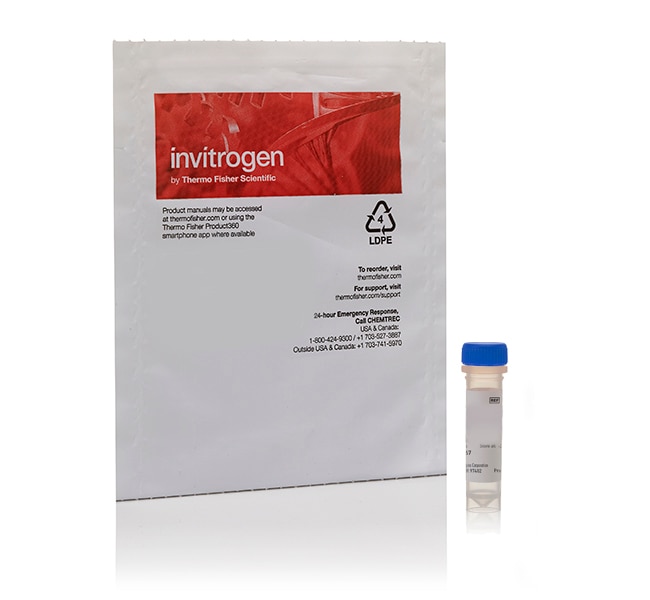
Epidermal Growth Factor, Fluorescein Conjugate (Fluorescein EGF)
Wir bieten verschiedene Konjugate des epidermalen Wachstumsfaktors an, die für den Nachweis von EGF-Rezeptoren in Zellen geeignet sind. Der fluoreszierendWeitere Informationen
| Katalognummer | Menge |
|---|---|
| E3478 | 20 μg |
Katalognummer E3478
Preis (EUR)
824,00
Each
Menge:
20 μg
Preis (EUR)
824,00
Each
Wir bieten verschiedene Konjugate des epidermalen Wachstumsfaktors an, die für den Nachweis von EGF-Rezeptoren in Zellen geeignet sind. Der fluoreszierend markierte EGF ermöglicht Wissenschaftlern die Untersuchung von Rezeptor-Membran-Interaktionen, die Untersuchung der Rezeptorverteilung, die Berechnung von Geschwindigkeitskonstanten für die Interaktion des EGF mit seinem Rezeptor und vieles mehr. Bei den Konjugaten mit Fluorescein (FITC), Oregon Green™ 514 und Tetramethylrhodamin ist der Farbstoff direkt am EGF befestigt Bei den EGF-Konjugaten mit Alexa Fluor™ Farbstoffen und Texas Red™ handelt es sich um Komplexe des Farbstoff-Streptavidin-Moleküls und des biotinylierten EGF. Die biotinylierten Konjugate nutzen Biotin-XX, das einen langen Spacerarm enthält, der die Affinität der Sonde für den EGF-Rezeptor erhöht.
Spezifikationen der Konjugate des epidermalen Wachstumsfaktors:
• EGF-Molekül: 53 Aminosäuren, MW = 6.045 Da
• Markierung (Ex/Em): Fluorescein (∼494/518 nm)
• Anzahl der Fluorophormoleküle auf jedem EGF-Molekül: 1
• Fluoreszenz wird typischerweise mit einem Durchflusszytometer, Fluoreszenzmikroskop oder Fluorimeter überwacht
Weitere Sonden für Rezeptorbindung und Phagozytose
Wir bieten zahlreiche Fluoreszenz-markierte Sonden zur Untersuchung der Rezeptor-vermittelten Endozytose, Membranmarker für Endozytose und Exozytose sowie Methoden zum Nachweis internalisierter fluoreszierender Liganden an. Weitere Informationen zu diesen Produkten finden Sie im Molecular Probes™ Handbuch unter Sonden für die Verfolgung von Rezeptorbindung und Phagozytose – Abschnitt 16.1.
Für Forschungszwecke. Nicht für therapeutische oder diagnostische Zwecke bei Menschen oder Tieren vorgesehen.
Spezifikationen der Konjugate des epidermalen Wachstumsfaktors:
• EGF-Molekül: 53 Aminosäuren, MW = 6.045 Da
• Markierung (Ex/Em): Fluorescein (∼494/518 nm)
• Anzahl der Fluorophormoleküle auf jedem EGF-Molekül: 1
• Fluoreszenz wird typischerweise mit einem Durchflusszytometer, Fluoreszenzmikroskop oder Fluorimeter überwacht
Weitere Sonden für Rezeptorbindung und Phagozytose
Wir bieten zahlreiche Fluoreszenz-markierte Sonden zur Untersuchung der Rezeptor-vermittelten Endozytose, Membranmarker für Endozytose und Exozytose sowie Methoden zum Nachweis internalisierter fluoreszierender Liganden an. Weitere Informationen zu diesen Produkten finden Sie im Molecular Probes™ Handbuch unter Sonden für die Verfolgung von Rezeptorbindung und Phagozytose – Abschnitt 16.1.
Für Forschungszwecke. Nicht für therapeutische oder diagnostische Zwecke bei Menschen oder Tieren vorgesehen.
Nur für Forschungszwecke. Nicht zur Verwendung bei diagnostischen Verfahren.
Specifications
NachweisverfahrenFluoreszenz
Marker oder FarbstoffKlassische Farbstoffe
Menge20 μg
VersandbedingungNasseis
FormFest
ProdukttypWachstumsfaktor
Unit SizeEach
Inhalt und Lagerung
Bei -5 bis -30 °C lagern und vor Licht schützen.
Zitierungen und Referenzen (18)
Zitierungen und Referenzen
Abstract
Visualization of epidermal growth factor (EGF) receptor aggregation in plasma membranes by fluorescence resonance energy transfer. Correlation of receptor activation with aggregation.
Journal:J Biol Chem
PubMed ID:2498317
'Fluorescence resonance energy transfer between epidermal growth factor (EGF) molecules, labeled with fluorescent reporter groups, was used as a monitor for EGF receptor-receptor interactions in plasma membranes isolated from human epidermoid A431 cells. Epidermal growth factor molecules labeled at the amino terminus with fluorescein isothiocyanate served as donor molecules in
The interaction of epidermal growth factor with its receptor in A431 cell membranes: a stopped-flow fluorescence anisotropy study.
Journal:Biochemistry
PubMed ID:7578056
'We describe a quantitative examination of the interaction of epidermal growth factor (EGF) with the EGF receptor using A431 cell membrane vesicles as a receptor source. Using T-format steady-state fluorescence anisotropy detection coupled with stopped-flow mixing, we measured the association and EGF-induced dissociation kinetics of fluorescein 5-isothiocyanate-labeled mEGF (FITC-EGF) with
Electric field-directed cell motility involves up-regulated expression and asymmetric redistribution of the epidermal growth factor receptors and is enhanced by fibronectin and laminin.
Journal:Mol Biol Cell
PubMed ID:10198071
'Wounding corneal epithelium establishes a laterally oriented, DC electric field (EF). Corneal epithelial cells (CECs) cultured in similar physiological EFs migrate cathodally, but this requires serum growth factors. Migration depends also on the substrate. On fibronectin (FN) or laminin (LAM) substrates in EF, cells migrated faster and more directly cathodally.
Heterogeneity of epidermal growth factor binding kinetics on individual cells.
Journal:Biophys J
PubMed ID:9251825
'Binding of fluorescein-conjugated epidermal growth factor (EGF) to individual A431 cells at 4 degrees C is measured by a quantitative fluorescence imaging technique. After background fluorescence and cell autofluorescence photobleaching corrections, the kinetic data are fit to simple models of one monovalent site and two independent monovalent sites, both of
c-Jun N-terminal kinase 2 (JNK2) enhances cell migration through epidermal growth factor substrate 8 (EPS8).
Journal:J Biol Chem
PubMed ID:21357683
Membrane-bound receptors induce biochemical signals to remodel the actin cytoskeleton and mediate cell motility. In association with receptor tyrosine kinases, several downstream mitogen-induced kinases facilitate cell migration. Here, we show a role for c-Jun N-terminal kinase 2 (JNK2) in promoting mammary cancer cell migration through inhibition of epidermal growth factor