Search

Thermo Scientific™
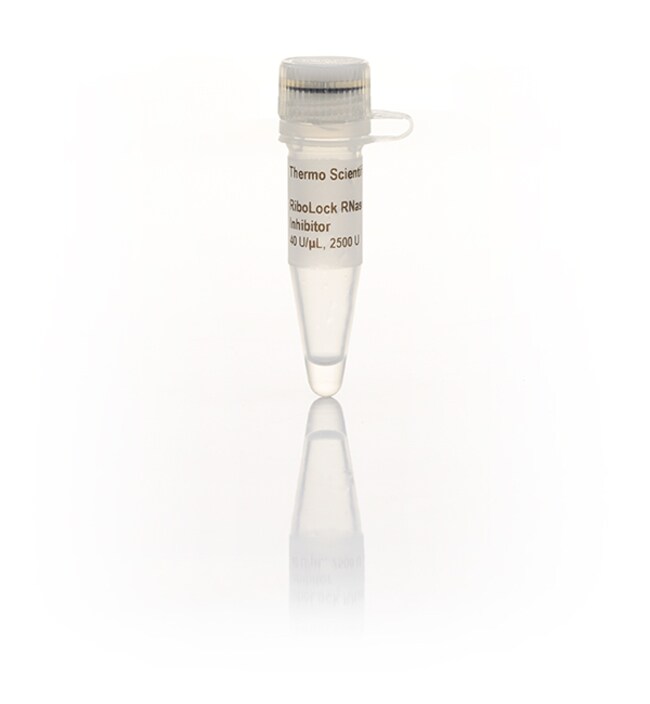
RiboLock RNase Inhibitor (40 U/μl)
Thermo Scientific RiboLock RNase Inhibitor hemmt die Aktivität von RNase A, B und C, durch nicht-kompetitive Bindung im Verhältnis 1:1.Weitere Informationen
Have Questions?
Ansicht ändern

| Katalognummer | Menge |
|---|---|
| EO0382 | 4 x 2500 U |
| EO0381 | 2500 E |
| EO0384 | 24 x 2500 E |
Katalognummer EO0382
Preis (EUR)
262,65
Exklusiv online
316,00Ersparnis 53,35 (17%)
Each
Menge:
4 x 2500 U
Preis (EUR)
262,65
Exklusiv online
316,00Ersparnis 53,35 (17%)
Each
Thermo Scientific RiboLock RNase Inhibitor hemmt die Aktivität von RNase A, B und C, durch nicht-kompetitive Bindung im Verhältnis 1:1. Es hemmt keine eukaryotischen RNasen T1, T2, U1, U2, CL3 sowie prokaryotische RNasen I und H.
Highlights
• Gute Wirkung unter zahlreichen Reaktionsbedingungen
• Schützt RNA vor Zersetzung bei Temperaturen bis zu 55°C
Hinweis
DTT im Speicherpuffer gewährleistet Stabilität während der Langzeitlagerung, ist aber nicht für die Inhibitoraktivität erforderlich. Empfohlene Konzentration: 1 U/µl eines Reaktionsgemisches.
Highlights
• Gute Wirkung unter zahlreichen Reaktionsbedingungen
• Schützt RNA vor Zersetzung bei Temperaturen bis zu 55°C
Hinweis
DTT im Speicherpuffer gewährleistet Stabilität während der Langzeitlagerung, ist aber nicht für die Inhibitoraktivität erforderlich. Empfohlene Konzentration: 1 U/µl eines Reaktionsgemisches.
Nur für Forschungszwecke. Nicht zur Verwendung bei diagnostischen Verfahren.
Specifications
Kompatibler PufferLagerungspuffer
ProdukttypRNase-Hemmer
Menge4 x 2500 U
Konzentration40 U/μl
ProduktlinieRiboLock
Unit SizeEach