Search
 Elementsuche
 Struktursuche


Thermo Scientific Chemicals
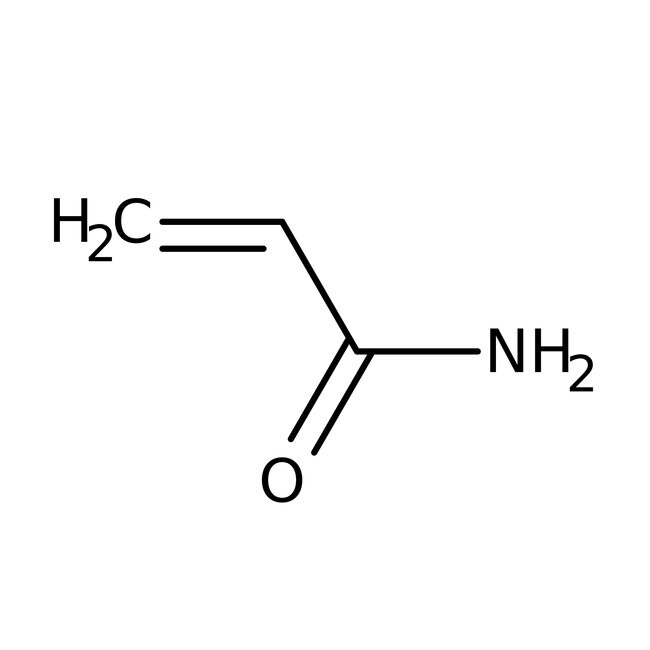
Acrylamid, 40%ige Lösung, frei von Bis-Acrylamid
CAS: 79-06-1 | C3H5NO | 71.08 g/mol
Have Questions?
Ansicht ändern


Katalognummer J62480.AP
auch als J62480-AP bezeichnet
Preis (EUR)
99,65
Exklusiv online
111,00Ersparnis 11,35 (10%)
Each
Menge:
500 mL
Preis (EUR)
99,65
Exklusiv online
111,00Ersparnis 11,35 (10%)
Each
Chemikalien-Kennzeichnungen
CAS79-06-1
IUPAC Nameprop-2-enamide
Molecular FormulaC3H5NO
InChI KeyHRPVXLWXLXDGHG-UHFFFAOYSA-N
SMILESNC(=O)C=C
Mehr anzeigen
Specifications Datenblatt
DatenblattFormLiquid
ConcentrationBisacrylamide: none
ConcentrationAcrylamide: 40%
CommentSuitable for electrophoresis
Acrylamide is a commonly used matrix for electrophoretic separation of nucleic acids and proteins. Acrylamide is used as a chemical intermediate in production of polyacrylamides, for use in protein electrophoresis (PAGE), synthesis of dyes and copolymers for contact lenses.
This Thermo Scientific Chemicals brand product was originally part of the Alfa Aesar product portfolio. Some documentation and label information may refer to the legacy brand. The original Alfa Aesar product / item code or SKU reference has not changed as a part of the brand transition to Thermo Scientific Chemicals.
Anwendungen
Acrylamid ist eine häufig verwendete Matrix für die elektrophoretische Trennung von Nukleinsäuren und Proteinen. Acrylamid wird als chemisches Zwischenprodukt bei der Herstellung von Polyacrylamiden verwendet, für die Proteinelektrophorese (PAGE), die Synthese von Farbstoffen und Copolymeren für Kontaktlinsen.
Löslichkeit
Es ist in Wasser löslich.
Hinweise
Kühl lagern. Behälter an einem trockenen und gut belüfteten Ort dicht verschlossen halten. Lichtempfindlich. Von Säuren, Oxidationsmitteln, Eisen- und Eisensalzen, Kupfer, Messing und Freiradikalinitiatoren fernhalten.
Acrylamid ist eine häufig verwendete Matrix für die elektrophoretische Trennung von Nukleinsäuren und Proteinen. Acrylamid wird als chemisches Zwischenprodukt bei der Herstellung von Polyacrylamiden verwendet, für die Proteinelektrophorese (PAGE), die Synthese von Farbstoffen und Copolymeren für Kontaktlinsen.
Löslichkeit
Es ist in Wasser löslich.
Hinweise
Kühl lagern. Behälter an einem trockenen und gut belüfteten Ort dicht verschlossen halten. Lichtempfindlich. Von Säuren, Oxidationsmitteln, Eisen- und Eisensalzen, Kupfer, Messing und Freiradikalinitiatoren fernhalten.
RUO – Research Use Only
Allgemeine Referenzen:
- Molloy, M.P., et al. Extraktion von Membranproteinen durch differenzielle Löslichkeit zur Trennung mittels zweidimensionaler Gelelektrophorese. Electrophoresis. 1998, 19, (5), 837-44.
- Rabilloud, T. Two-dimensional gel electrophoresis in proteomics: old, old fashioned, but it still climbs up the mountains. Proteomics. 2002, 2, (1), 3-10.