Search
 Elementsuche
 Struktursuche


Thermo Scientific Chemicals
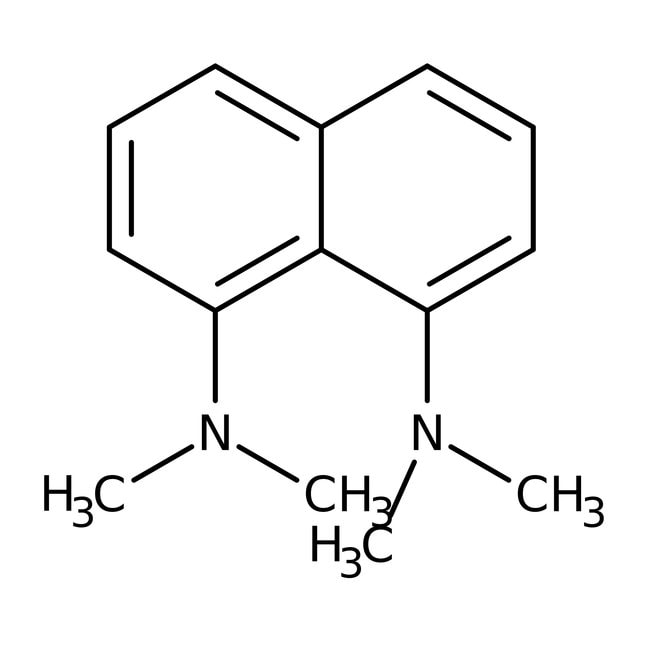
-Bis(Dimethylamino)naphthalin, 98+ %, Thermo Scientific Chemicals
CAS: 20734-58-1 | C14H18N2 | 214.312 g/mol
Have Questions?
Ansicht ändern


Katalognummer L00313.18
auch als L00313-18 bezeichnet
Preis (EUR)
150,00
Each
Menge:
50 g
Preis (EUR)
150,00
Each
Chemikalien-Kennzeichnungen
CAS20734-58-1
IUPAC NameN1,N1,N8,N8-tetramethylnaphthalene-1,8-diamine
Molecular FormulaC14H18N2
InChI KeyGJFNRSDCSTVPCJ-UHFFFAOYSA-N
SMILESCN(C)C1=CC=CC2=CC=CC(N(C)C)=C12
Mehr anzeigen
Specifications Datenblatt
DatenblattFormCrystalline powder
Melting Point (clear melt)46-52?C
Appearance (Color)White to cream to yellow to pink or pink-brown
Assay (GC)≥98.0%
1,8-Bis(dimethylamino)naphthalene is used in the synthesis of C-substituted t-BuNH-8,9-R,R?-nido-7,8,9-C3B8H9 (R,R? = H,H; MeH; Me,Me; Ph,H and Ph,Ph) tricarbollide compounds. It was also used in the preparation of saturated fluoroalkyl(hydrido) complexes of Iridium.
This Thermo Scientific Chemicals brand product was originally part of the Alfa Aesar product portfolio. Some documentation and label information may refer to the legacy brand. The original Alfa Aesar product / item code or SKU reference has not changed as a part of the brand transition to Thermo Scientific Chemicals.
Anwendungen
1,8-Bis(Dimethylamino)Naphthalin wird bei der Synthese von C-substituierten t-BuNH-8,9-R,R′-nido-7,8,9-C3B8H9(R,R′ = H,H; MeH; Me,Me; Ph,H und Ph,Ph)-Tricarbollid-Verbindungen verwendet. Es wurde auch bei der Herstellung gesättigter Fluorokyl(Hydrido)-Komplexe von Iridium verwendet.
Löslichkeit
Löslich in organischen Lösungsmitteln.
Hinweise
Luft- & lichtempfindlich. Behälter dicht verschlossen lassen. Kühl und trocken in einem gut versiegelten Behälter lagern.
1,8-Bis(Dimethylamino)Naphthalin wird bei der Synthese von C-substituierten t-BuNH-8,9-R,R′-nido-7,8,9-C3B8H9(R,R′ = H,H; MeH; Me,Me; Ph,H und Ph,Ph)-Tricarbollid-Verbindungen verwendet. Es wurde auch bei der Herstellung gesättigter Fluorokyl(Hydrido)-Komplexe von Iridium verwendet.
Löslichkeit
Löslich in organischen Lösungsmitteln.
Hinweise
Luft- & lichtempfindlich. Behälter dicht verschlossen lassen. Kühl und trocken in einem gut versiegelten Behälter lagern.
RUO – Research Use Only
Allgemeine Referenzen:
- Fumiyuki Ozawa.; Akihiko Kubo.; Tamio Hayashi. Palladium-catalyzed asymmetric arylation of 2,3-dihydrofuran: 1,8-Bis(dimethylamino)naphthalene as an efficient base. Tetrahedron Letters. 1992, 33, (11), 1485-1488.
- Danuta Pyzalska.; Robert Pyzalski.; Teresa Borowiak. Structure of 1,8-bis(dimethylamino)naphthalene hydrobromide dihydrate. Journal of Crystallographic and Spectroscopic Research. 1983, 13, (3), 211-220.
- Die Van der Waals-Spannung wird bei der Protonierung abgebaut, daher ist sie eine der stärksten bekannten organischen Basen, ist aber nur schwach nukleophile: Chem. Commun., 723 (1968). Bei DMF werden Vic-Dibromide mit hoher Ausbeute debromiert: Synth. Commun., 5, 87 (1975).
- Wurde in Kombination mit Diphenyl Phosphonazid, A12124, zur Umwandlung von Carbonsäuren in Isocyanate verwendet: Synth. Commun., 23, 335 (1993). Bevorzugte Base für die Umwandlung aliphatischer Amine in Isocyanate mit Trichlormethyl Chlorformiat, A17444.