Search
 Elementsuche
 Struktursuche


Thermo Scientific Chemicals
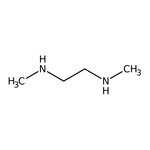
N,N'-Dimethylethylenediamin, 95 %, Thermo Scientific Chemicals
CAS: 110-70-3 | C4H12N2 | 88.154 g/mol
Have Questions?
Ansicht ändern


Katalognummer L02204.14
auch als L02204-14 bezeichnet
Preis (EUR)
153,00
Each
Menge:
25 g
Preis (EUR)
153,00
Each
Chemikalien-Kennzeichnungen
CAS110-70-3
IUPAC Namemethyl[2-(methylamino)ethyl]amine
Molecular FormulaC4H12N2
InChI KeyKVKFRMCSXWQSNT-UHFFFAOYSA-N
SMILESCNCCNC
Mehr anzeigen
Specifications Datenblatt
DatenblattRefractive Index1.4270-1.4330 @ 20?C
FormLiquid
Identification (FTIR)Conforms
Appearance (Color)Clear colorless to pale yellow
Assay (GC)≥94.0%
N,N'-Dimethylethylenediamine is used in DNA binding effect. It is used to enhance the adsorption of carbon dioxide. It acts as a ligand and form coordination complex such as dinitrato(N,N'-dimethyl-1,2-ethanediamine)copper(II) and dichloro(1,4-bis-(diphenyl phosphino)butane)-(1,2-ethylenediamine)ruthenium(II).
This Thermo Scientific Chemicals brand product was originally part of the Alfa Aesar product portfolio. Some documentation and label information may refer to the legacy brand. The original Alfa Aesar product / item code or SKU reference has not changed as a part of the brand transition to Thermo Scientific Chemicals.
Anwendungen
N,N′ -Dimethylethylendiamin wird bei der DNA-Bindungswirkung verwendet. Es wird zur Verbesserung der Adsorption von Kohlendioxid verwendet. Es fungiert als Ligand und bildet Koordinationskomplex wie Dinitrato(N,N′ -dimethyl-1,2 -Ethandiamin)Kupfer(II) und Dichlor(1,4 -bis-(Diphenylphosphin)butan)-(1,2 -ethylendiamin)Ruthenium(II).
Löslichkeit
Mischbar mit Chloroform und Dichlormethan.
Hinweise
Nicht kompatibel mit Säuren, sauren Chloriden, sauren Anhydriden, starken Oxidationsmitteln und Kohlendioxid.
N,N′ -Dimethylethylendiamin wird bei der DNA-Bindungswirkung verwendet. Es wird zur Verbesserung der Adsorption von Kohlendioxid verwendet. Es fungiert als Ligand und bildet Koordinationskomplex wie Dinitrato(N,N′ -dimethyl-1,2 -Ethandiamin)Kupfer(II) und Dichlor(1,4 -bis-(Diphenylphosphin)butan)-(1,2 -ethylendiamin)Ruthenium(II).
Löslichkeit
Mischbar mit Chloroform und Dichlormethan.
Hinweise
Nicht kompatibel mit Säuren, sauren Chloriden, sauren Anhydriden, starken Oxidationsmitteln und Kohlendioxid.
RUO – Research Use Only
Allgemeine Referenzen:
- Reagenz zum Schutz von Aldehydgruppen als2 -substituierte-1,3 -Dimethylimidazolidine, z. B. durch azeotrope Dehydrierung mit Benzol. Die Derivate sind stabil bis n-BuLi und LDA und können durch Säurehydrolyse oder in hoher Ausbeute durch Quaternisierung mit MeI und leichter Hydrolyse gespalten werden: Tetrahedron, 41, 3803 (1985). Bei aromatischen Aldehyden werden die Imidazolidin-Derivate zur Ortho-Lithiierung aktiviert und bieten so einen Weg zu o-substituierten Benzaldehyden: J. Org. Chem., 44, 2004 (1979).
- Kürkçüoğlu, G. S.; Yeşilel, O. Z.; Aksel, M.; Büyükgüngör, O. Hetero-octanuclear cubane-like and one-dimensional cyano complexes with the N,N-dimethylethylenediamine ligand. Polyhedron 2015, 85, 720-726.
- Mandal, S.; Naskar, B.; Modak, R.; Sikdar, Y.; Chatterjee, S.; Biswas, S.; Mondal, T. K.; Modak, D.; Goswami, S. Syntheses, crystal structures, spectral study and DFT calculation of three new copper(II) complexes derived from pyridoxal hydrochloride, N,N-dimethylethylenediamine and N,N-diethylethylenediamine. J. Mol. Struct. 2015, 1088, 38-49.