Search


Zitierungen und Referenzen (14)
Invitrogen™
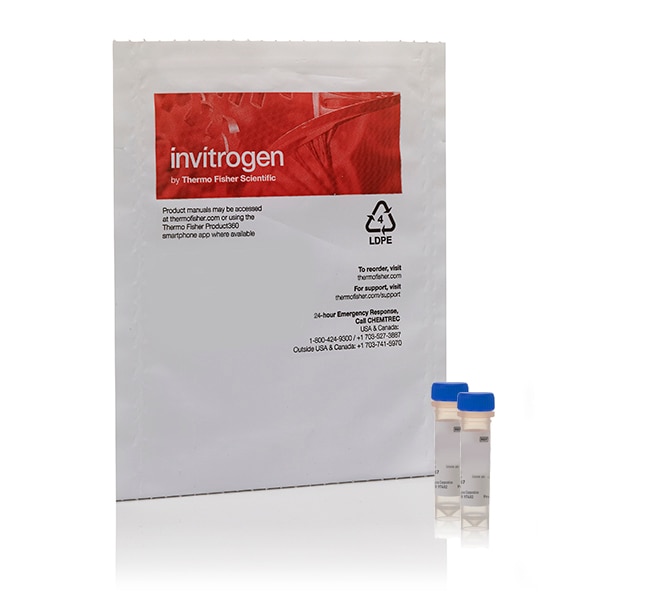
FilmTracer™ LIVE/DEAD™ Biofilmviabilitäts-Kit
Das FilmTracer™ LIVE⁄DEAD Biofilm Viabilitätskit liefert einen zweifarbigen Fluoreszenz-Assay für die Bakterienviabilität auf der Grundlage der Membranintegrität, der sich fürWeitere Informationen
| Katalognummer | Menge |
|---|---|
| L10316 | 1 Kit |
Katalognummer L10316
Preis (EUR)
792,00
Each
Menge:
1 Kit
Preis (EUR)
792,00
Each
Das FilmTracer™ LIVE⁄DEAD Biofilm Viabilitätskit liefert einen zweifarbigen Fluoreszenz-Assay für die Bakterienviabilität auf der Grundlage der Membranintegrität, der sich für eine Vielzahl von Bakteriengattungen, einschließlich solcher, die in Biofilm-Gemeinschaften wachsen, bewährt hat. Das LIVEDEAD Biofilm Viabilitätskit verwendet Mischungen aus unserem SYTO® 9 grün fluoreszierendem Nukleinsäure-Färbemittel und dem rot-fluoreszierenden Nukleinsäure-Färbemittel Propidiumiodid. Diese Farbstoffe unterscheiden sich sowohl in ihren spektralen Eigenschaften als auch in ihrer Fähigkeit, in gesunde Bakterienzellen einzudringen. Bei alleiniger Anwendung markiert der SYTO® 9 Farbstoff im Allgemeinen alle Bakterien in einer Population: solche mit intakten Membranen und solche mit beschädigten Membranen. Im Gegensatz dazu dringt Propidiumiodid nur in Bakterien mit beschädigten Membranen ein, wodurch eine geringere Fluoreszenz mit SYTO® 9 Färbemittel mit beiden Farbstoffen entsteht. So färben Bakterien mit einer geeigneten Mischung aus SYTO™ 9 und Propdiumiodid-Färbungen fluoreszierend grün, während Bakterien mit beschädigten Membranen fluoreszierend rot färben.
Nur für Forschungszwecke. Nicht zur Verwendung bei diagnostischen Verfahren.
Specifications
NachweisverfahrenFluoreszent, Fluoreszent
FarbstofftypSYTO™ 9, Propidiumjodid
FormFlüssig
Menge1 Kit
VersandbedingungRaumtemperatur, Raumtemperatur
Subzelluläre LokalisationZytoplasma und Zytosol
FarbeRot, grün
EmissionSichtbar
Zur Verwendung mit (Anwendung)Viabilitätsassay
Zur Verwendung mit (Geräte)Konfokalmikroskop, Fluoreszenzmikroskop, Durchflusszytometer, Mikrotiterplatten-Lesegerät, Fluoreszenz-Bildgebungsgerät, Konfokalmikroskop, Fluoreszenzmikroskop, Durchflusszytometer, Mikrotiterplatten-Lesegerät, Fluoreszenz-Imager
ProduktlinieFilmTracer, Molecular Probes
ProdukttypBiofilm Viabilitätskit
Unit SizeEach
Inhalt und Lagerung
2 Zutaten, im Tiefkühlgerät lagern (-5 bis -30 °C); vor Licht schützen
Häufig gestellte Fragen (FAQ)
How do I prepare dead cell controls for LIVE/DEAD cell viability assays?
Zitierungen und Referenzen (14)
Zitierungen und Referenzen
Abstract
Biofilm formations in nasopharyngeal tissues of patients with nasopharyngeal osteoradionecrosis.
Journal:Otolaryngol Head Neck Surg
PubMed ID:23348872
'Objective Determine the presence of nasopharynx biofilms in patients with nasopharyngeal cancer (NPC) and osteoradionecrosis (ORN) and patients with NPC but no ORN. Study Design Cross-sectional study. Setting Tertiary referral medical center. Subjects and Methods We enrolled 27 patients with NPC from our outpatient clinic during January 2010 to June
Comparison of methods for evaluation of the bactericidal activity of copper-sputtered surfaces against methicillin-resistant Staphylococcus aureus.
Journal:Appl Environ Microbiol
PubMed ID:22983970
Bacteria can survive on hospital textiles and surfaces, from which they can be disseminated, representing a source of health care-associated infections (HCAIs). Surfaces containing copper (Cu), which is known for its bactericidal properties, could be an efficient way to lower the burden of potential pathogens. The antimicrobial activity of Cu-sputtered
Fratricide is essential for efficient gene transfer between pneumococci in biofilms.
Journal:Appl Environ Microbiol
PubMed ID:22706053
Streptococcus pneumoniae and a number of commensal streptococcal species are competent for natural genetic transformation. The natural habitat of these bacteria is multispecies biofilms in the human oral cavity and nasopharynx. Studies investigating lateral transfer of virulence and antibiotic resistance determinants among streptococci have shown that interspecies as well as
Comparison of different live/dead stainings for detection and quantification of adherent microorganisms in the initial oral biofilm.
Journal:Clin Oral Investig
PubMed ID:22821430
The aim of the present study was to investigate different fluorescence-based, two-color viability assays for visualization and quantification of initial bacterial adherence and to establish reliable alternatives to the ethidium bromide staining procedure. Bacterial colonization was attained in situ on bovine enamel slabs (n?=?6 subjects). Five different live/dead assays were
Rapid Bacterial Detection during Endodontic Treatment.
Journal:J Dent Res
PubMed ID:28530469