Search
 Elementsuche
 Struktursuche


Thermo Scientific Chemicals
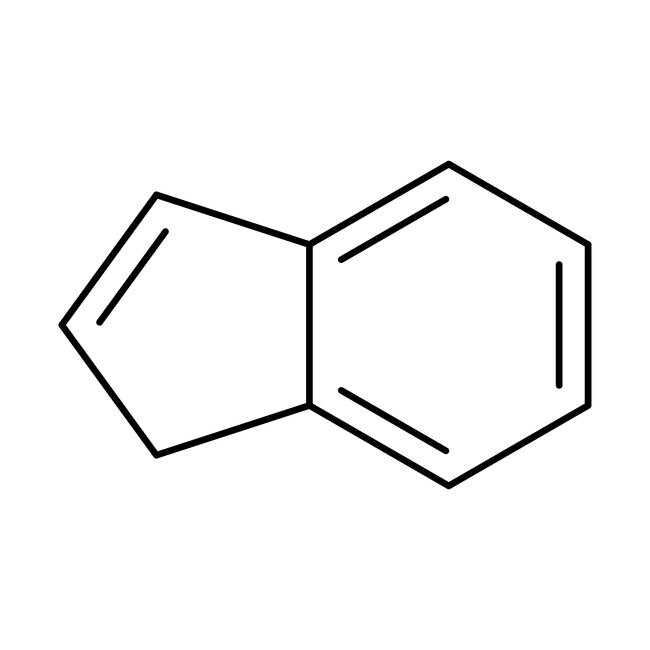
1H-Inden, 97 %, Thermo Scientific Chemicals
CAS: 95-13-6 | C9H8 | 116.163 g/mol
Have Questions?
Ansicht ändern


Katalognummer L12665.14
auch als L12665-14 bezeichnet
Preis (EUR)
209,00
Each
Menge:
25 g
Preis (EUR)
209,00
Each
Chemikalien-Kennzeichnungen
CAS95-13-6
IUPAC Name1H-indene
Molecular FormulaC9H8
InChI KeyYBYIRNPNPLQARY-UHFFFAOYSA-N
SMILESC1C=CC2=CC=CC=C12
Mehr anzeigen
Specifications Datenblatt
DatenblattAssay (GC)>96.0%
Refractive Index1.5720-1.5770 @ 20?C
FormLiquid
Appearance (Color)Clear colorless to yellow
1H-Indene is used in the synthesis of new C60 derivative, indene-C60 bisadduct1. It was used in preparing polyindene by the controlled cationic polymerization initiated with cumyl methyl ether/TiCl4 in CH2Cl2. It is also used in the synthesis of istatins and in the production of indene/cumarone thermoplastic resins.
This Thermo Scientific Chemicals brand product was originally part of the Alfa Aesar product portfolio. Some documentation and label information may refer to the legacy brand. The original Alfa Aesar product / item code or SKU reference has not changed as a part of the brand transition to Thermo Scientific Chemicals.
Anwendungen
1H-Inden wird bei der Synthese des neuen C60-Derivats Inden-C60-bisaddukt1 verwendet. Wurde bei der Herstellung von Polyinden durch kontrollierte kationische Polymerisation verwendet, eingeleitet durch Cumylmethylether/TiCl4 in CH2Cl2. Wird auch bei der Synthese von Istatinen und bei der Herstellung von thermoplastischen Inden-Cumaron-Harzen verwendet.
Löslichkeit
Löslich in Ethanol, Aceton, Ethylether und Ether. Unlöslich in Wasser.
Hinweise
Kühl lagern. Behälter an einem trockenen und gut belüfteten Ort dicht verschlossen halten. Geöffnete Behälter müssen wieder luftdicht verschlossen und aufrecht gelagert werden, um ein Auslaufen zu vermeiden. Nicht kompatibel mit starken Oxidationsmitteln. Empfohlene Lagertemperatur ist 2-8 °C. Lichtempfindliche Substanz.
1H-Inden wird bei der Synthese des neuen C60-Derivats Inden-C60-bisaddukt1 verwendet. Wurde bei der Herstellung von Polyinden durch kontrollierte kationische Polymerisation verwendet, eingeleitet durch Cumylmethylether/TiCl4 in CH2Cl2. Wird auch bei der Synthese von Istatinen und bei der Herstellung von thermoplastischen Inden-Cumaron-Harzen verwendet.
Löslichkeit
Löslich in Ethanol, Aceton, Ethylether und Ether. Unlöslich in Wasser.
Hinweise
Kühl lagern. Behälter an einem trockenen und gut belüfteten Ort dicht verschlossen halten. Geöffnete Behälter müssen wieder luftdicht verschlossen und aufrecht gelagert werden, um ein Auslaufen zu vermeiden. Nicht kompatibel mit starken Oxidationsmitteln. Empfohlene Lagertemperatur ist 2-8 °C. Lichtempfindliche Substanz.
RUO – Research Use Only
Allgemeine Referenzen:
- Hahn SF.; Hillmyer MA. High glass transition temperature polyolefins obtained by the catalytic hydrogenation of polyindene. Macromolecules. 2003, 36 (1), 71-76.
- Youjun He.; Hsiang-Yu Chen.; Jianhui Hou.; Yongfang Li. Indene-C(60) bisadduct: a new acceptor for high-performance polymer solar cells. Journal of the American Chemical Society. 2010, 132 (4), 1377-1382.