Search


Zitierungen und Referenzen (8)
Invitrogen™
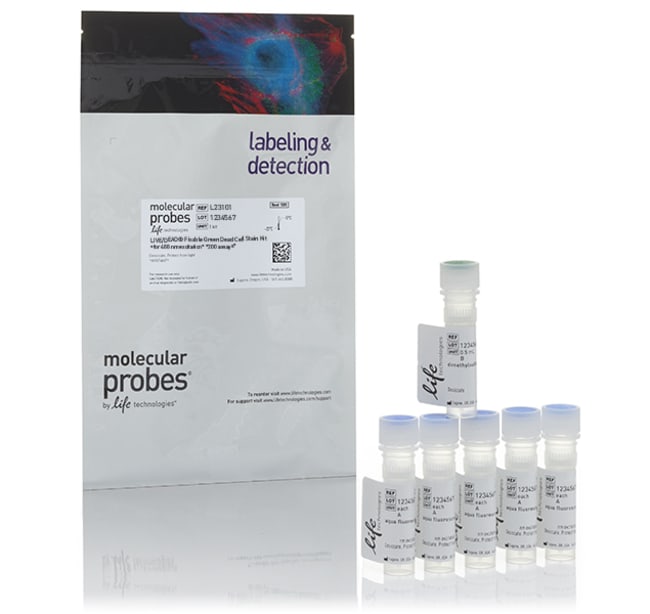
LIVE/DEAD™ Fixable Green Dead Cell Stain Kit, for 488 nm excitation
Das LIVE/DEAD™ Fixable Green Dead Cell Stain Kit dient der Bestimmung der Zellviabilität vor einer Fixierung und Permeabilisierung, die fürWeitere Informationen
Have Questions?
Ansicht ändern

| Katalognummer | Menge |
|---|---|
| L23101 | 200 Assays |
| L34970 | 400 Assays |
| L34969 | 80 Assays |
Katalognummer L23101
Preis (EUR)
350,65
Online Exclusive
468,00Ersparnis 117,35 (25%)
Each
Menge:
200 Assays
Preis (EUR)
350,65
Online Exclusive
468,00Ersparnis 117,35 (25%)
Each
Das LIVE/DEAD™ Fixable Green Dead Cell Stain Kit dient der Bestimmung der Zellviabilität vor einer Fixierung und Permeabilisierung, die für die intrazelluläre Färbung mit Antikörpern erfoderlich ist, oder der Beseitigung biogefährlicher Materialien mittels Formaldehyd-Fixierung. Dieses Kit wurde für die Verwendung mit einem Durchflusszytometer mit blauem Laser optimiert und validiert.
• Stabil — Farbstoffe werden in separaten Fläschchen gefriergetrocknet, um Stabilität zu erhalten
• Robust — Färbemuster ist vor und nach der Fixierung gleich
• Helles Signal — Ermöglicht eine einfache Unterscheidung zwischen lebenden/toten Zellen in einem Kanal
Sehen Sie sich eine Auswahlanleitung für alle fixierbaren Viabilitätfarbstoffe für die Durchflusszytometrie an.
Stabil
Im Gegensatz zu Produkten, die als Lösung verkauft werden, wurden die LIVE/DEAD™ Fixable Green Stain praktisch in 40 Testfläschchen verpackt, um eine langanhaltende Stabilität und Leistung des Farbstoffs zu gewährleisten. Amin-reaktive Farbstoffe in Lösung verlieren ihre Wirksamkeit nach kurzer Zeit. Es ist daher empfehlenswert, das Röhrchen nach der Rehydrierung komplett aufzubrauchen. Falls dies nicht möglich ist, aliquotieren Sie die Röhrchen in kleinere Volumen, und bewahren Sie diese bei -80 °C unter Vermeidung von wiederholtem Einfrieren und Auftauen auf.
Robust
Farbstoffe, die zur Kenntlichmachung toter Zellen eingesetzt werden, können nach bestimmten Behandlungsverfahren an Empfindlichkeit verlieren. Dazu gehören die Behandlung mit Fixiermitteln wie Formaldehyd oder Fixiermethoden, die auf Ethanol basieren und die für intrazelluläre Phosphorylierungsstudien benötigt werden. Der LIVE/DEAD™ Fixable Green Stain ist ein Amin-reaktiver Farbstoff, der kovalent an intrazelluläre und extrazelluläre Amine bindet. Das Färbungsmuster bleibt nach der Formaldehyd-Fixierung erhalten.
Optimale Helligkeit
Der LIVE/DEAD™ Fixable Green Stain wurde wegen seiner fluoreszierenden Eigenschaften ausgewählt und erzeugt nach Anregung durch einen blauen 488-nm-Laser ein helles Signal. Der grün-fluoreszierende reaktive Farbstoff hat ein Anregungsmaximum bei ∼495 nm, ideal für den Einsatz mit einem blauen Laser, und eine Emission bei ∼520 nm zur Detektion im FITC-Kanal. Da lebende und tote Zellen mit einem einzigen Farbstoff und einem einzigen Kanal eines Durchflusszytometers diskriminiert werden können, ist er ideal für mehrfarbige Experimente.
Funktionsweise
In Zellen mit beeinträchtigten Membranen reagiert der Farbstoff mit freien Aminen sowohl im Zellinneren als auch auf der Zelloberfläche, was zu einer intensiven fluoreszierenden Färbung führt. Bei lebensfähigen Zellen ist die Reaktivität des Farbstoffs auf die Amine der Zelloberfläche beschränkt und die Fluoreszenz weniger intensiv. Der Unterschied zwischen den Intensitäten beträgt in der Regel mehr als das 50-Fache zwischen lebenden und toten Zellen, sodass eine Unterscheidung problemlos möglich ist.
Erhältliche Farben
LIVE/DEAD™ Fixable Dead Cell Stains sind in unterschiedlichen Farben erhältlich, um eine flexible Kombination mit anderen Farbstoffen zu ermöglichen.
• Stabil — Farbstoffe werden in separaten Fläschchen gefriergetrocknet, um Stabilität zu erhalten
• Robust — Färbemuster ist vor und nach der Fixierung gleich
• Helles Signal — Ermöglicht eine einfache Unterscheidung zwischen lebenden/toten Zellen in einem Kanal
Sehen Sie sich eine Auswahlanleitung für alle fixierbaren Viabilitätfarbstoffe für die Durchflusszytometrie an.
Stabil
Im Gegensatz zu Produkten, die als Lösung verkauft werden, wurden die LIVE/DEAD™ Fixable Green Stain praktisch in 40 Testfläschchen verpackt, um eine langanhaltende Stabilität und Leistung des Farbstoffs zu gewährleisten. Amin-reaktive Farbstoffe in Lösung verlieren ihre Wirksamkeit nach kurzer Zeit. Es ist daher empfehlenswert, das Röhrchen nach der Rehydrierung komplett aufzubrauchen. Falls dies nicht möglich ist, aliquotieren Sie die Röhrchen in kleinere Volumen, und bewahren Sie diese bei -80 °C unter Vermeidung von wiederholtem Einfrieren und Auftauen auf.
Robust
Farbstoffe, die zur Kenntlichmachung toter Zellen eingesetzt werden, können nach bestimmten Behandlungsverfahren an Empfindlichkeit verlieren. Dazu gehören die Behandlung mit Fixiermitteln wie Formaldehyd oder Fixiermethoden, die auf Ethanol basieren und die für intrazelluläre Phosphorylierungsstudien benötigt werden. Der LIVE/DEAD™ Fixable Green Stain ist ein Amin-reaktiver Farbstoff, der kovalent an intrazelluläre und extrazelluläre Amine bindet. Das Färbungsmuster bleibt nach der Formaldehyd-Fixierung erhalten.
Optimale Helligkeit
Der LIVE/DEAD™ Fixable Green Stain wurde wegen seiner fluoreszierenden Eigenschaften ausgewählt und erzeugt nach Anregung durch einen blauen 488-nm-Laser ein helles Signal. Der grün-fluoreszierende reaktive Farbstoff hat ein Anregungsmaximum bei ∼495 nm, ideal für den Einsatz mit einem blauen Laser, und eine Emission bei ∼520 nm zur Detektion im FITC-Kanal. Da lebende und tote Zellen mit einem einzigen Farbstoff und einem einzigen Kanal eines Durchflusszytometers diskriminiert werden können, ist er ideal für mehrfarbige Experimente.
Funktionsweise
In Zellen mit beeinträchtigten Membranen reagiert der Farbstoff mit freien Aminen sowohl im Zellinneren als auch auf der Zelloberfläche, was zu einer intensiven fluoreszierenden Färbung führt. Bei lebensfähigen Zellen ist die Reaktivität des Farbstoffs auf die Amine der Zelloberfläche beschränkt und die Fluoreszenz weniger intensiv. Der Unterschied zwischen den Intensitäten beträgt in der Regel mehr als das 50-Fache zwischen lebenden und toten Zellen, sodass eine Unterscheidung problemlos möglich ist.
Erhältliche Farben
LIVE/DEAD™ Fixable Dead Cell Stains sind in unterschiedlichen Farben erhältlich, um eine flexible Kombination mit anderen Farbstoffen zu ermöglichen.
Nur für Forschungszwecke. Nicht zur Verwendung bei diagnostischen Verfahren.
Specifications
ZellpermeabilitätNicht zellgängig
ZelltypEukaryotische Zellen
BeschreibungLIVE/DEAD™ Kit mit fixierbarem grünem Totzellenfärbemittel zur Anregung mit 488 nm
NachweisverfahrenFluoreszent
FarbstofftypAndere Etiketten oder Farbstoffe
FormFest
FormatRöhrchen
Menge200 Assays
VersandbedingungRaumtemperatur
LöslichkeitDMSO (Dimethylsulfoxid)
FarbeGrün
Emission520 nm
Excitation Wavelength Range495 nm
Zur Verwendung mit (Anwendung)Viabilitätsassay
Zur Verwendung mit (Geräte)Durchflusszytometer
ProduktlinieLIVE/DEAD
ProdukttypFärben
Unit SizeEach
Inhalt und Lagerung
Enthält 5 Fläschchen LIVE/DEAD™ Fixierbares Totzellenfärbemittel und 500 μl DMSO.
Bei -20 °C lagern.
Bei -20 °C lagern.
Häufig gestellte Fragen (FAQ)
I need to use a dead cell control for my viability assay. Do you have a protocol for killing cells for this?
Regarding the LIVE/DEAD Fixable Dead Cell Stain Kits, which can discriminate between live and dead cells using flow cytometry with one emission wavelength. Can these kits be used with microscopy?
How do I prepare dead cell controls for LIVE/DEAD cell viability assays?
Which cell viability kits are compatible with fixation?
Why do I need to include a viability stain in my assays?
Zitierungen und Referenzen (8)
Zitierungen und Referenzen
Abstract
Techniques to improve the direct ex vivo detection of low frequency antigen-specific CD8+ T cells with peptide-major histocompatibility complex class I tetramers.
Journal:Cytometry A
PubMed ID:18836993
'The ability to quantify and characterize antigen-specific CD8+ T cells irrespective of functional readouts using fluorochrome-conjugated peptide-major histocompatibility complex class I (pMHCI) tetramers in conjunction with flow cytometry has transformed our understanding of cellular immune responses over the past decade. In the case of prevalent CD8+ T cell populations that
Amine reactive dyes: an effective tool to discriminate live and dead cells in polychromatic flow cytometry.
Journal:J Immunol Methods
PubMed ID:16756987
'Membrane-damaged cells caused by either mechanical trauma or through normal biological processes can produce artifacts in immunophenotyping analysis by flow cytometry. Dead cells can nonspecifically bind monoclonal antibody conjugates, potentially leading to erroneous conclusions, particularly when cell frequencies are low. To date, DNA intercalating dyes (Ethidium monoazaide (EMA), Propidium Iodide,
Phenotypic Screening with Human iPS Cell-Derived Cardiomyocytes: HTS-Compatible Assays for Interrogating Cardiac Hypertrophy.
Journal:
PubMed ID:24071917
'A major hurdle for cardiovascular disease researchers has been the lack of robust and physiologically relevant cell-based assays for drug discovery. Derivation of cardiomyocytes from human-induced pluripotent stem (iPS) cells at high purity, quality, and quantity enables the development of relevant models of human cardiac disease with source material that
Anakinra treatment in patients with refractory inflammatory myopathies and possible predictive response biomarkers: a mechanistic study with 12 months follow-up.
Journal:Ann Rheum Dis
PubMed ID:23625983
'OBJECTIVE: To perform a mechanistic study on the effect of interleukin (IL)-1 blockade by anakinra in patients with refractory myositis and to explore possible predictive biomarkers. METHODS: Fifteen patients with refractory myositis were treated with anakinra for 12 months. Clinical response was assessed by the six-item core set measures of
Blocking angiotensin-converting enzyme induces potent regulatory T cells and modulates TH1- and TH17-mediated autoimmunity.
Journal:Proc Natl Acad Sci U S A
PubMed ID:19706421
The renin-angiotensin-aldosterone system (RAAS) is a major regulator of blood pressure. The octapeptide angiotensin II (AII) is proteolytically processed from the decapeptide AI by angiotensin-converting enzyme (ACE), and then acts via angiotensin type 1 and type 2 receptors (AT1R and AT2R). Inhibitors of ACE and antagonists of the AT1R are