Search


Zitierungen und Referenzen (2)
Invitrogen™
Pacific Orange™ and Pacific Blue™ Antibody Labeling Kits
Antibody Labeling Kits specifically bind small amounts of antibody with violet light-excitable Pacific Orange or Pacific Blue dyes. Conveniently label up to 100 μg of antibody per reaction, with 5 reactions per kit.
Have Questions?
Ansicht ändern

| Katalognummer | Anregung/Emission | Farbe |
|---|---|---|
| P30014 | 405/551 | Pacific Orange |
| P30013 | 410/455 | Pacific Blue |
Katalognummer P30014
Preis (EUR)
974,00
Each
Anregung/Emission:
405/551
Farbe:
Pacific Orange
Preis (EUR)
974,00
Each
Pacific Orange and Pacific Blue antibody labeling kits enable attachment of a violet light-excitable fluorescent label on antibodies (up to 100 μg per reaction). Each kit contains enough dye for five reactions.
A primary antibody directly labeled with a fluorophore often produces lower background fluorescence and less nonspecific binding. Primary antibodies of the same isotype or derived from the same species can be multiplexed if they are directly labeled with compatible fluorophores. Using Pacific Blue and Pacific Orange dyes simultaneously allows you to excite both dyes at the same wavelength while their emissions are differentially distinguished.
Pacific Orange and Pacific Blue antibody labeling kits allow the labeling of small amounts of antibody with a violet light-excitable dye (up to 100 μg of antibody per reaction). Small amounts of other proteins (>40 kDa) can also be labeled using these kits.
Features of these antibody labeling kits
• Pacific Blue excitation and emission maxima: 410/455 nm
• Pacific Orange excitation and emission maxima: 405/551 nm
• Labeled proteins typically ready to use in 90 min. (∼15 min. hands-on time)
• Optimized for small-scale labeling of any protein >40 kDa
• Stabilizing proteins should be removed from the sample before labeling
• Purified using convenient spin filters
• Includes detailed instructions for determining degree of labeling (DOL)
These kits contain everything you need to perform five separate labeling reactions as well as to purify the resulting conjugates. Conjugates are ideal for multiple applications, including flow cytometry, fluorescent microscopy, immunohistochemistry, primary detection, ELISA, immunocytochemistry, indirect FISH, and more. We are ISO 13485:2000 certified.
For Research Use Only. Not for use in diagnostic procedures.
Specifications
FarbePacific Orange
NachweisverfahrenFluoreszent, Fluoreszenz, Fluoreszent, Fluoreszenz
Anregung/Emission405/551
MarkertypPacific Farbstoffe
Kennzeichnungsmaßstab100 μg
ProduktliniePacific Orange
ProdukttypAntikörpermarkierungskit
Menge5 Reaktionen
VersandbedingungRaumtemperatur
Ausreichend für5 Reactions
Chemische ReaktivitätAmin
Labeling TargetAntikörper, Proteine
Marker oder FarbstoffPacific Orange, Pacific Orange
LöslichkeitDMSO (Dimethylsulfoxid)
Unit SizeEach
Inhalt und Lagerung
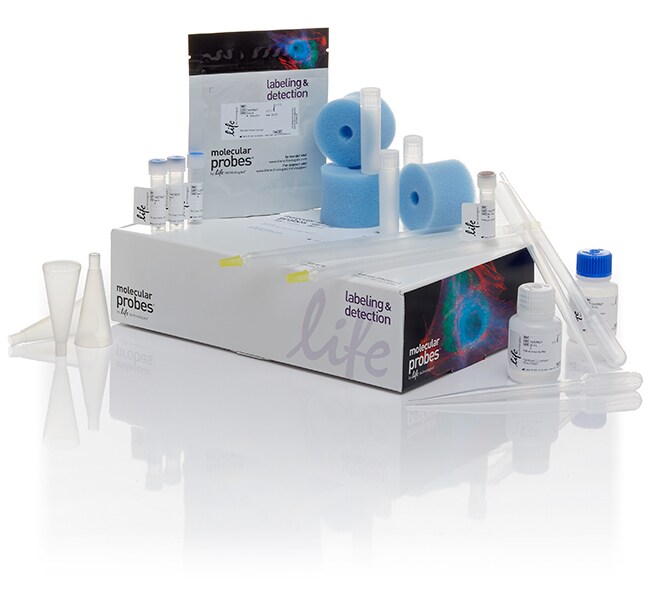
Das Pacific Orange™ Antikörperkennzeichnungskit wird mit 5 Fläschchen mit reaktivem Farbstoff, Natriumbicarbonat, Reinigungsharz, Spin-Säulen und Entnahmeröhrchen geliefert.
Zwischen 2 und 8 °C lichtgeschützt lagern. Komponente A kann zwischen -20 und 8 °C gelagert werden.
Zwischen 2 und 8 °C lichtgeschützt lagern. Komponente A kann zwischen -20 und 8 °C gelagert werden.
Häufig gestellte Fragen (FAQ)
What formulation of antibody should I use for conjugation for small animal in vivo imaging?
What is degree of labeling (DOL)?
Zitierungen und Referenzen (2)
Zitierungen und Referenzen
Abstract
Lytic immune synapse function requires filamentous actin deconstruction by Coronin 1A.
Journal:
PubMed ID:24760828
'Lytic immune effector function depends upon directed secretion of cytolytic granules at the immunological synapse (IS) and requires dynamic rearrangement of filamentous (F)-actin. Coronin 1A (Coro1A) is the hematopoietic-specific member of the Coronin family of actin regulators that promote F-actin disassembly. Here, we show that Coro1A is required for natural
Perinucleolar relocalization and nucleolin as crucial events in the transcriptional activation of key genes in mantle cell lymphoma.
Journal:
PubMed ID:24452204
'In mantle cell lymphoma (MCL), one allele of the cyclin D1 (Ccnd1) gene is translocated from its normal localization on chromosome 11 to chromosome 14. This is considered as the crucial event in the transformation process of a normal naive B-cell; however, the actual molecular mechanism leading to Ccnd1 activation