Search


Zitierungen und Referenzen (23)
Invitrogen™
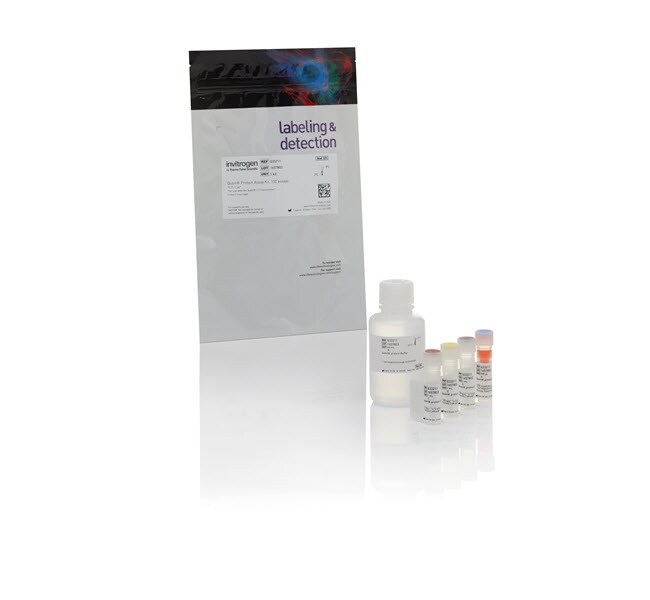
Qubit™ Protein Assay Kit
Mit Qubit Protein und Protein BR Assaykits für fluoreszenzbasierte Assays zur Proteinquantifizierung erzielen Sie einen empfindlichen Nachweis von Proteinen und eine geringe Protein-Protein-Variation.
Have Questions?
Ansicht ändern

| Katalognummer | Assay | Bestimmungsbereich | Ausreichend für |
|---|---|---|---|
| Q33211 | Qubit Protein Assay | 12,5 µg/ml bis 5 mg/ml | 100 Reaktionen |
| Q33212 | Qubit Protein Assay | 12,5 µg/ml bis 5 mg/ml | 500 Reaktionen |
| A50668 | Qubit Protein Broad Range Assay | 0,1 bis 20 mg/ml | 100 Reaktionen |
| A50669 | Qubit Protein Broad Range Assay | 0,1 bis 20 mg/ml | 500 Reaktionen |
Katalognummer Q33211
Preis (EUR)
156,65
キャンペーン価格
170,00Ersparnis 13,35 (8%)
Each
Assay:
Qubit Protein Assay
Bestimmungsbereich:
12,5 µg/ml bis 5 mg/ml
Ausreichend für:
100 Reaktionen
Preis (EUR)
156,65
キャンペーン価格
170,00Ersparnis 13,35 (8%)
Each
Quantifizieren Sie Proteine schnell und genau mit zwei einzigartigen Qubit Proteinquantifizierungskits, dem Qubit Protein Assay, der 12,5 μg/ml bis zu 5 mg/ml Protein quantifiziert, und dem Qubit Protein BR Assaykit, das 0,1 bis 20 mg/ml Protein quantifiziert. Beide Assays sind für viele gängige Kontaminanten verträglich, was Reagenzien, Salze und Nukleinsäuren reduziert. Das Protein BR Assaykit ist auch tolerant gegenüber Detergenzien.
Qubit Protein Assaykit
Das Qubit Protein Assaykit wurde speziell für die Verwendung mit allen Qubit Fluorometern entwickelt. Bei Verwendung von 1 bis 20 µl Probe kann dieser Assay Proben von 12,5 µg⁄ml bis zu 5 mg⁄ml mit geringer Variation zwischen Proteinen quantifizieren.
Das Qubit Protein Assaykit ist hochgradig selektiv für Proteine und so aufgebaut, dass es in Gegenwart von Reduktionsreagenzien genau ist, nicht aber in Gegenwart einer großen Menge an Detergenzien. Häufige Kontaminanten wie z. B. Reduktionsreagenzien (z. B. DTT, β-Mercaptoethanol), Salze, freie Nukleotide, Aminosäuren, Lösemittel und DNA, aber keine Detergenzien, sind in diesem Assay gut verträglich. Für andere Kontaminanten sind geringfügige Protokolländerungen erforderlich.
Das Kit enthält konzentrierte Assayreagenzien, Verdünnungspuffer und vorverdünnte BSA-Standards. Einfach das Reagenz mit dem im Lieferumfang enthaltenen Puffer verdünnen, Ihre Probe hinzufügen (beliebige Volumina zwischen 1 µl und 20 µl sind akzeptabel) und die Konzentration ablesen.
Welches Produkt sollten Sie für die fluorometrische Proteinquantifizierung wählen?
• 1 – 20 Proben: Verwenden Sie dieses Qubit Protein Assaykit mit dem Qubit Fluorometer
• 20 – 2.000 Proben: Verwenden Sie das Quant-iT Proteinassaykit mit einem Mikrotiterplatten-Lesegerät
Qubit Protein BR Assaykit
Das Qubit Protein BR Assaykit bietet eine schnelle, einfache und zuverlässige Methode zur Bestimmung der Proteinkonzentration von aufgereinigten Proteinen, Lysaten, Serum, Plasma oder komplexen Proteinmischungen mit einem Qubit 4 Fluorometer. Dieses Proteinkit liefert eine genaue Proteinquantifizierung über einen breiten Bereich (0,1 – 20 mg/ml), wodurch die meisten Proben sauber (unverdünnt) verwendet werden können und das mit den herkömmlichen Proteinquantifizierungsmethoden einhergehende Ausprobieren und die Verdünnungsschritte entfallen. Der Assay ist für viele gängige Kontaminanten wie Detergenzien, Reduktionsreagenzien (z. B. DTT, β-Mercaptoethanol), Salzen und Nukleinsäuren verträglich.
Zu den wichtigsten Merkmalen des Qubit Protein BR Assaykits gehören:
• Breiter dynamischer Bereich:—0,1 20 mg/ml, Messung von Proben ohne Verdünnung
• Zwei-Punkt-Standardkurve:—zeitaufwändige Standardpräparation entfällt
• Automatische Konzentrationsbestimmung:—Proteinkonzentration liegt sofort vor; keine Offline-Berechnungen erforderlich
• Kompatibel:—präzise bei Vorhandensein von Reduktionsreagenzien, Detergenzien und anderen gängigen Pufferkomponenten
Das Qubit Protein BR Assaykit enthält zwei Kalibrierstandards: Protein BR Assaypuffer und Protein BR Assayreagenz. Fügen Sie einfach 150 bis 160 µl Protein BR Assaypuffer zu 10 oder 20 µl Ihrer Probe hinzu, gefolgt von 30 µl Protein BR Assayreagenz. 10 Minuten bei Raumtemperatur inkubieren. Anschließend die Probe in ein Qubit 4-Gerät einführen und die Konzentration ablesen.
Hinweise
• Das Qubit Protein-Assay-Kit kann mit Qubit 1.0-, Qubit 2.0-, Qubit 3-, Qubit 4-, und Qubit Flex-Fluorometern verwendet werden.
• Das Qubit Protein BR Assay-Kit ist ein fluoreszenzbasierter Assay, der nur für den Einsatz mit den Qubit 4-Fluorometern vorgesehen ist
• Dünnwandige klare 500 µl-PCR-Röhrchen (Best.- Nr. Q32856) sind erforderlich, aber nicht in den Proteinassay- und BR-Assay-Kits enthalten.
Das Qubit Protein Assaykit wurde speziell für die Verwendung mit allen Qubit Fluorometern entwickelt. Bei Verwendung von 1 bis 20 µl Probe kann dieser Assay Proben von 12,5 µg⁄ml bis zu 5 mg⁄ml mit geringer Variation zwischen Proteinen quantifizieren.
Das Qubit Protein Assaykit ist hochgradig selektiv für Proteine und so aufgebaut, dass es in Gegenwart von Reduktionsreagenzien genau ist, nicht aber in Gegenwart einer großen Menge an Detergenzien. Häufige Kontaminanten wie z. B. Reduktionsreagenzien (z. B. DTT, β-Mercaptoethanol), Salze, freie Nukleotide, Aminosäuren, Lösemittel und DNA, aber keine Detergenzien, sind in diesem Assay gut verträglich. Für andere Kontaminanten sind geringfügige Protokolländerungen erforderlich.
Das Kit enthält konzentrierte Assayreagenzien, Verdünnungspuffer und vorverdünnte BSA-Standards. Einfach das Reagenz mit dem im Lieferumfang enthaltenen Puffer verdünnen, Ihre Probe hinzufügen (beliebige Volumina zwischen 1 µl und 20 µl sind akzeptabel) und die Konzentration ablesen.
Welches Produkt sollten Sie für die fluorometrische Proteinquantifizierung wählen?
• 1 – 20 Proben: Verwenden Sie dieses Qubit Protein Assaykit mit dem Qubit Fluorometer
• 20 – 2.000 Proben: Verwenden Sie das Quant-iT Proteinassaykit mit einem Mikrotiterplatten-Lesegerät
Qubit Protein BR Assaykit
Das Qubit Protein BR Assaykit bietet eine schnelle, einfache und zuverlässige Methode zur Bestimmung der Proteinkonzentration von aufgereinigten Proteinen, Lysaten, Serum, Plasma oder komplexen Proteinmischungen mit einem Qubit 4 Fluorometer. Dieses Proteinkit liefert eine genaue Proteinquantifizierung über einen breiten Bereich (0,1 – 20 mg/ml), wodurch die meisten Proben sauber (unverdünnt) verwendet werden können und das mit den herkömmlichen Proteinquantifizierungsmethoden einhergehende Ausprobieren und die Verdünnungsschritte entfallen. Der Assay ist für viele gängige Kontaminanten wie Detergenzien, Reduktionsreagenzien (z. B. DTT, β-Mercaptoethanol), Salzen und Nukleinsäuren verträglich.
Zu den wichtigsten Merkmalen des Qubit Protein BR Assaykits gehören:
• Breiter dynamischer Bereich:—0,1 20 mg/ml, Messung von Proben ohne Verdünnung
• Zwei-Punkt-Standardkurve:—zeitaufwändige Standardpräparation entfällt
• Automatische Konzentrationsbestimmung:—Proteinkonzentration liegt sofort vor; keine Offline-Berechnungen erforderlich
• Kompatibel:—präzise bei Vorhandensein von Reduktionsreagenzien, Detergenzien und anderen gängigen Pufferkomponenten
Das Qubit Protein BR Assaykit enthält zwei Kalibrierstandards: Protein BR Assaypuffer und Protein BR Assayreagenz. Fügen Sie einfach 150 bis 160 µl Protein BR Assaypuffer zu 10 oder 20 µl Ihrer Probe hinzu, gefolgt von 30 µl Protein BR Assayreagenz. 10 Minuten bei Raumtemperatur inkubieren. Anschließend die Probe in ein Qubit 4-Gerät einführen und die Konzentration ablesen.
Hinweise
• Das Qubit Protein-Assay-Kit kann mit Qubit 1.0-, Qubit 2.0-, Qubit 3-, Qubit 4-, und Qubit Flex-Fluorometern verwendet werden.
• Das Qubit Protein BR Assay-Kit ist ein fluoreszenzbasierter Assay, der nur für den Einsatz mit den Qubit 4-Fluorometern vorgesehen ist
• Dünnwandige klare 500 µl-PCR-Röhrchen (Best.- Nr. Q32856) sind erforderlich, aber nicht in den Proteinassay- und BR-Assay-Kits enthalten.
For Research Use Only. Not for use in diagnostic procedures.
Specifications
AssayQubit Protein Assay
Zur Verwendung mit (Geräte)Qubit Fluorometer, Mikrotiterplatten-Lesegerät
ProduktlinieQubit
ProdukttypAssay zur Proteinquantifizierung
Bestimmungsbereich12,5 µg/ml bis 5 mg/ml
Menge100 Assays
VersandbedingungRaumtemperatur
Ausreichend für100 Reaktionen
NachweisverfahrenFluoreszenz
Unit SizeEach
Häufig gestellte Fragen (FAQ)
How does the accuracy and sensitivity of the Qubit quantitation assays using the Qubit fluorometer compare to a microplate reader?
Can the Qubit kits give an indication of sample quality in nucleic acid samples?
Can I use the Quant-iT and Qubit Kits with other fluorometers?
Can I use the original Quant-iT Kits with the Qubit Fluorometer?
Is 1X RIPA buffer (50 mM Tris-HCl, 150 mM NaCl, 0.25% deoxycholic acid, 1% NP-40, 1mM EDTA, pH 7.4) compatible with the Qubit Protein Assay (Cat. No. Q33211/Q33212)?
Zitierungen und Referenzen (23)
Zitierungen und Referenzen
Abstract
Post-training disruption of Arc protein expression in the anterior cingulate cortex impairs long-term memory for inhibitory avoidance training.
Journal:Neurobiol Learn Mem
PubMed ID:21315825
'The activity-regulated-cytoskeletal-associated protein (Arc) has a well established role in memory consolidation and synaptic plasticity in the hippocampus and amygdala. However the role of Arc within the anterior cingulate cortex (ACC), an area of the brain involved in processing memory for pain, has yet to be examined. Here we sought
Investigation of the involvement of P-glycoprotein and multidrug resistance-associated protein 2 in the efflux of ximelagatran and its metabolites by using short hairpin RNA knockdown in Caco-2 cells.
Journal:Drug Metab Dispos
PubMed ID:20023051
'Liver and bile secretion can be an important first-pass and clearance route for drug compounds and also the site of several drug-drug interactions. In the clinical program for ximelagatran development, an unexpected effect of erythromycin on the pharmacokinetics of the direct thrombin inhibitor ximelagatran and its metabolites was detected. This
Synthesis and optimization of lectin functionalized nanoprobes for the selective recovery of glycoproteins from human body fluids.
Journal:Anal Chem
PubMed ID:21809823
'Biomedical sciences, and in particular biomarker research, demand efficient glycoprotein enrichment platforms. Herein magnetic nanoprobes (MNP), after being coated with three broad-spectrum lectins-concanavalin A (ConA), wheat germ agglutinin (WGA), and Maackia amurensis lectin (MA)-were utilized to selectively capture glycoproteins from human body fluids. Additionally, a new methodology, based on protection
Active and total transforming growth factor-ß1 are differentially regulated by dopamine and estradiol in the pituitary.
Journal:Endocrinology
PubMed ID:21521749
'Dopamine, acting through the dopamine type 2 receptor (Drd2), is the main inhibitor of pituitary prolactin (PRL) secretion and lactotroph proliferation. TGF-ß1 is involved, at least in part, in mediating these actions. It was described that TGF-ß1 synthesis in rat pituitary lactotrophs is up-regulated by dopamine and down-regulated by estradiol.
Silencing of NHE-1 blunts the slow force response to myocardial stretch.
Journal:J Appl Physiol (1985)
PubMed ID:21659487
'Myocardial stretch induces a biphasic force response: a first abrupt increase followed by a slow force response (SFR), believed to be the in vitro manifestation of the Anrep effect. The SFR is due to an increase in Ca²? transient of unclear mechanism. We proposed that Na?/H? exchanger (NHE-1) activation is