Search


Zitierungen und Referenzen (17)
Invitrogen™
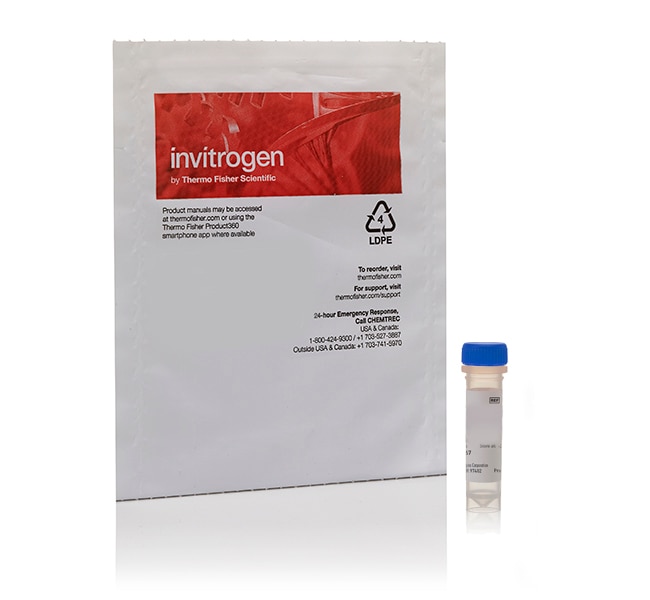
SYTO™ 62 Red Fluorescent Nucleic Acid Stain - 5 mM Solution in DMSO
Zur Verwendung in der Fluoreszenzmikroskopie und Durchflusszytometrie
| Katalognummer | Menge |
|---|---|
| S11344 | 250 μl |
Katalognummer S11344
Preis (EUR)
543,65
キャンペーン価格
572,00Ersparnis 28,35 (5%)
Each
Menge:
250 μl
Preis (EUR)
543,65
キャンペーン価格
572,00Ersparnis 28,35 (5%)
Each
Der membrangängige, rot fluoreszierende Nukleinsäure-Farbstoff SYTO 62 erzeugt bei Bindung an Nukleinsäuren eine helle, rote Fluoreszenz. Da die Färbungsmuster der SYTO Farbstoffe in lebenden Zellen zwischen Zelltypen variieren können, bieten wir das SYTO Red Fluorescent Nucleic Acid Stain Sampler Kit (S-11340), damit Forscher den für ihr System am besten geeigneten rot fluoreszierenden SYTO Farbstoff auswählen können.
Nur für Forschungszwecke. Nicht zur Verwendung bei diagnostischen Verfahren.
Specifications
FarbeRot, Rot
BeschreibungSYTO™ 62 Red Fluorescent Nucleic Acid Stain – 5 mmol-Lösung in DMSO
NachweisverfahrenFluoreszenz, Fluoreszent
FarbstofftypMembrangängig
Emission680 nm
Anregungswellenlängenbereich649 nm
Zur Verwendung mit (Geräte)Fluoreszenzmikroskop, Fluoreszenzmikroskop, Durchflusszytometer
ProduktlinieSYTO
Menge250 μl
VersandbedingungRaumtemperatur, Raumtemperatur
Volumen (metrisch)250 μl
MarkertypFluoreszent
ProdukttypNukleinsäurefärbemittel
SubCellular LocalizationNukleinsäuren
Unit SizeEach
Inhalt und Lagerung
Bei -5 bis -30 °C lagern und vor Licht schützen.
Häufig gestellte Fragen (FAQ)
How do SYTO dyes bind to DNA?
Zitierungen und Referenzen (17)
Zitierungen und Referenzen
Abstract
Nucleic acid binding agents exert local toxic effects on neurites via a non-nuclear mechanism.
Journal:J Neurochem
PubMed ID:16441515
'The mechanism by which drugs that target nucleic acids cause neurotoxicity is not well described. We characterized the neurotoxicity of Hoechst 33342 (bis-benzimide), a common cell permeable nuclear dye, in primary neuronal cultures. The mechanism of cell death was not apoptotic, as death is rapid, not accompanied by typical nuclear
Multiparameter detection of apoptosis using red-excitable SYTO probes.
Journal:Cytometry A
PubMed ID:18431792
'Functional assays allowing phenotypic characterization of different cell death parameters at a single-cell level are important tools for preclinical anticancer drug screening. Currently, the selection of cytometric assays is limited by the availability of fluorescent probes with overlapping spectral characteristics. Following on our earlier reports on green and orange fluorescent
Differentiation of Phytophthora infestans sporangia from other airborne biological particles by flow cytometry.
Journal:Appl Environ Microbiol
PubMed ID:11772606
'The ability of two different flow cytometers, the Microcyte (Optoflow) and the PAS-III (Partec), to differentiate sporangia of the late-blight pathogen Phytophthora infestans from other potential airborne particles was compared. With the PAS-III, light scatter and intrinsic fluorescence parameters could be used to differentiate sporangia from conidia of Alternaria or
Glutamate release promotes growth of malignant gliomas.
Journal:Nat Med
PubMed ID:11533703
'Glutamate neurotoxicity has been implicated in stroke, head trauma, multiple sclerosis and neurodegenerative diseases. Although recent data show that cultured glioma cells secrete glutamate, the growth potential of brain tumors has not yet been linked to an excitotoxic mechanism. Using bioluminescence detection of glutamate release from freshly prepared brain slices,
Surface imaging microscopy, an automated method for visualizing whole embryo samples in three dimensions at high resolution.
Journal:Dev Dyn
PubMed ID:12412023
Modern biology is faced with the challenge of understanding the specification, generation, and maintenance of structures ranging from cells and tissues to organs and organisms. By acquiring images directly from the block face of an embedded sample, surface imaging microscopy (SIM) generates high-resolution volumetric images of biological specimens across all