Search


Zitierungen und Referenzen (8)
Invitrogen™
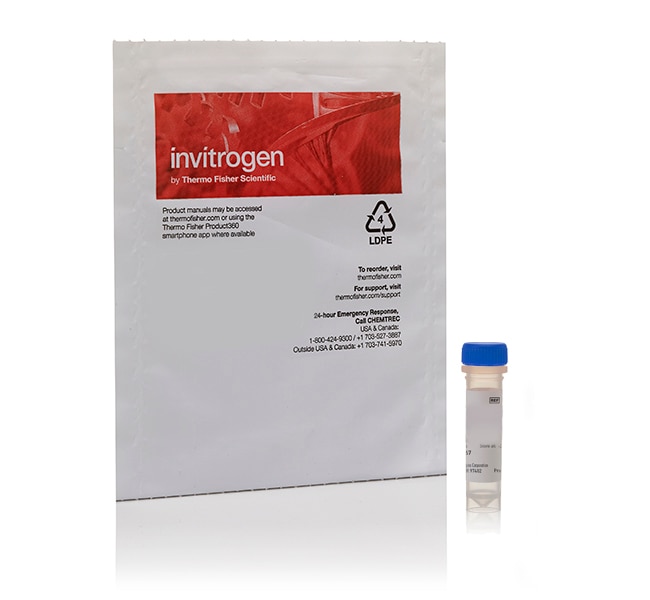
Streptavidin, Alexa Fluor™ 680 Conjugate
Alexa Fluor™ 680 Streptavidin enthält ein Biotin-bindendes Protein (Streptavidin), das kovalent an einen fluoreszierenden Marker (Alexa Fluor™ Farbstoff) gebunden ist.Weitere Informationen
Have Questions?
Ansicht ändern

| Katalognummer | Menge | Form |
|---|---|---|
| S21378 | 1 mg | Fest |
| S32358 | 38 ml | Flüssig |
Katalognummer S21378
Preis (EUR)
453,00
Each
Menge:
1 mg
Form:
Fest
Preis (EUR)
453,00
Each
Alexa Fluor™ 680 Streptavidin enthält ein Biotin-bindendes Protein (Streptavidin), das kovalent an einen fluoreszierenden Marker (Alexa Fluor™ Farbstoff) gebunden ist. Streptavidin besitzt eine sehr hohe Bindungsaffinität für Biotin. Streptavidin-Konjugate werden häufig gemeinsam mit Biotin-Konjugaten zum spezifischen Nachweis verschiedenster Proteine, Proteinmotive, Nukleinsäuren und anderer Moleküle verwendet (z. B. kann ein an eine Protein-Zielstruktur gebundener biotinylierter Primär-Antikörper mithilfe von fluoreszenzmarkiertem Streptavidin nachgewiesen werden). Ähnliche Strategien kommen in zahlreichen Nachweisprotokollen zum Einsatz, einschließlich Western Blots, Durchflusszytometrie, Bildgebung und Mikroskopie sowie Mikrotiterplatten-Assays. Streptavidin-Konjugate mit Alexa Fluor™ Farbstoffen sind als 1 mg gefriergetrocknetes Produkt oder als 0,5 ml-Volumen einer 2 mg/ml-Lösung erhältlich.
Wichtige Merkmale von Alexa Fluor™ 680 Streptavidin-Konjugaten:
• Alexa Fluor™ 680 Streptavidin-Konjugat hat Anregungs/Emissions-Maxima von ∼ (679/702)
• Helle, photostabile Fluoreszenz
• Hohe Löslichkeit in wässrigen Lösungen
• In mehreren Farben erhältlich
• Ideal für Western Blots, Durchflusszytometrie, Bildgebung und Mikroskopie, Mikrotiterplatten-Assays und mehr
Eigenschaften von Alexa Fluor™ Farbstoffen
Alexa Fluor™ Farbstoffe sind organische Fluoreszenzfarbstoffe, die für ein besseres Leistungsverhalten bei der Bildgebung und anderen Markierungsprotokollen entwickelt wurden und eine verbesserte Photostabilität und Helligkeit sowie eine verbesserte Löslichkeit in wässrigen Lösungen aufweisen. Diese Farbstoffe sind in einer Vielzahl von Farben erhältlich und eignen sich für die meisten Bildgebungsanwendungen.
Blockierung von endogenem Biotin
Natürlich vorkommende Biotine können Biotin-Streptavidin-Nachweismethoden beeinträchtigen. Nutzen Sie für Experimente mit fixierten und permeabilisierten Zellen unser Blockier-Kit für endogenes Biotin, um solche Interferenzen auf ein Minimum zu beschränken.
Nur für Forschungszwecke. Nicht für therapeutische oder diagnostische Zwecke an Tieren und Menschen vorgesehen.
Verwandte Links:
Erfahren Sie mehr über Avidin-Biotin-Nachweismethoden
Erfahren Sie mehr über Alexa Fluor™ Farbstoffe
Erfahren Sie mehr über andere markierte Streptavidin-Konjugate
Lesen Sie Abschnitt 7.6 zu Avidin und Streptavidin-Konjugaten im Handbuch Molecular Probes
Wichtige Merkmale von Alexa Fluor™ 680 Streptavidin-Konjugaten:
• Alexa Fluor™ 680 Streptavidin-Konjugat hat Anregungs/Emissions-Maxima von ∼ (679/702)
• Helle, photostabile Fluoreszenz
• Hohe Löslichkeit in wässrigen Lösungen
• In mehreren Farben erhältlich
• Ideal für Western Blots, Durchflusszytometrie, Bildgebung und Mikroskopie, Mikrotiterplatten-Assays und mehr
Eigenschaften von Alexa Fluor™ Farbstoffen
Alexa Fluor™ Farbstoffe sind organische Fluoreszenzfarbstoffe, die für ein besseres Leistungsverhalten bei der Bildgebung und anderen Markierungsprotokollen entwickelt wurden und eine verbesserte Photostabilität und Helligkeit sowie eine verbesserte Löslichkeit in wässrigen Lösungen aufweisen. Diese Farbstoffe sind in einer Vielzahl von Farben erhältlich und eignen sich für die meisten Bildgebungsanwendungen.
Blockierung von endogenem Biotin
Natürlich vorkommende Biotine können Biotin-Streptavidin-Nachweismethoden beeinträchtigen. Nutzen Sie für Experimente mit fixierten und permeabilisierten Zellen unser Blockier-Kit für endogenes Biotin, um solche Interferenzen auf ein Minimum zu beschränken.
Nur für Forschungszwecke. Nicht für therapeutische oder diagnostische Zwecke an Tieren und Menschen vorgesehen.
Verwandte Links:
Erfahren Sie mehr über Avidin-Biotin-Nachweismethoden
Erfahren Sie mehr über Alexa Fluor™ Farbstoffe
Erfahren Sie mehr über andere markierte Streptavidin-Konjugate
Lesen Sie Abschnitt 7.6 zu Avidin und Streptavidin-Konjugaten im Handbuch Molecular Probes
Nur für Forschungszwecke. Nicht zur Verwendung bei diagnostischen Verfahren.
Specifications
Marker oder FarbstoffAlexa Fluor Farbstoffe
ProdukttypStreptavidin-Konjugat (fluoreszierend)
Menge1 mg
VersandbedingungRaumtemperatur
KonjugatAlexa Fluor 680
FormFest
ProduktlinieAlexa Fluor
Unit SizeEach
Inhalt und Lagerung
Bei -5 bis -30 °C lagern und vor Licht schützen.
Häufig gestellte Fragen (FAQ)
I am planning to use a fluorescent streptavidin labeled conjugate. What are the storage conditions and shelf life for the lyophilized powder and reconstituted solution?
I am planning to use a fluorescent streptavidin labeled conjugate. How should I prepare the working solution of the conjugate?
Zitierungen und Referenzen (8)
Zitierungen und Referenzen
Abstract
Development of homogeneous binding assays based on fluorescence resonance energy transfer between quantum dots and Alexa Fluor fluorophores.
Journal:Anal Biochem
PubMed ID:16860286
'We studied the fluorescence resonance energy transfer (FRET) between quantum dots emitting at 565, 605, and 655 nm as energy donors and Alexa Fluor fluorophores with absorbance maxima at 594, 633, 647, and 680 nm as energy acceptors. As a first step, we prepared covalent conjugates between all three types
Interaction of the selectin ligand PSGL-1 with chemokines CCL21 and CCL19 facilitates efficient homing of T cells to secondary lymphoid organs.
Journal:Nat Immunol
PubMed ID:17401367
'P-selectin glycoprotein ligand 1 (PSGL-1) is central to the trafficking of immune effector cells to areas of inflammation through direct interactions with P-selectin, E-selectin and L-selectin. Here we show that PSGL-1 was also required for efficient homing of resting T cells to secondary lymphoid organs but functioned independently of selectin
Reversibility of covalent electrophile-protein adducts and chemical toxicity.
Journal:Chem Res Toxicol
PubMed ID:19548357
The biotin-tagged electrophiles 1-biotinamido-4-(4'-[maleimidoethylcyclohexane]-carboxamido)butane (BMCC) and N-iodoacetyl-N-biotinylhexylenediamine (IAB) have been used as model electrophile probes in complex proteomes to identify protein targets associated with chemical toxicity. Whereas IAB activates stress signaling and apoptosis in HEK293 cells, BMCC does not. Cysteine Michael adducts formed from BMCC and nonbiotinylated analogues rapidly disappeared
Dynamin 2 mutations associated with human diseases impair clathrin-mediated receptor endocytosis.
Journal:Hum Mutat
PubMed ID:19623537
Dynamin 2 (DNM2) is a large GTPase involved in the release of nascent vesicles during endocytosis and intracellular membrane trafficking. Distinct DNM2 mutations, affecting the middle domain (MD) and the Pleckstrin homology domain (PH), have been identified in autosomal dominant centronuclear myopathy (CNM) and in the intermediate and axonal forms
Identification and structural basis of binding to host lung glycogen by streptococcal virulence factors.
Journal:Nat Struct Mol Biol
PubMed ID:17187076
The ability of pathogenic bacteria to recognize host glycans is often essential to their virulence. Here we report structure-function studies of previously uncharacterized glycogen-binding modules in the surface-anchored pullulanases from Streptococcus pneumoniae (SpuA) and Streptococcus pyogenes (PulA). Multivalent binding to glycogen leads to a strong interaction with alveolar type II