Search


Zitierungen und Referenzen (86)
Invitrogen™
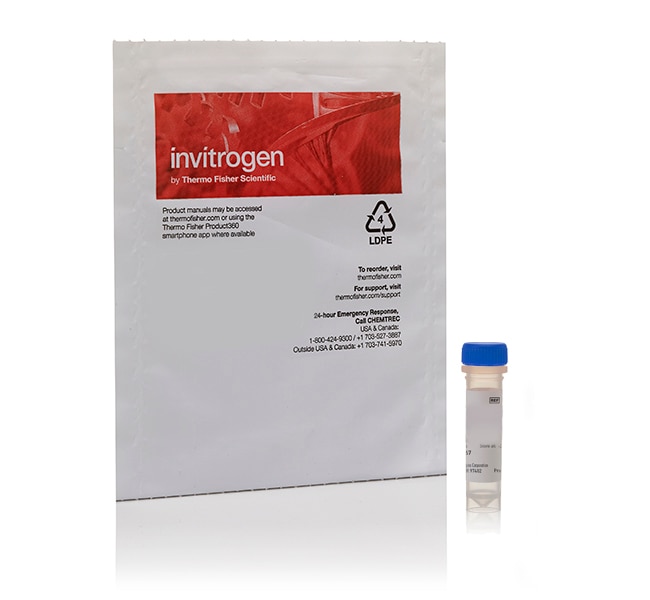
Streptavidin, Alexa Fluor™ 488 Konjugat
Alexa Fluor™ 488 Streptavidin enthält ein Biotin-bindendes Protein (Streptavidin), das kovalent an einen fluoreszierenden Marker (Alexa Fluor™ Farbstoff) gebunden ist.Weitere Informationen
Have Questions?
Ansicht ändern

| Katalognummer | Menge | Form |
|---|---|---|
| S32354 | 38 ml | Flüssig |
| S11223 | 1 mg | Fest |
Katalognummer S32354
Preis (EUR)
540,00
Each
Menge:
38 ml
Form:
Flüssig
Preis (EUR)
540,00
Each
Alexa Fluor™ 488 Streptavidin enthält ein Biotin-bindendes Protein (Streptavidin), das kovalent an einen fluoreszierenden Marker (Alexa Fluor™ Farbstoff) gebunden ist. Streptavidin besitzt eine sehr hohe Bindungsaffinität für Biotin. Streptavidin-Konjugate werden häufig gemeinsam mit Biotin-Konjugaten zum spezifischen Nachweis verschiedenster Proteine, Proteinmotive, Nukleinsäuren und anderer Moleküle verwendet (z. B. kann ein an eine Protein-Zielstruktur gebundener biotinylierter Primär-Antikörper mithilfe von fluoreszenzmarkiertem Streptavidin nachgewiesen werden). Ähnliche Strategien kommen in zahlreichen Nachweisprotokollen zum Einsatz, einschließlich Western Blots, Durchflusszytometrie, Bildgebung und Mikroskopie sowie Mikrotiterplatten-Assays. Streptavidin-Konjugate mit Alexa Fluor™ Farbstoffen sind als 1 mg gefriergetrocknetes Produkt oder als 0,5 ml-Volumen einer 2 mg/ml-Lösung erhältlich.
Wichtige Merkmale von Alexa Fluor™ 488 Streptavidin-Konjugaten:
• Alexa Fluor™ 488 Streptavidin-Konjugat hat Anregungs/Emissions-Maxima von ∼ (495/519)
• Helle, photostabile Fluoreszenz
• Hohe Löslichkeit in wässrigen Lösungen
• In mehreren Farben erhältlich
• Ideal für Western Blots, Durchflusszytometrie, Bildgebung und Mikroskopie, Mikrotiterplatten-Assays und mehr
Eigenschaften von Alexa Fluor™ Farbstoffen
Alexa Fluor™ Farbstoffe sind organische Fluoreszenzfarbstoffe, die für ein besseres Leistungsverhalten bei der Bildgebung und anderen Markierungsprotokollen entwickelt wurden und eine verbesserte Photostabilität und Helligkeit sowie eine verbesserte Löslichkeit in wässrigen Lösungen aufweisen. Diese Farbstoffe sind in einer Vielzahl von Farben erhältlich und eignen sich für die meisten Bildgebungsanwendungen.
Blockierung von endogenem Biotin
Natürlich vorkommende Biotine können Biotin-Streptavidin-Nachweismethoden beeinträchtigen. Nutzen Sie für Experimente mit fixierten und permeabilisierten Zellen unser Blockier-Kit für endogenes Biotin, um solche Interferenzen auf ein Minimum zu beschränken.
Nur für Forschungszwecke. Nicht für therapeutische oder diagnostische Zwecke an Tieren und Menschen vorgesehen.
Verwandte Links:
Erfahren Sie mehr über Avidin-Biotin-Nachweismethoden
Erfahren Sie mehr über Alexa Fluor™ Farbstoffe
Erfahren Sie mehr über andere markierte Streptavidin-Konjugate
Lesen Sie Abschnitt 7.6 zu Avidin und Streptavidin-Konjugaten im Handbuch Molecular Probes
Wichtige Merkmale von Alexa Fluor™ 488 Streptavidin-Konjugaten:
• Alexa Fluor™ 488 Streptavidin-Konjugat hat Anregungs/Emissions-Maxima von ∼ (495/519)
• Helle, photostabile Fluoreszenz
• Hohe Löslichkeit in wässrigen Lösungen
• In mehreren Farben erhältlich
• Ideal für Western Blots, Durchflusszytometrie, Bildgebung und Mikroskopie, Mikrotiterplatten-Assays und mehr
Eigenschaften von Alexa Fluor™ Farbstoffen
Alexa Fluor™ Farbstoffe sind organische Fluoreszenzfarbstoffe, die für ein besseres Leistungsverhalten bei der Bildgebung und anderen Markierungsprotokollen entwickelt wurden und eine verbesserte Photostabilität und Helligkeit sowie eine verbesserte Löslichkeit in wässrigen Lösungen aufweisen. Diese Farbstoffe sind in einer Vielzahl von Farben erhältlich und eignen sich für die meisten Bildgebungsanwendungen.
Blockierung von endogenem Biotin
Natürlich vorkommende Biotine können Biotin-Streptavidin-Nachweismethoden beeinträchtigen. Nutzen Sie für Experimente mit fixierten und permeabilisierten Zellen unser Blockier-Kit für endogenes Biotin, um solche Interferenzen auf ein Minimum zu beschränken.
Nur für Forschungszwecke. Nicht für therapeutische oder diagnostische Zwecke an Tieren und Menschen vorgesehen.
Verwandte Links:
Erfahren Sie mehr über Avidin-Biotin-Nachweismethoden
Erfahren Sie mehr über Alexa Fluor™ Farbstoffe
Erfahren Sie mehr über andere markierte Streptavidin-Konjugate
Lesen Sie Abschnitt 7.6 zu Avidin und Streptavidin-Konjugaten im Handbuch Molecular Probes
Nur für Forschungszwecke. Nicht zur Verwendung bei diagnostischen Verfahren.
Specifications
Konzentration2 mg/ml
Marker oder FarbstoffAlexa Fluor Farbstoffe
ProdukttypStreptavidin-Konjugat (fluoreszierend)
Menge38 ml
VersandbedingungNasseis
KonjugatAlexa Fluor 488
FormFlüssig
ProduktlinieAlexa Fluor
Unit SizeEach
Inhalt und Lagerung
Im Kühlschrank (2 bis 8 °C) und vor Licht geschützt lagern.
Häufig gestellte Fragen (FAQ)
I am planning to use a fluorescent streptavidin labeled conjugate. What are the storage conditions and shelf life for the lyophilized powder and reconstituted solution?
I am planning to use a fluorescent streptavidin labeled conjugate. How should I prepare the working solution of the conjugate?
Zitierungen und Referenzen (86)
Zitierungen und Referenzen
Abstract
SHAP potentiates the CD44-mediated leukocyte adhesion to the hyaluronan substratum.
Journal:The Journal of biological chemistry
PubMed ID:16702221
A novel fluorescent toxin to detect and investigate Kv1.3 channel up-regulation in chronically activated T lymphocytes.
Journal:J Biol Chem
PubMed ID:12511563
T lymphocytes with unusually high expression of the voltage-gated Kv1.3 channel (Kv1.3(high) cells) have been implicated in the pathogenesis of experimental autoimmune encephalomyelitis, an animal model for multiple sclerosis. We have developed a fluoresceinated analog of ShK (ShK-F6CA), the most potent known inhibitor of Kv1.3, for detection of Kv1.3(high) cells
Inhibition of platelet-derived growth factor-BB-induced receptor activation and fibroblast migration by hyaluronan activation of CD44.
Journal:J Biol Chem
PubMed ID:16809345
'The extracellular matrix molecule hyaluronan was found to suppress platelet-derived growth factor (PDGF) beta-receptor activation and PDGF-BB-induced migration of primary human dermal fibroblasts. The suppressive effect of hyaluronan was neutralized by a monoclonal antibody that specifically inhibits hyaluronan binding to its receptor CD44. Moreover, co-immunoprecipitation experiments showed that the PDGF
PKC putative phosphorylation site Ser235 is required for MIP/AQP0 translocation to the plasma membrane.
Journal:Mol Vis
PubMed ID:18523655
'PURPOSE: To investigate the functional significance of MIP/AQP0 phosphorylation at serine(235). METHODS: MIP/AQP0 expression and cellular localization was studied in rat lens epithelia explants induced to differentiate by FGF-2. MIP wild type (WT) and MIP (S235A) mutant expression plasmids were constructed and transiently expressed in RK13 cells. Subcellular localization of
An impaired transendothelial migration potential of chronic lymphocytic leukemia (CLL) cells can be linked to ephrin-A4 expression.
Journal:Blood
PubMed ID:19828693
'Chronic lymphocytic leukemia (CLL) cell migration into lymphoid tissues is an important aspect of the pathobiology of this disease. Here, we investigated the role of ephrin-A4 (EFNA4) in the transendothelial migration (TEM) capacity of CLL and normal B cells through interacting with endothelial EphA2 (erythropoietin-producing hepatocellular carcinoma). CLL cells showed