Search




Zitierungen und Referenzen (60)
Invitrogen™
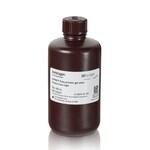
SYPRO™ Proteingel-Färbemittel
SYPRO Ruby Protein-Gelfärbung ist eine hochempfindliche, gebrauchsfertige fluoreszierende Färbung für den Nachweis von durch Polyacrylamid-Gelelektrophorese (PAGE) getrennten Gesamtproteinen. Ideal fürWeitere Informationen
Have Questions?
Ansicht ändern

| Katalognummer | Farbe | Menge |
|---|---|---|
| S6654 auch als S-6654 bezeichnet | Rot | 10 x 50 μl |
| S6650 | Orange | 500 μl |
| S6651 | Orange | 10 x 50 μl |
| S12010 | Orangefarben | 500 μl |
| S6653 | Rot | 500 μl |
| S12001 | Rubin | 200 mL |
| S12000 | Rubin | 1 l |
| S21900 | Rubin | 5 l |
| S12000X3 | Rubin | 3 x 1 l |
Katalognummer S6654
auch als S-6654 bezeichnet
Preis (EUR)
482,65
Online exclusive
508,00Ersparnis 25,35 (5%)
Each
Farbe:
Rot
Menge:
10 x 50 μl
Preis (EUR)
482,65
Online exclusive
508,00Ersparnis 25,35 (5%)
Each
SYPRO Ruby Protein-Gelfärbung ist eine hochempfindliche, gebrauchsfertige fluoreszierende Färbung für den Nachweis von durch Polyacrylamid-Gelelektrophorese (PAGE) getrennten Gesamtproteinen. Ideal für den Einsatz in 1D- und 2D-PAGE. Die Empfindlichkeit von SYPRO Ruby Gelfärbung ist mindestens so hoch wie die der besten Silberfärbeverfahren. Gefärbte Proteine können mit einem standardmäßigen UV- oder Blaulicht-Transilluminator oder einem Bildgebungsgerät mit den entsprechenden Filtern oder Lasern betrachtet werden.
Merkmale:
• Einfaches Färbeverfahren: kein Entfärben oder zeitgesteuerte Schritte erforderlich
• Linearer Quantifizierungsbereich über drei Größenordnungen
• Kompatibilität mit Massenspektrometrie und Mikrosequenzierung
Vergleich aller Fluoreszenz-Färbemittel ›
Merkmale:
• Einfaches Färbeverfahren: kein Entfärben oder zeitgesteuerte Schritte erforderlich
• Linearer Quantifizierungsbereich über drei Größenordnungen
• Kompatibilität mit Massenspektrometrie und Mikrosequenzierung
Vergleich aller Fluoreszenz-Färbemittel ›
For Research Use Only. Not for use in diagnostic procedures.
Specifications
Konzentration5000X in DMSO
DetektionsstelleIn-Gel-Detektion
NachweisverfahrenFluoreszenz
Anregung/Emission300, 550/630 nm
Menge10 x 50 μl
VersandbedingungRaumtemperatur
ZielmolekülProtein
FarbeRot
Marker oder FarbstoffSYPRO Rot
ProduktlinieSYPRO
ProdukttypProteingel-Färbemittel
Unit SizeEach
Inhalt und Lagerung
Lagerung bei Raumtemperatur und vor Licht geschützt
Häufig gestellte Fragen (FAQ)
If I increase the final concentration of my SYPRO Orange or SYPRO Red staining solution above 1X, can I increase the signal of my stained proteins?
Can I dry my SYPRO Ruby, SYPRO Orange, or SYPRO Red stained gels?
Can I pre-stain proteins with SYPRO Ruby, SYPRO Orange or SYPRO Red Protein Gel Stains and then run them through a gel?
Zitierungen und Referenzen (60)
Zitierungen und Referenzen
Abstract
Design and characterization of a compact dual channel virus counter.
Journal:Cytometry. Part A : the journal of the International Society for Analytical Cytology
PubMed ID:15830378
Adenosine to inosine editing by ADAR2 requires formation of a ternary complex on the GluR-B R/G site.
Journal:J Biol Chem
PubMed ID:12163487
'RNA editing by members of the ADAR (adenosine deaminase that acts on RNA) enzyme family involves hydrolytic deamination of adenosine to inosine within the context of a double-stranded pre-mRNA substrate. Editing of the human GluR-B transcript is catalyzed by the enzyme ADAR2 at the Q/R and R/G sites. We have
Defining the SNARE complex binding surface of alpha-SNAP: implications for SNARE complex disassembly.
Journal:J Biol Chem
PubMed ID:12730228
'N-Ethylmaleimide-sensitive factor (NSF) and its adaptor protein alpha-soluble NSF attachment protein (alpha-SNAP) sustain membrane trafficking by disassembling soluble NSF attachment protein receptor (SNARE) complexes that form during membrane fusion. To better understand the role of alpha-SNAP in this process, we used site-directed mutagenesis to identify residues in alpha-SNAP that interact
Involvement of DnaE, the second replicative DNA polymerase from Bacillus subtilis, in DNA mutagenesis.
Journal:J Biol Chem
PubMed ID:14593098
'In a large group of organisms including low G + C bacteria and eukaryotic cells, DNA synthesis at the replication fork strictly requires two distinct replicative DNA polymerases. These are designated pol C and DnaE in Bacillus subtilis. We recently proposed that DnaE might be preferentially involved in lagging strand
Dynamics of myo1c (myosin-ibeta ) lipid binding and dissociation.
Journal:J Biol Chem
PubMed ID:12221091
'Myosin-I is the single-headed member of the myosin superfamily that associates with lipid membranes. Biochemical experiments have shown that myosin-I membrane binding is the result of electrostatic interactions between the basic tail domain and acidic phospholipids. To better understand the dynamics of myosin-I membrane association, we measured the rates of