Search


Zitierungen und Referenzen (28)
Invitrogen™
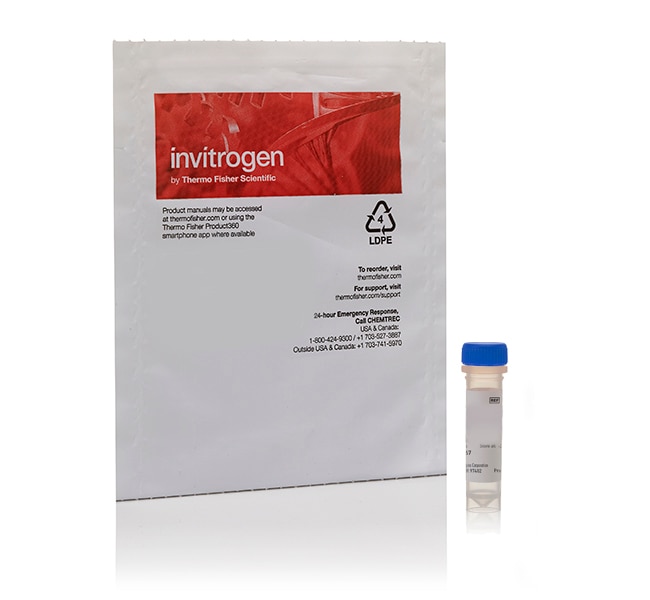
TetraSpeck™ Mikrosphären, 0,1 μm, fluoreszent blau/grün/orange/dunkelrot
Die 0,1 µm TetraSpeck™ Mikrokugeln sind durchgehend mit vier verschiedenen fluoreszierenden Farbstoffen angefärbt und liefern Beads, die jeweils vier gutWeitere Informationen
| Katalognummer | Menge |
|---|---|
| T7279 | 38 ml |
Katalognummer T7279
Preis (EUR)
584,00
0.5 mL
Menge:
38 ml
Preis (EUR)
584,00
0.5 mL
Die 0,1 µm TetraSpeck™ Mikrokugeln sind durchgehend mit vier verschiedenen fluoreszierenden Farbstoffen angefärbt und liefern Beads, die jeweils vier gut getrennte Anregungs-/Emissions-Peaks anzeigen: 360/430 nm (blau), 505/515 nm (grün), 560/580 nm (orange) und 660/680 nm (dunkelrot). Diese Mikrokugeln können die Kalibrierung von konventionellen Fluoreszenz-Mikroskopen, konfokalen Laser-Scanning-Mikroskopen und entsprechenden bildverarbeitenden Geräten für wissenschaftliche und kommerzielle Bildgebung, insbesondere bei mehrfarbigen Anwendungen, erheblich erleichtern.
Unser vollständiges Angebot von Mikroskop-Kalibrierungsreagenzien ›
Unser vollständiges Angebot von Mikroskop-Kalibrierungsreagenzien ›
Nur für Forschungszwecke. Nicht zur Verwendung bei diagnostischen Verfahren.
Specifications
KalibrierungsartKonfokalmikroskop-Kalibrierung, Fluoreszenzmikroskop-Kalibrierung
FormatSuspensions-Beads
ProduktlinieTetraSpeck
Menge38 ml
VersandbedingungRaumtemperatur
FarbeOrange, Dunkelrot, Blau, Grün, Dark Red, Blue, Green
Durchmesser (metrisch)0,1 μm
ProdukttypMikrokugel
Unit Size0.5 mL
Inhalt und Lagerung
Im Kühlschrank (2–8 °C) aufbewahren und vor Licht schützen.
Häufig gestellte Fragen (FAQ)
What are the excitation/emission peaks for TetraSpeck Microspheres?
The TetraSpeck Microspheres (Cat. Nos. T7279, T7280, T7281, T7283, T7284, T14792) are stained throughout with four different fluorescent dyes, yielding beads that each display four well-separated excitation/emission peaks at 360/430 nm (blue), 505/515 nm (green), 560/580 nm (orange) and 660/680 nm (dark red).
TetraSpeck Blue Dye Spectra
Fluorescence excitation and emission spectra of bead encapsulated TetraSpeck blue dye.

TetraSpeck Orange Dye Spectra

TetraSpeck Green Dye Spectra

TetraSpeck Dark Red Dye Spectra

Find additional tips, troubleshooting help, and resources within our Cell Analysis Support Center.
Zitierungen und Referenzen (28)
Zitierungen und Referenzen
Abstract
Nuclear pore scaffold structure analyzed by super-resolution microscopy and particle averaging.
Journal:
PubMed ID:23845946
'Much of life''s essential molecular machinery consists of large protein assemblies that currently pose challenges for structure determination. A prominent example is the nuclear pore complex (NPC), for which the organization of its individual components remains unknown. By combining stochastic super-resolution microscopy, to directly resolve the ringlike structure of the
The cohesion protein ORD is required for homologue bias during meiotic recombination.
Journal:J Cell Biol
PubMed ID:15007062
'During meiosis, sister chromatid cohesion is required for normal levels of homologous recombination, although how cohesion regulates exchange is not understood. Null mutations in orientation disruptor (ord) ablate arm and centromeric cohesion during Drosophila meiosis and severely reduce homologous crossovers in mutant oocytes. We show that ORD protein localizes along
Exocytosis of IgG as mediated by the receptor, FcRn: an analysis at the single-molecule level.
Journal:Proc Natl Acad Sci U S A
PubMed ID:15258288
'IgG transport within and across cells is essential for effective humoral immunity. Through a combination of biochemical and in vivo analyses, the MHC class I-related neonatal Fc receptor (FcRn) is known to play a central role in delivering IgGs within and across cells. However, little is known about the molecular
Fast, three-dimensional super-resolution imaging of live cells.
Journal:Nat Methods
PubMed ID:21552254
'We report super-resolution fluorescence imaging of live cells with high spatiotemporal resolution using stochastic optical reconstruction microscopy (STORM). By labeling proteins either directly or via SNAP tags with photoswitchable dyes, we obtained two-dimensional (2D) and 3D super-resolution images of living cells, using clathrin-coated pits and the transferrin cargo as model
Practical confocal microscopy and the evaluation of system performance.
Journal:Methods
PubMed ID:10491274
'The laser scanning confocal microscope has enormous potential in many fields of biology. Currently there is a subjective nature in the assessment of a confocal microscope''s performance by primarily evaluating the system with a specific test slide provided by the user''s laboratory. To achieve better performance from the equipment, it