Search


Zitierungen und Referenzen (20)
Invitrogen™
Vybrant™ FLICA Caspase Apoptosis Assay Kits for flow cytometry
Nachweis von Apoptose durch Durchflusszytometrie mit Vybrant FLICA Caspase-Assays, die Poly- und Caspase-3/7/8-Aktivitäten nachweisen.
Have Questions?
Ansicht ändern

| Katalognummer | Enzym |
|---|---|
| V35118 | Caspase 3/7 |
| V35117 | Poly Caspases |
| V35119 | Caspase 8 |
Katalognummer V35118
Preis (EUR)
522,00
25 assays
Enzym:
Caspase 3/7
Preis (EUR)
522,00
25 assays
Schneller Nachweis der von Caspase-vermittelten Apoptose durch Durchflusszytometrie mit Vybrant FAM Caspase-Assay-Kits für Polycaspasen und Caspasen-3 und -7. Vybrant FAM Caspase-Assay-Kits nutzen fluoreszierende Inhibitoren der Caspasen (FLICA)-Methodik zum Nachweisen und Melden von Caspase-Aktivität. Diese Caspase-Assay-Kits enthalten speziell entwickelte FLICA-Substrate FAM-VAD-FMK (für Polycaspasen), FAM-DEVD-FMK (für Caspase-3/7) und FAM-LETD-FMK (für Caspase-8). Sie umfassen auch Hoechst 33342 und Propidiumiodid-Färbemittel, was eine gleichzeitige Bewertung der Membrandurchlässigkeit und des Zellzyklus durch Durchflusszytometrie ermöglicht.
Vybrant FAM Caspase-Assay-Kits für die Durchflusszytometrie nutzen einen neuartigen Ansatz zur Erkennung aktiver Caspasen: die FLICA-Methodik, eine Affinitätsmarkierung. Diese Affinitätsmarkierung verbindet einen Fluoromethylketon (FMK)-Anteil, der kovalent mit einem Cystein reagieren kann, mit einer caspasespezifischen Aminosäuresequenz. Verschiedene Aminosäure-Erkennungssequenzen werden zum Nachweis verschiedener Caspasen verwendet: Valin-Alanin-Asparaginsäure (VAD) für Polycaspasen (einschließlich Caspase-1, -3, -4, -5, -6, -7, -8 und -9), Asparaginsäure-Glutaminsäure-Valin-Asparaginsäure (DEVD) für Caspase-3/7 und Leucin-Glutaminsäure-Threonin-Asparaginsäure (LETD) für Caspase-8. Eine Carboxyfluorescein-Gruppe (FAM) wird als Reporter angehängt.
Das FLICA-Reagenz soll über die Erkennungssequenz mit dem enzymatischen reaktiven Zentrum einer aktivierten Caspase interagieren und dann kovalent durch den FMK-Anteil anbinden. Der FLICA-Hemmer ist membrangängig und nicht-zytotoxisch. Ungebundene FLICA-Moleküle diffundieren aus der Zelle und werden weggespült; das verbleibende fluoreszierende Signal ist ein direktes Maß für die Menge an aktiver Caspase, die zum Zeitpunkt der Zugabe des Inhibitors vorhanden war. Die ungefähren Anregungs- und Emissionsspitzen der Reagenzien FLICA, Propidiumiodid und Hoechst 33342 betragen 488 nm⁄530 nm, 535 nm⁄617 nm bzw. 350 nm⁄461 nm. Die in den einzelnen Vybrant FAM Polycaspase-Assay-, Caspase-3 und -7 Assay- und Caspase-8 Assay-Apoptose-Kits enthaltenen Nachweisreagenzien sind 488⁄530 FAM-VAD-FMK- , 488⁄530 FAM-DEVD-FMK- bzw. 488⁄530 FAM-LETD-FMK-Reagenz.
Das FLICA-Reagenz soll über die Erkennungssequenz mit dem enzymatischen reaktiven Zentrum einer aktivierten Caspase interagieren und dann kovalent durch den FMK-Anteil anbinden. Der FLICA-Hemmer ist membrangängig und nicht-zytotoxisch. Ungebundene FLICA-Moleküle diffundieren aus der Zelle und werden weggespült; das verbleibende fluoreszierende Signal ist ein direktes Maß für die Menge an aktiver Caspase, die zum Zeitpunkt der Zugabe des Inhibitors vorhanden war. Die ungefähren Anregungs- und Emissionsspitzen der Reagenzien FLICA, Propidiumiodid und Hoechst 33342 betragen 488 nm⁄530 nm, 535 nm⁄617 nm bzw. 350 nm⁄461 nm. Die in den einzelnen Vybrant FAM Polycaspase-Assay-, Caspase-3 und -7 Assay- und Caspase-8 Assay-Apoptose-Kits enthaltenen Nachweisreagenzien sind 488⁄530 FAM-VAD-FMK- , 488⁄530 FAM-DEVD-FMK- bzw. 488⁄530 FAM-LETD-FMK-Reagenz.
Nur für Forschungszwecke. Nicht zur Verwendung bei diagnostischen Verfahren.
Specifications
EnzymCaspase 3/7
Anregung/EmissionFAM-DEVD-FMD: 388/530
PI: 535/617
Hoechst 33342: 350/461
PI: 535/617
Hoechst 33342: 350/461
Durchflusszytometer-LaserlinienUV, 488
Zur Verwendung mit (Geräte)Durchflusszytometer
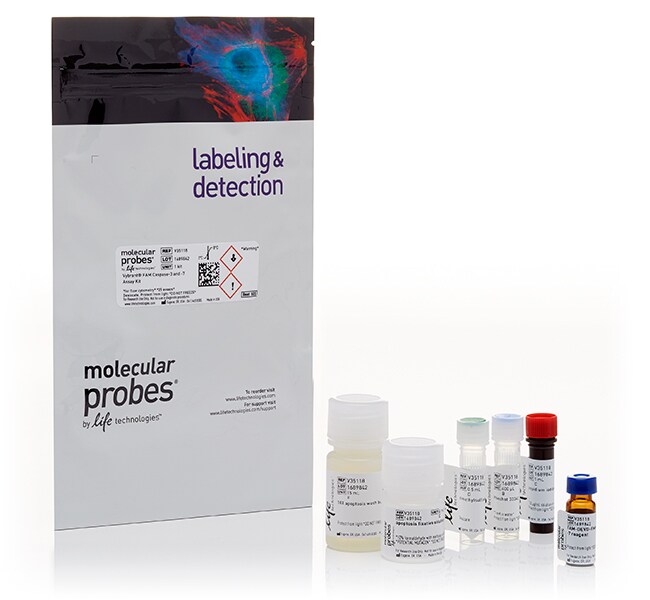
Kitinhalt1 Fläschchen FAM-DEVD-FMK Caspase-3 und -7 Reagenz (FLICA-Reagenz, lyophilisierter Feststoff), 1 Fläschchen Hoechst 33342 (400 μl, 1 mM in Wasser), 1 Fläschchen PI (1 ml, 250 μg/ml in Wasser), 1 Fläschchen DMSO (0,5 ml), 1 Flasche Apoptose-Fixierlösung (10 % Formaldehyd mit Methanol in PBS, 6 ml) und 1 Flasche 10x Apoptose-Waschpuffer.
MarkertypAndere Labels oder Farbstoffe
Marker oder FarbstoffFAM, Hoechst 33342, Propidiumiodid
ProduktlinieVybrant
ProdukttypCaspase-Assay-Kit
Menge25 Assays
VersandbedingungRaumtemperatur
LagerungsbedingungenIm Kühlschrank (2-8 °C) aufbewahren und vor Licht schützen.
NachweisverfahrenFluoreszenz
FormatRörchen
Unit Size25 assays
Inhalt und Lagerung
Vybrant FAM Caspase-3 and -7 Assay Kit
Häufig gestellte Fragen (FAQ)
What are the fluorescence excitation/emission maxima for the FAM-DEVD-FMK FLICA reagent, Hoechst 33342, and propidium iodide supplied in the Vybrant FAM Caspase-3 and -7 Assay Kit, for flow cytometry?
Zitierungen und Referenzen (20)
Zitierungen und Referenzen
Abstract
Monocyte Chemoattractant Protein-Induced Protein 1 (MCPIP1) Enhances Angiogenic and Cardiomyogenic Potential of Murine Bone Marrow-Derived Mesenchymal Stem Cells.
Journal:
PubMed ID:26214508
'The current evidence suggests that beneficial effects of mesenchymal stem cells (MSCs) toward myocardial repair are largely due to paracrine actions of several factors. Although Monocyte chemoattractant protein-induced protein 1 (MCPIP1) is involved in the regulation of inflammatory response, apoptosis and angiogenesis, whether MCPIP1 plays any role in stem cell-induced
Multiparametric evaluation of apoptosis: effects of standard cytotoxic agents and the cyanoguanidine CHS 828.
Journal:Mol Cancer Ther
PubMed ID:15141009
'A multiparametric high-content screening assay for measurement of apoptosis was developed. HeLa cells and lymphoma U-937 cells were exposed to cytotoxic drugs in flat-bottomed optical microtiter plates. After incubation, the DNA-binding dye Hoechst 33342, fluorescein-tagged probes that covalently bind active caspases and chloromethyl-X-rosamine to detect mitochondrial membrane potential (MMP) were
Flow cytometry-based apoptosis detection.
Journal:Methods Mol Biol
PubMed ID:19609746
'An apoptosing cell demonstrates multitude of characteristic morphological and biochemical features, which vary depending on the stimuli and the cell type. The gross majority of classical apoptotic hallmarks can be rapidly examined by flow and image cytometry. Cytometry thus became a technology of choice in diverse studies of cellular demise.
BH3-only protein Noxa regulates apoptosis in activated B cells and controls high-affinity antibody formation.
Journal:Blood
PubMed ID:22144184
The efficiency of humoral immune responses depends on the selective outgrowth of B cells and plasma cells that produce high affinity antibodies. The factors responsible for affinity maturation of B cell clones in the germinal center (GC) have been well established but selection mechanisms that allow clones to enter the
In vitro primary human lymphocyte flow cytometry based micronucleus assay: simultaneous assessment of cell proliferation, apoptosis and MN frequency.
Journal:Mutagenesis
PubMed ID:21791709
In order to minimise the number of positive in vitro cytogenetic results which are not confirmed in rodent carcinogenicity tests, biological systems that are p53 and DNA repair proficient should be recommended. Moreover, an appropriate cytotoxicity parameter for top dose selection should be considered. Recent International Conference on Harmonisation draft