Search



Zitierungen und Referenzen (2)
Invitrogen™
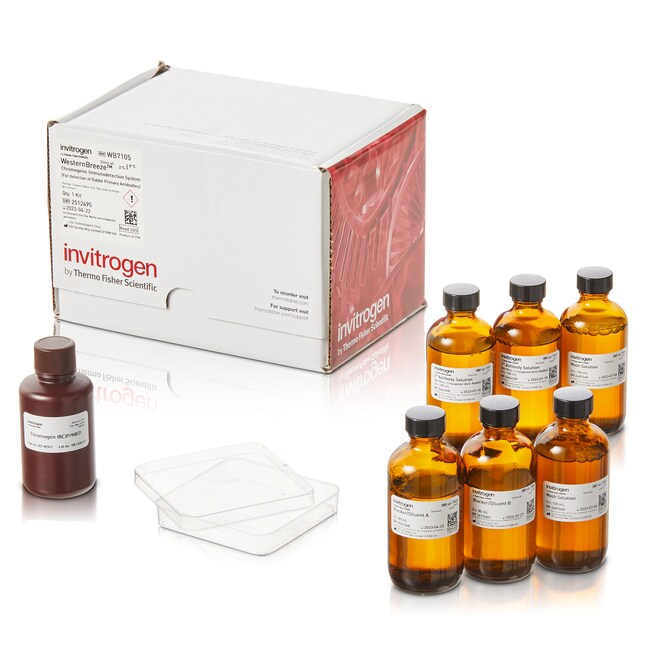
WesternBreeze™ Chromogenic Kit, anti-rabbit
WesternBreeze® Chromogen-Kits dienen zum Nachweis von Proteinen, die auf Membranen (Nitrozellulose oder PVDF) nach dem Western-Transfer immobilisiert oder direkt ausWeitere Informationen
| Katalognummer | Menge |
|---|---|
| WB7105 | 1 Kit |
Katalognummer WB7105
Preis (EUR)
518,00
1 kit
Menge:
1 Kit
Preis (EUR)
518,00
1 kit
WesternBreeze® Chromogen-Kits dienen zum Nachweis von Proteinen, die auf Membranen (Nitrozellulose oder PVDF) nach dem Western-Transfer immobilisiert oder direkt aus der Lösung gebunden wurden (Dot-Blots). Der Nachweis erfolgt mit einem gebrauchsfertigen BCIP/NBT-Substrat für alkalische Phosphatase. An den Proteinbändern an der Membran entwickeln sich nicht verblassende violette Präzipitate. WesternBreeze® Chromogen bietet:
• Klarer Hintergrund
• Hohe Empfindlichkeit – niedrige Picogrammwerte nachweisbar
• Hohe Spezifität
• Ein einfaches Protokoll – keine Optimierung erforderlich
• Klarer Hintergrund
• Hohe Empfindlichkeit – niedrige Picogrammwerte nachweisbar
• Hohe Spezifität
• Ein einfaches Protokoll – keine Optimierung erforderlich
Nur für Forschungszwecke. Nicht zur Verwendung bei diagnostischen Verfahren.
Specifications
KreuzreaktivitätKaninchen
Menge1 Kit
ReaktivitätKaninchen
VersandbedingungNasseis
SubstrattypAP-Substrat (alkalische Phosphatase)
NachweisverfahrenChromogen
Membrane CompatibilityNitrozellulose, PVDF
ProduktlinieWesternBreeze
ProdukttypWestern-Blot-Kit
Unit Size1 kit
Inhalt und Lagerung
Die WesternBreeze™ Chromogen-Kits enthalten Blockierungslösungen, Verdünnungsmittel für primäre Antikörper, gebrauchsfertige sekundäre Antikörperlösung (Anti-Maus, Anti-Kaninchen oder Anti-Ziege), gebrauchsfertiges chromogenes Substrat, Waschlösungen und Inkubationstabletts. Jedes Kit enthält genügend Reagenzien für 20 Mini-Blots. Lagern Sie die Kits bei +4 °C. Bei ordnungsgemäßer Lagerung garantiert 6 Monate stabil.
Häufig gestellte Fragen (FAQ)
Why is the actual band size on a western blot different from the predicted size of the protein?
What are the standard lysis buffers used with mammalian cells for detection of protein expression by immunoprecipitation (IP) or Western blot analysis?
What conditions do you recommend for overnight Western transfer?
Can I purchase the Secondary Antibody solutions from the WesternBreeze Chromogenic Detection kits as standalone products?
Can I purchase the Blocker/Diluent and Antibody Wash solutions from the WesternBreeze Chromogenic Detection kits as standalone products?
Zitierungen und Referenzen (2)
Zitierungen und Referenzen
Abstract
Hop Is an Unusual Homeobox Gene that Modulates Cardiac Development.
Journal:Cell
PubMed ID:12297045
'Hop is a small, divergent homeodomain protein that lacks certain conserved residues required for DNA binding. Hop gene expression initiates early in cardiogenesis and continues in cardiomyocytes throughout embryonic and postnatal development. Genetic and biochemical data indicate that Hop functions directly downstream of Nkx2-5. Inactivation of Hop in mice by
An iron-regulated ferric reductase associated with the absorption of dietary iron.
Journal:Science
PubMed ID:11230685
The ability of intestinal mucosa to absorb dietary ferric iron is attributed to the presence of a brush-border membrane reductase activity that displays adaptive responses to iron status. We have isolated a complementary DNA, Dcytb (for duodenal cytochrome b), which encoded a putative plasma membrane di-heme protein in mouse duodenal