Search

Invitrogen™
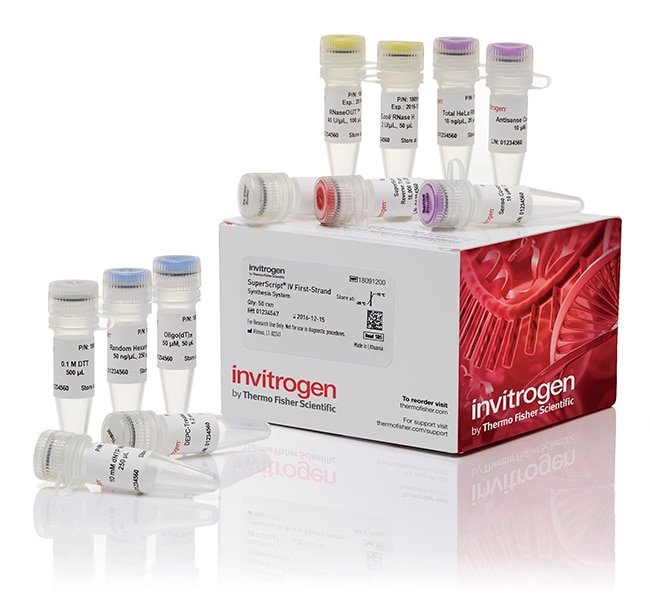
Système de synthèse premier brin SuperScript™ IV
Le système de synthèse premier brin SuperScript™ IV pour la RT-PCR est optimisé pour synthétiser l’ADNc premier brin à partirAfficher plus
Have Questions?
Modifier l'affichage

| Référence | Comprend | Nbre de réactions |
|---|---|---|
| 18091050 | Kit only | 50 réactions |
| 18091200 | Kit only | 200 réactions |
| 18091150 | Kit with ezDNase | 50 réactions |
| 18091300 | Kit with ezDNase | 200 réactions |
Référence 18091050
Prix (EUR)
704,65
Online Exclusive
726,00Économisez 21,35 (3%)
Each
Comprend:
Kit only
Nbre de réactions:
50 réactions
Prix (EUR)
704,65
Online Exclusive
726,00Économisez 21,35 (3%)
Each
Le système de synthèse premier brin SuperScript™ IV pour la RT-PCR est optimisé pour synthétiser l’ADNc premier brin à partir de poly(A)+ purifié ou d’ARN total. Le kit contient la transcriptase inverse (RT) SuperScript™ IV, un mutant exclusif du M-MLV qui produit une synthèse robuste et fiable d’ADNc dans les réactions RT. Le système de synthèse SuperScript™ IV a été sensiblement amélioré par rapport au système SuperScript™ III en termes de résistance aux inhibiteurs, de processivité et de vitesse de réaction, tout en conservant tous les avantages du système précédent, notamment une thermostabilité supérieure, une synthèse d’ADNc pleine longueur très efficace et une activité ARNase réduite. Le système SuperScript™ IV est conçu pour fournir une synthèse fiable, cohérente et rapide de l’ADNc en présence d’inhibiteurs trouvés dans une grande variété d’échantillons qui font que d’autres RT actuellement disponibles ne fonctionnent pas efficacement.
Le système de synthèse premier brin SuperScript™ IV contient tous les composants nécessaires aux réactions RT, ainsi qu’un gène de contrôle supplémentaire et des amorces. Il offre la flexibilité nécessaire pour personnaliser la configuration RT et répondre aux besoins de votre application. Le système de synthèse SuperScript™ IV est le choix idéal pour assurer une performance et une flexibilité exceptionnelles pour les applications RT-PCR. Nous le recommandons pour toutes les applications RT-PCR, tout particulièrement lorsque la reproductibilité et la fiabilité sont des préoccupations majeures et lorsque les inhibiteurs de l’échantillon d’ARN risquent d’interférer avec la synthèse d’ADNc, conduisant à des résultats biaisés dans les études d’expression génétique.
Les caractéristiques du système de synthèse premier brin SuperScript™ IV comprennent :
• Résistance grandement améliorée à une variété d’inhibiteurs pouvant interférer avec la synthèse d’ADNc
• Synthèse robuste et spécifique de l’ADNc dans une large gamme de types d’échantillons
• Réaction de transcriptase inverse plus rapide qui réduit le temps d’incubation de >50 min à 10 min
• Une processivité nettement meilleure par rapport à la
source d’enzymes RT SuperScript™ III
Purifié à partir d’E. coli exprimant le gène pol du M-MLV, modifié pour augmenter la thermostabilité et la demi-vie, la processivité, la résistance aux inhibiteurs et pour réduire l’activité de la RNase H.
Tests de performance et de qualité
Dosages d’endodésoxyribonucléase, d’exodésoxyribonucléase et de ribonucléase ; rendement et longueur du produit d’ADNc.
Définition de l’unité
Une unité de RT SuperScript™ IV est la quantité d’enzymes nécessaire pour incorporer 1 nmol de désoxyribonucléotide dans un matériau précipitable à l’acide en 10 min à 37°C en utilisant le poly(A) oligo(dT)12-18 comme modèle / amorce.
Conditions de réaction de l’unité
50 mM de Tris-HCl (pH 8,3), 4 mM de MgCl2, 10 mM de DTT, 50 mM de KCl, 0,5 mM de dTTP, 0,4 MBq / ml [3H]-dTTP, 0,4 mM de poly(A) oligo (dT)12-18 et enzyme dans 20 μl pendant 10 min à 37°C.
Le système de synthèse premier brin SuperScript™ IV contient tous les composants nécessaires aux réactions RT, ainsi qu’un gène de contrôle supplémentaire et des amorces. Il offre la flexibilité nécessaire pour personnaliser la configuration RT et répondre aux besoins de votre application. Le système de synthèse SuperScript™ IV est le choix idéal pour assurer une performance et une flexibilité exceptionnelles pour les applications RT-PCR. Nous le recommandons pour toutes les applications RT-PCR, tout particulièrement lorsque la reproductibilité et la fiabilité sont des préoccupations majeures et lorsque les inhibiteurs de l’échantillon d’ARN risquent d’interférer avec la synthèse d’ADNc, conduisant à des résultats biaisés dans les études d’expression génétique.
Les caractéristiques du système de synthèse premier brin SuperScript™ IV comprennent :
• Résistance grandement améliorée à une variété d’inhibiteurs pouvant interférer avec la synthèse d’ADNc
• Synthèse robuste et spécifique de l’ADNc dans une large gamme de types d’échantillons
• Réaction de transcriptase inverse plus rapide qui réduit le temps d’incubation de >50 min à 10 min
• Une processivité nettement meilleure par rapport à la
source d’enzymes RT SuperScript™ III
Purifié à partir d’E. coli exprimant le gène pol du M-MLV, modifié pour augmenter la thermostabilité et la demi-vie, la processivité, la résistance aux inhibiteurs et pour réduire l’activité de la RNase H.
Tests de performance et de qualité
Dosages d’endodésoxyribonucléase, d’exodésoxyribonucléase et de ribonucléase ; rendement et longueur du produit d’ADNc.
Définition de l’unité
Une unité de RT SuperScript™ IV est la quantité d’enzymes nécessaire pour incorporer 1 nmol de désoxyribonucléotide dans un matériau précipitable à l’acide en 10 min à 37°C en utilisant le poly(A) oligo(dT)12-18 comme modèle / amorce.
Conditions de réaction de l’unité
50 mM de Tris-HCl (pH 8,3), 4 mM de MgCl2, 10 mM de DTT, 50 mM de KCl, 0,5 mM de dTTP, 0,4 MBq / ml [3H]-dTTP, 0,4 mM de poly(A) oligo (dT)12-18 et enzyme dans 20 μl pendant 10 min à 37°C.
Usage exclusivement réservé à la recherche. Ne pas utiliser pour des procédures de diagnostic.
Spécifications
Type de produit finalADNc premier brin
FormatKit
ComprendKit only
Nbre de réactions50 réactions
Température de réaction optimale50°C
Quantité50 réactions
Format de réactionComposants séparés
Type de réactifTranscription inverse
Transcriptase inverseSuperScript IV
Conditions d’expéditionGlace carbonique
Taille (produit final)Jusqu’à 12,3 kb
Matériau de départARN
TechniqueTranscription inverse
À utiliser avec (application)PCR en temps réel, PCR en temps réel (qPCR)
GC-Rich PCR PerformanceÉlevé
Vitesse de réaction10 min
Unit SizeEach
Contenu et stockage
• Oligo(dT)20 , 50 μl (50 μM)
• Hexamères aléatoires, 250 μl (50 ng/μl)
• Tampon RT 5X, 1 ml
• DTT, 250 μl (0,1 M)
• Mélange de dNTP, 250 μl (10 mM)
• RT SuperScript III, 50 μl (200 U/μl)
• Inhibiteur de ribonucléase, 100 μl (40 U/μl)
• RNase H d’E. coli, 50 μl (2 U/μl)
• Eau traitée au DEPC, 1,2 ml
• ARN total HeLa, 20 μl (10 ng/μl)
• Amorce de contrôle sens, 25 μl (10 μM)
• Amorce de contrôle antisens, 25 μl (10 μM)
Conserver tous les composants de –30°C à –5°C.