Search


Citations et références (6)
Invitrogen™
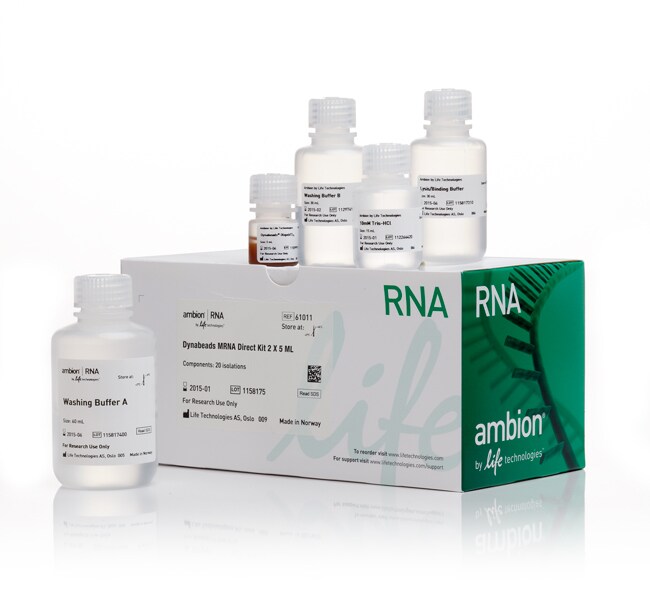
Dynabeads™ mRNA DIRECT™ Purification Kit
Conçu pour l’isolement simple et rapide de l’ARNm polydénylé (polyA) pur et intact directement à partir de lysat brut de cellules et de tissus d’origine animale et végétale.
Have Questions?
Modifier l'affichage

| Référence | Quantité |
|---|---|
| 61012 | 10 mL |
| 61011 | 5 mL |
Référence 61012
Prix (EUR)
1 026,65
Online Exclusive
1 316,00Économisez 289,35 (22%)
Each
Quantité:
10 mL
Prix (EUR)
1 026,65
Online Exclusive
1 316,00Économisez 289,35 (22%)
Each
Le kit Dynabeads® mRNA DIRECT™ est conçu pour l’isolement simple et rapide de l’ARNm polydénylé (polyA) pur et intact directement à partir de lysat brut de cellules et de tissus d’origine animale et végétale. L’ARNm isolé convient à toutes les applications en aval.
Avantages du kit Dynabeads® mRNA DIRECT™ :
• Rapide : la procédure en 15 minutes produit un ARNm pur et intact
• Isolement d’ARNm haute pureté : le meilleur choix en amont de la synthèse d’ADNc
• Isolement d’ARNm sensible : permet la synthèse de l’ADNc et la construction de bibliothèques d’ADNc à partir d’échantillons de départ ultra petits (permet la construction de bibliothèques d’ADNc à partir d’une seule cellule)
Présentation du système
Le protocole d’isolement repose sur l’appariement de base entre les résidus polyA à l’extrémité 3’ de la plupart des ARNm et les d’oligo (dT)25 couplés par covalence à la surface des Dynabeads®. D’autres espèces d’ARN privées d’une queue polyA ne peuvent pas hybrider sur les microbilles et sont facilement éliminées. L’ARN ribosomal, l’ADN, les protéines et les petites molécules d’ARN (ARN de transfert, micro-ARN et petits ARN nucléolaires) ne se fixent pas aux microbilles et sont éliminés. Les agents inhibiteurs de RNase dans le tampon de lyse / liaison associés à des conditions strictes d’hybridation et de lavage garantissent l’isolement d’ARNm pur et intact à partir d’échantillons bruts riches en RNase, sans utiliser d’agents chaotropiques puissants. Les microbilles de purification d’ARNm ciblent et capturent spécifiquement le transcriptome d’ARNm à partir d’une variété extrêmement étendue d’échantillons de départ bruts (voir protocole). 1 mg de microbilles Dynabeads® d’oligo (dT)25 (200 µl) peut lier jusqu’à 2 µg d’ARNm. Une cellule de mammifère type contient environ 10 à 30 pg d’ARN total, dont 1 à 5 % sont de l’ARNm.
Usage exclusivement réservé à la recherche. Ne pas utiliser pour des procédures de diagnostic.
Spécifications
Volume d’élution10 to 100 μL
Type de produit finalARNm
À utiliser avec (application)PCR quantitative en temps réel (qPCR)
À utiliser avec (équipement)Automated Liquid Handling Systems
Concept écologiqueBeads may be reused for multiple extractions
Compatibilité à haut débitCompatible avec le haut débit
Quantité10 mL
Conditions d’expéditionTempérature ambiante
Quantité de matériel de démarrageCells: ≤106
Plant: ≤400 mg
Tissue: ≤200 mg
Plant: ≤400 mg
Tissue: ≤200 mg
Rendement2 μg mRNA per 200 μL of beads (Binding capacity)
Isolation TechnologyMicrobille magnétique
Type d’échantillonÉchantillons liquides (par exemple Sérum), échantillons végétaux, échantillons viraux, cellules, tissus, FFPE et échantillons fixes, levure, ARN, sang, échantillons végétaux, échantillons viraux, cellules, tissus, FFPE & échantillons fixes, sang
Unit SizeEach
Contenu et stockage
Contenu :
• 10 ml de microbilles Dynabeads oligo (dT)25
•, 60 ml de tampon de lyse / liaison
• 120 ml de tampon de lavage A
• 60 ml de tampon de lavage B
• 15 ml (10 mM) de Tris-HCl (tampon d’élution)
Contient suffisamment de réactifs pour 40 isolements standard. Conservez entre 2°C et 8°C.
• 10 ml de microbilles Dynabeads oligo (dT)25
•, 60 ml de tampon de lyse / liaison
• 120 ml de tampon de lavage A
• 60 ml de tampon de lavage B
• 15 ml (10 mM) de Tris-HCl (tampon d’élution)
Contient suffisamment de réactifs pour 40 isolements standard. Conservez entre 2°C et 8°C.
Foire aux questions (FAQ)
I am getting DNA contamination after mRNA isolation using Dynabeads magnetic beads. Why is this?
My Dynabeads magnetic beads are not pelleting well with the magnet. Do you have any suggestions for me?
I have a long double-stranded DNA fragment I would like to isolate. What product do you recommend?
Can I use Dynabeads magnetic beads to isolate single-stranded DNA templates?
What is the magnetic susceptibility for Dynabeads magnetic beads?
Citations et références (6)
Citations et références
Abstract
Extracellular plasma RNA from colon cancer patients is confined in a vesicle-like structure and is mRNA-enriched.
Journal:RNA
PubMed ID:18456845
'Little is yet known about the origin and protective mechanism of free nucleic acids in plasma. We investigated the possibility of these free nucleic acids being particle associated. Plasma samples from colon cancer patients and cell culture media were subjected to various antibody incubations, ultracentrifugation, and RNA extraction protocols for
Relationships and differentially expressed genes among pancreatic cancers examined by large-scale serial analysis of gene expression.
Journal:Cancer Res
PubMed ID:11830538
'Pancreatic adenocarcinoma is among the most fatal of cancers, in part because of late diagnosis and a lack of effective therapies. Comprehensive studies are needed to better understand and address the cellular mechanisms and pathways of tumorigenesis. Serial analysis of gene expression was used to analyze gene expression profiles of
Stem cell and epithelial-mesenchymal transition markers are frequently overexpressed in circulating tumor cells of metastatic breast cancer patients.
Journal:Breast Cancer Res
PubMed ID:19589136
The persistence of circulating tumor cells (CTC) in breast cancer patients might be associated with stem cell like tumor cells which have been suggested to be the active source of metastatic spread in primary tumors. Furthermore, these cells also may undergo phenotypic changes, known as epithelial-mesenchymal transition (EMT), which allows
The transcription factors SOX9 and SOX10 are vitiligo autoantigens in autoimmune polyendocrine syndrome type I.
Journal:J Biol Chem
PubMed ID:11423552
Vitiligo is common in the hereditary disorder autoimmune polyendocrine syndrome type I (APS I). Patients with APS I are known to have high titer autoantibodies directed against various tissue-specific antigens. Using sera from APS I patients for immunoscreening of a cDNA library from human scalp, we identified the transcription factors
Disease-associated mutations in human mannose-binding lectin compromise oligomerization and activity of the final protein.
Journal:J Biol Chem
PubMed ID:14764589
Deficiency of human mannose-binding lectin (MBL) caused by mutations in the coding part of the MBL2 gene is associated with increased risk and severity of infections and autoimmunity. To study the biological consequences of MBL mutations, we expressed wild type MBL and mutated MBL in Chinese hamster ovary cells. The