Search

Thermo Scientific™
Armadillo PCR Plate, 384-well, clear, clear wells, barcoded
Les plaques PCR Thermo Scientific Armadillo, code-barres, sont les plus performantes en matière de PCR plastique haute performance. Alliant laAfficher plus
| Référence | Quantité |
|---|---|
| BC2384 | 50 plaques |
Référence BC2384
Prix (EUR)
446,00
Each
Quantité:
50 plaques
Prix (EUR)
446,00
Each
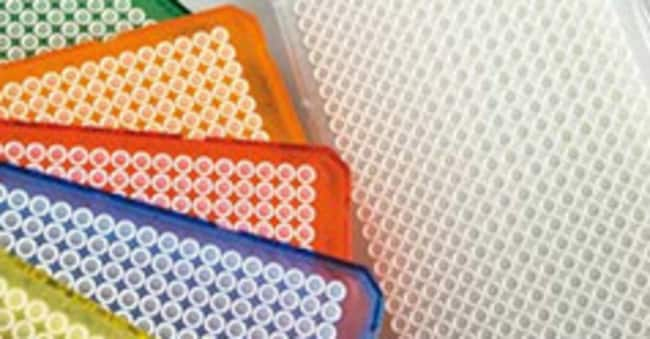
Les plaques PCR Thermo Scientific Armadillo, code-barres, sont les plus performantes en matière de PCR plastique haute performance. Alliant la rigidité d’un cadre en polycarbonate à des puits en polypropylène à paroi fine, la plaque Armadillo offre des performances de thermocyclage supérieures dans toutes les conditions sans se déformer. Ces plaques 384 puits sont transparentes avec des puits transparents.
Caractéristiques des plaques PCR Armadillo code-barres :
• Jupe transparente : facilite la visualisation des liquides et améliore les capacités d’empilement dans les systèmes de manipulation automatisés
• Conception à bord surélevé : la surface de puits améliorée améliore l’intégrité des joints dans l’étanchéité thermique automatisée
• Conforme aux normes ANSI / SBS : grâce à la rigidité de la jupe en polycarbonate, le format ANSI garantit une compatibilité totale avec les systèmes robotisés pour des applications à haut débit
• Structure à cadre en polycarbonate thermostable : cycle thermique résistant aux déformations et stabilité mécanique améliorée dans la manipulation robotique
• Puits à fond en U à paroi fine : transfert de chaleur optimal et récupération maximale des échantillons
• Utilisation de lettres de référence sur grille alphanumérique en retrait : conception de cadre et de puits intégrée pour un meilleur thermoscellage
• Conception à profil bas : permet un transfert de chaleur maximal et une évaporation minimale lors de l’utilisation d’échantillons à faible volume (volume utile de 30 µl)
• À code-barres : toutes les plaques sont fournies avec un code-barres qui peut être personnalisé du client pour les applications entièrement automatisées
Applications :
• PCR
Produits associés
Plaque PCR Armadillo, 384 puits, transparente, puits transparents
Plaque PCR Armadillo, 384 puits, bleue, puits transparents
Plaque PCR Armadillo, 384 puits, verte, puits transparents
Plaque PCR Armadillo, 384 puits, orange, puits transparents
Plaque PCR Armadillo, 384 puits, rouge, puits transparents
Plaque PCR Armadillo, 384 puits, jaune, puits transparents
Plaque PCR Armadillo, 384 puits, rouge, puits blancs
Plaque PCR Armadillo, 384 puits, orange, puits transparents
Plaque PCR Armadillo, 384 puits, rouge, puits transparents, code-barres
Plaque PCR Armadillo, 384 puits, jaune, puits transparents, code-barres
Plaque PCR Armadillo, 384 puits, transparente, puits blancs, code-barres
Plaque PCR Armadillo, 384 puits, bleue, puits blancs, code-barres
Plaque PCR Armadillo, 384 puits, verte, puits blancs, code-barres
Plaque PCR Armadillo, 384 puits, orange, puits blancs, code-barres
Plaque PCR Armadillo, 384 puits, rouge, puits blancs, code-barres
Plaque PCR Armadillo, 384 puits, jaune, puits blancs, code-barres
Caractéristiques des plaques PCR Armadillo code-barres :
• Jupe transparente : facilite la visualisation des liquides et améliore les capacités d’empilement dans les systèmes de manipulation automatisés
• Conception à bord surélevé : la surface de puits améliorée améliore l’intégrité des joints dans l’étanchéité thermique automatisée
• Conforme aux normes ANSI / SBS : grâce à la rigidité de la jupe en polycarbonate, le format ANSI garantit une compatibilité totale avec les systèmes robotisés pour des applications à haut débit
• Structure à cadre en polycarbonate thermostable : cycle thermique résistant aux déformations et stabilité mécanique améliorée dans la manipulation robotique
• Puits à fond en U à paroi fine : transfert de chaleur optimal et récupération maximale des échantillons
• Utilisation de lettres de référence sur grille alphanumérique en retrait : conception de cadre et de puits intégrée pour un meilleur thermoscellage
• Conception à profil bas : permet un transfert de chaleur maximal et une évaporation minimale lors de l’utilisation d’échantillons à faible volume (volume utile de 30 µl)
• À code-barres : toutes les plaques sont fournies avec un code-barres qui peut être personnalisé du client pour les applications entièrement automatisées
Applications :
• PCR
Produits associés
Plaque PCR Armadillo, 384 puits, transparente, puits transparents
Plaque PCR Armadillo, 384 puits, bleue, puits transparents
Plaque PCR Armadillo, 384 puits, verte, puits transparents
Plaque PCR Armadillo, 384 puits, orange, puits transparents
Plaque PCR Armadillo, 384 puits, rouge, puits transparents
Plaque PCR Armadillo, 384 puits, jaune, puits transparents
Plaque PCR Armadillo, 384 puits, rouge, puits blancs
Plaque PCR Armadillo, 384 puits, orange, puits transparents
Plaque PCR Armadillo, 384 puits, rouge, puits transparents, code-barres
Plaque PCR Armadillo, 384 puits, jaune, puits transparents, code-barres
Plaque PCR Armadillo, 384 puits, transparente, puits blancs, code-barres
Plaque PCR Armadillo, 384 puits, bleue, puits blancs, code-barres
Plaque PCR Armadillo, 384 puits, verte, puits blancs, code-barres
Plaque PCR Armadillo, 384 puits, orange, puits blancs, code-barres
Plaque PCR Armadillo, 384 puits, rouge, puits blancs, code-barres
Plaque PCR Armadillo, 384 puits, jaune, puits blancs, code-barres
Ce produit est vendu sous licence par Eppendorf AG.
Spécifications
Certifications/ConformitéCertifié sans RNase / DNase
À utiliser avec (équipement)Systèmes de PCR en temps réel ou thermocycleurs
Conditionnement50/plaque
Type de produitMicroplaque PCR
Quantité50 plaques
Vitesse de réactionÉtalon
Type de jupeÀ jupe
Volume (métrique) de travail25 μl
Couleur du puitsTransparent
Code-barresCode-barres inclus
CouleurTransparent
MatériauPC, PP
Nbre de puits384
Gamme de produitsArmadillo
Unit SizeEach